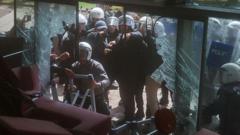
The tea in the paper cup had gone cold, forming a dark, bitter skin around the rim. Outside, the Ankara drizzle was turning the pavement into a mirror, reflecting the blue and red strobe lights of the armored vehicles parked at the curb.
Inside the district headquarters of the opposition party, the air tasted of old cigarette smoke and collective panic.
A young volunteer named Leyla—let us use her name to represent the dozen young campaign workers trapped behind the glass doors that night—clutched a stack of voter registration printouts to her chest like a shield. She had spent the last six months knocking on doors in the gray concrete suburbs, convincing skeptical shopkeepers and tired mothers that their ballots mattered. That democracy wasn't just a word imported from textbooks, but a tangible mechanism that could change the price of bread.
Then came the heavy thud of combat boots on the stairs.
The news ticker on the muted television screen in the corner delivered the verdict before the doors even splintered. The elected mayors and party leaders of several major municipalities across Turkey’s southeast had just been stripped of their mandates. Ousted by a sudden decree from the interior ministry. Replaced by government-appointed trustees. Bureaucrats who hadn't received a single vote.
When the riot police broke through the entrance, they didn't just bring shields, tear gas, and zip-ties. They brought a profound, suffocating silence that swallowed months of democratic mobilization in a matter of seconds.
The Illusion of the Ballot
Western observers often look at elections in hybrid regimes through a flawed lens. They treat the day of the vote as the ultimate test. If citizens line up, if the ink is stamped on their thumbs, and if the ballot boxes are counted, we label it a democracy—even if a flawed one.
But this framework misses the entire point of modern authoritarian statecraft.
The real theater of control doesn’t happen at the ballot box anymore. It happens in the aftermath. It is a slow, bureaucratic strangulation that waits for the international press to pack up their cameras before undoing the geometry of the electorate.
Consider the mathematics of this political erasure. When a central government invalidates an election, it does not merely remove an individual from office. It retroactively disenfranchises every human being who woke up early, stood in line, and cast a vote. It turns the act of political participation into a farce.
Imagine spending your weekends organizing neighborhood councils, debating municipal budgets, and building a coalition from the ground up, only to have a single piece of paper from a capital city hundreds of miles away render your entire community invisible. This is the weaponization of administrative law. It uses the very vocabulary of the state to dismantle the spirit of the citizens.
The official justification always arrives wrapped in the language of national security and counter-terrorism. It is a predictable script, read with a flat, unwavering cadence by state spokespeople. But the timing tells a completely different story. These crackdowns rarely happen during periods of chaos; they happen when the opposition shows signs of genuine, organized resilience. They happen when the status quo feels the ground shifting beneath its feet.
When the State Locks the Front Door
The assault on the party offices wasn't an isolated incident or a sudden burst of police frustration. It was a calculated logistical operation.
As Leyla watched from the second-floor window, the street below was systematically cordoned off. The tactics were precise. First came the water cannons, positioned at the intersections to prevent sympathizers from gathering. Next came the metal barricades, erected with a metallic clang that echoed through the empty neighborhood. Finally, the masked officers moved in, carrying battering rams and crowbars.
Inside, the lights were cut. The sudden darkness forced everyone to rely on the pale, shaking glow of their smartphones.
[State Decree Issued] ➔ [Mayors Deposed] ➔ [Offices Raided] ➔ [Trustees Appointed]
This sequence is a template used globally by regimes looking to maintain the outward facade of a republic while exercising absolute control over its outcomes. It is democracy by permission only. You are allowed to run, you are allowed to campaign, and you are even allowed to win—provided your victory doesn't actually threaten the central architecture of power.
The physical raid on an office is a deeply symbolic act. It is designed to humiliate. Files are dumped onto the floor. Computers are seized, their hard drives containing the names and phone numbers of ordinary citizens who dared to sign a petition or donate ten liras to a campaign. The message sent to the public is clear: We see you. We know who you are. And we can touch you whenever we want.
But what happens to the collective psyche of a city when its choices are deleted overnight?
The immediate reaction is a mixture of fury and profound exhaustion. The exhaustion is the regime's greatest ally. When people realize that their votes can be canceled by a midnight press release, the temptation to retreat into private life becomes overwhelming. Cynicism becomes a survival mechanism. People stop looking at the news. They stop attending rallies. They whisper to their children that it is better to keep your head down, study hard, and look for a way out of the country.
The Mechanics of the Trustee System
To understand how a modern state hollows out its own institutions, one must look closely at the figure of the kayyum—the trustee.
These are not politicians. They do not hold town halls. They do not have to look their constituents in the eye at the Friday market. They are career civil servants, appointed by the ministry of the interior to take over the functions of elected mayors.
When a trustee walks into a city hall, the priorities of the municipality flip upside down. The local budget, which had been earmarked for language classes, women’s shelters, or neighborhood parks, is suddenly redirected. Cultural centers that served marginalized communities are shuttered or rebranded. The local language is scrubbed from municipal signs.
The city ceases to be an ecosystem of citizens and becomes an administrative zone to be policed and managed from afar.
This shift creates a strange, bifurcated reality. On one side of the ledger are the official statistics: roads paved, garbage collected, security maintained. On the other side is the unquantifiable loss of human agency. A city where the people have no say in who runs their schools, who manages their water, or who speaks for them on the national stage is a city living under a form of internal occupation.
The tragedy is that this process is entirely legal under the emergency decrees that have slowly been woven into the permanent fabric of the nation's legal code. The law is no longer a shield to protect the citizen from the state; it is a sword used by the state to slice away the rights of the citizen, one precedent at a time.
The Long Memory of the Street
By three in the morning, the raid was over. The party headquarters stood empty, its doors hanging off their hinges, the floor littered with torn posters, broken plastic chairs, and the scattered pages of Leyla’s voter lists.
A handful of detainees were loaded into the back of a white transit van, their faces illuminated briefly by the harsh light of a policeman’s flashlight before the doors slammed shut.
The international community will likely issue a statement of concern. A spokesperson in Brussels or Washington will express "deep anxiety over the regression of democratic norms" and urge all parties to respect the rule of law. These words will be drafted by diplomats who have never had to decide whether to burn their party membership cards in a kitchen sink to protect their families. The words will hang in the air for a day or two, entirely useless, before being archived and forgotten.
But the real story doesn’t end with the statement from Brussels, nor does it end with the locking of the party office doors.
It continues in the quiet, furious conversations taking place in the kitchens of Ankara, Diyarbakir, and Istanbul. It lives in the memory of the volunteers who saw their work stolen in the middle of the night. You can confiscate a building, you can replace a mayor with a bureaucrat, and you can clear a street with tear gas and water cannons. But you cannot easily erase the knowledge of what it felt like to believe, even for a brief moment, that your voice had power.
An elderly man stood across the street from the raided office as the police vehicles began to idle, their diesel engines rumbling in the cold morning air. He wasn't shouting. He wasn't throwing stones. He just stood there, his hands shoved deep into the pockets of his faded coat, watching the officers lock the chain around the front gates.
He had seen this happen in 1980. He had seen it in the nineties. He had seen it all before.
As the last police van pulled away, leaving the street suddenly dark and remarkably quiet, the old man spat on the wet asphalt, turned his collar up against the rain, and walked slowly down the hill into the shadows of the waking city.


