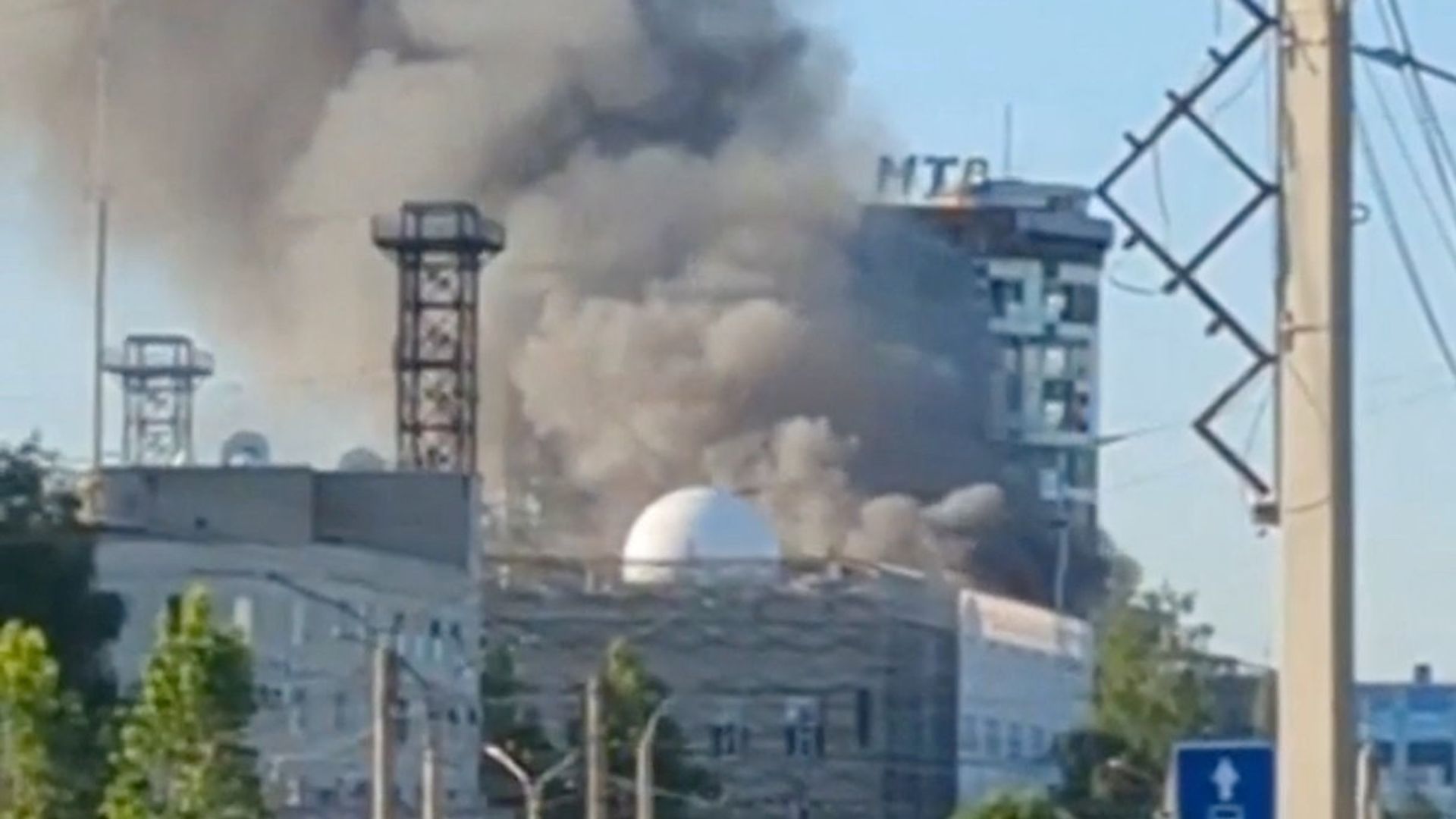
The windowpanes in Aleksinsky do not usually vibrate.
For decades, the town, nestled roughly 120 miles south of Moscow, existed in a sort of heavy, post-industrial slumber. Its heartbeat was the Aleksinsky Chemical Plant, a sprawling complex that most locals associated with steady paychecks, gray smoke, and the mundane reality of state-sanctioned manufacturing. It was a place where history happened elsewhere. The war, though fiercely debated on television screens in cramped kitchens and splashed across state media, was a distant abstraction. It was something happening "out there," hundreds of miles away in the scarred fields of Donbas or the battered streets of Kharkiv.
Then came the hum.
It started as a low, insectile drone in the pre-dawn stillness—a sound that tech-savvy military analysts recognize instantly, but to an ordinary citizen sleeping under a heavy duvet, it sounds like a lawnmower operating in the sky. Minutes later, the horizon split open. A series of orange blossoms shattered the dark, followed by a shockwave that rattled teacups on shelves and cracked the fragile illusion of geographic immunity.
Ukraine had just reached across the map and touched the furnace of Russia’s military engine.
We often talk about modern warfare in the sterile language of logistics. We read headlines about "deep strikes," "strategic degradation," and "infrastructure disruption." But these terms hide the messy, terrifying reality of a conflict that is rapidly erasing the concept of a safe zone. When Ukrainian drones slammed into the Aleksinsky Chemical Plant and an oil refinery in the Krasnodar region, they weren't just destroying brick, mortar, and fuel. They were fundamentally rewriting the psychological terms of engagement.
To understand why this matters, consider a hypothetical factory worker—let’s call him Mikhail. For two years, Mikhail has walked the same gravel path to his shift, punching a clock, perhaps aware that the gunpowder and ammunition components his factory produces are destined for the front lines, but insulated by the sheer vastness of the Russian landmass. Distance is a powerful narcotic. It allows people to support, or at least tolerate, the horror of war because the consequences happen in someone else’s backyard.
But when the sky begins to rain fire on Aleksinsky, the narcotic wears off. Suddenly, the war is no longer a spectator sport broadcast from a safe distance. It is in the air you breathe. It is the smoke rising above the tree line at the edge of your town.
The drones used in these operations are not the multimillion-dollar Predators or Reapers of American cinema. They are often jerry-rigged, long-range kamikaze UAVs, constructed from fiberglass, wood, and off-the-shelf electronics. They fly low, hugging the contours of the earth to evade radar networks designed to catch high-altitude jets. It is a terrifyingly democratic form of high-tech warfare. A nation under siege, facing a superpower with a vastly superior conventional arsenal, has learned to weaponize ingenuity.
By targeting the Aleksinsky plant, Ukrainian strategists struck at a vital artery. The facility is heavily involved in the production of gunpowder, ammunition, and specialized materials for the Russian aerospace forces. Think of it as hitting the software update center of a hostile operating system. You don’t need to destroy every soldier on the battlefield if you can stop the bullets from reaching them in the first place.
Simultaneously, further south in Krasnodar, the oil refinery took a hit. If ammunition is the muscle of a military machine, oil is its blood. Without it, the massive tanks, the armored personnel carriers, and the supply trucks become nothing more than very expensive, stationary targets.
The strategy is clear, but the execution reveals a deeper, more troubling truth about the architecture of modern air defense. Russia possesses some of the most sophisticated anti-aircraft systems on the planet, such as the S-400 Triumf. These systems are designed to detect and destroy incoming ballistic missiles or supersonic fighters. Yet, they are repeatedly baffled by slow-moving, low-flying lawnmowers packed with explosives.
It is a classic asymmetry. A system built to stop a spear is useless against a swarm of bees.
This creates a brutal dilemma for military planners in Moscow. Do you pull your elite air defense units away from the active front lines in Ukraine to protect factories and refineries deep inside the homeland? If you do, you leave your advancing troops vulnerable to Ukrainian air assaults. If you don't, your industrial base continues to burn, piece by piece, hundreds of miles behind the lines. Every strike forces a choice, and every choice carries a cost paid in blood or steel.
For those watching from the outside, the temptation is to view these events as a spreadsheet of wins and losses. We calculate the barrels of oil lost, the tons of gunpowder destroyed, the percentage of industrial capacity diminished. But this perspective misses the profound human shift occurring beneath the surface.
War has a way of expanding until it consumes everything. For the first two years of the invasion, the Russian populace was largely insulated from the physical realities of the destruction their government unleashed upon Ukraine. The theaters in Moscow remained open; the cafes in St. Petersburg were full. The conflict was something you watched on a screen, a narrative controlled and curated by state censors.
That curation is no longer possible. You cannot censor a pillar of black smoke rising from the local refinery. You cannot edit out the sound of air defense sirens waking your children at four in the morning.
The invisible stakes of these deep strikes are not just about degrading material capability; they are about shattering the contract of security. The unspoken agreement between an authoritarian regime and its populace is simple: surrender your political agency, and in return, the state will keep you safe and your life stable. When the drones arrive in Aleksinsky, that contract is revealed to be a forgery.
It is an agonizing realization for a community. The vulnerability is palpable. You look at the sky differently. Every distant engine sound makes you pause. The rhythm of daily life is hijacked by a persistent, low-grade dread.
This is the true, terrifying nature of modern conflict. The battlefield is no longer a designated patch of dirt where armies meet. The battlefield is everywhere. It is a chemical plant in a sleepy town, an oil terminal on a distant coast, and the collective psyche of millions of people who thought they were safe behind the shield of distance.
The fires in Aleksinsky and Krasnodar were eventually extinguished, the debris cleared, and the state media issued its standard, tightly worded reports about "downed debris" causing "minor localized damage." But the townspeople know what they felt. They felt the ground shake. They saw the sky turn orange.
The distance that once offered comfort has vanished, replaced by the cold understanding that in a world of autonomous, long-range warfare, the front line is wherever the drone lands.