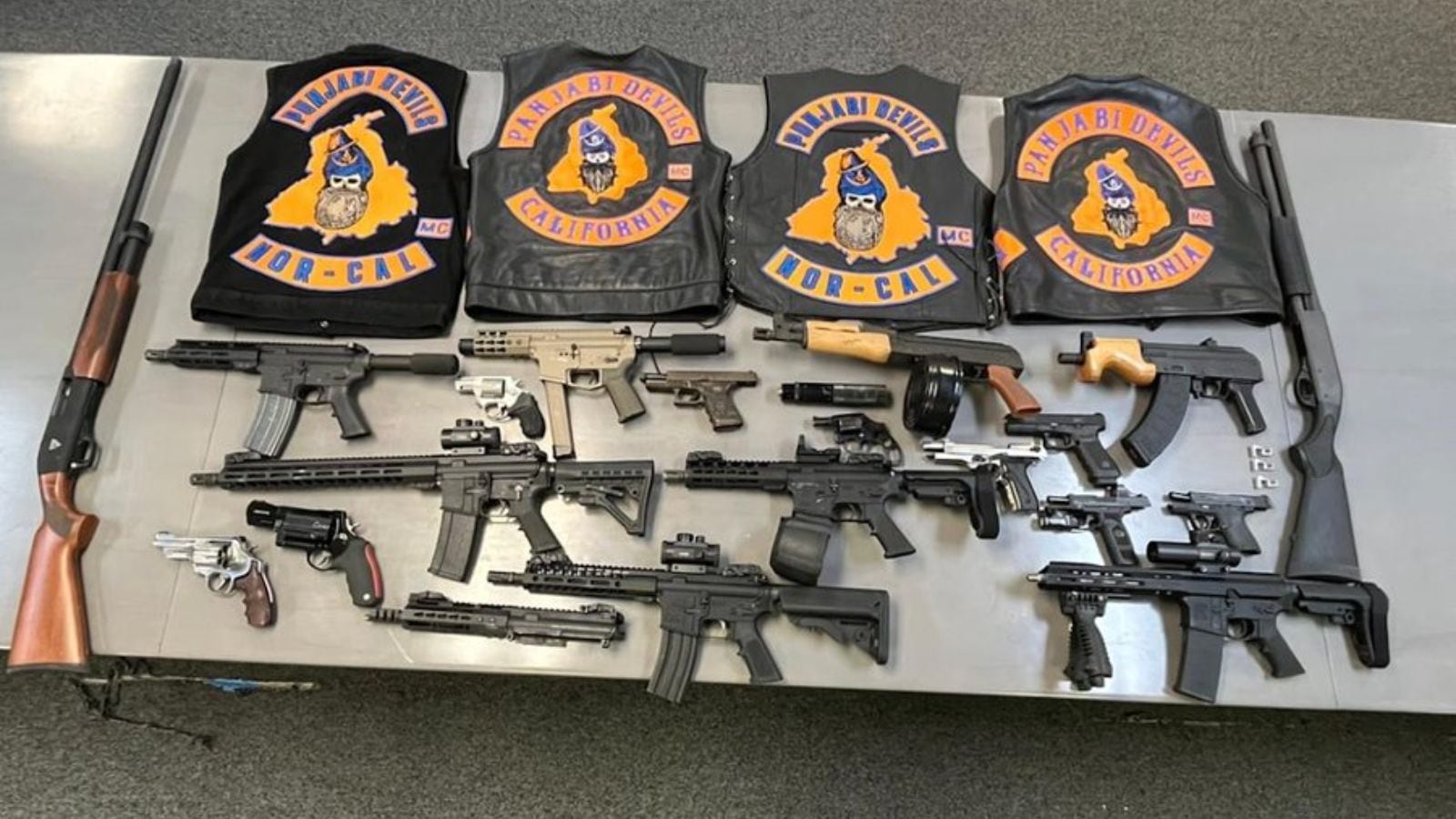
The intersection of ethnic subcultures and transnational organized crime creates a high-risk operational environment where symbolic identity provides the social glue for illicit logistics. The sentencing of Balwinder Singh, the founder of the California-based "Punjabi Devils" motorcycle club, to five years in federal prison for conspiracy to distribute firearms serves as a case study in the structural failure of niche criminal enterprises. When a localized social group transitions into a node for high-stakes contraband trafficking, it invariably encounters a "visibility-to-risk" paradox: the very markers that build internal group cohesion—visible branding, specialized identity, and hierarchical leadership—become the primary data points for federal surveillance and interdiction.
The Structural Mechanics of the Punjabi Devils Enterprise
To understand the downfall of the Punjabi Devils, one must analyze the organization through the lens of a distributed logistics network. Singh’s operation functioned as a bridge between legal retail acquisition and the black-market demand for untraceable weaponry. This specific criminal model relies on three critical operational pillars:
- Straw Purchase Arbitrage: Utilizing individuals with clean criminal records to navigate the Bureau of Alcohol, Tobacco, Firearms and Explosives (ATF) background check system. This exploits the gap between the legality of the initial transaction and the illegality of the intent to transfer.
- Serial Number Defacement: A technical process intended to decouple the physical asset from its paper trail, thereby increasing the market value of the firearm by providing the end-user with "anonymity of possession."
- Transnational Distribution Channels: Moving assets across state or national borders to distance the point of origin from the point of use, complicating jurisdictional coordination among law enforcement agencies.
The breakdown occurred because the Punjabi Devils failed to maintain compartmentalization. In sophisticated cartels, the procurement cell never interacts with the distribution cell. In Singh’s case, the social structure of the motorcycle club collapsed these boundaries, creating a "single point of failure" where the founder was directly involved in the tactical execution of the trade.
Mapping the Federal Interdiction Strategy
The federal investigation, spearheaded by the ATF and the FBI, utilized a "Node-Link" analysis to dismantle the organization. Law enforcement does not target individual sales; they target the flow of the commodity. By identifying the Punjabi Devils as the primary node, investigators could map the links between straw purchasers and the eventual recipients of the firearms.
The prosecution focused on the period between 2016 and 2018, during which Singh and his co-conspirators moved dozens of firearms, including high-capacity rifles and handguns. The legal strategy employed by the United States Attorney’s Office for the Eastern District of California relied on the Theory of Aggregate Impact. While a single illegal gun sale is a felony, the systematic movement of weaponry by an organized group triggers sentencing enhancements related to "organized criminal activity" and "trafficking across state lines."
Evidence presented during the trial indicated that the group didn't just sell guns; they sold a "service." This included the selection of firearms that were specifically requested by buyers, suggesting a demand-driven inventory model rather than a simple opportunistic sell-off. This level of sophistication is what elevated the case from a local police matter to a federal priority.
The Ethnicity-Identity Multiplier in Criminal Organizations
A significant variable in this case is the "Punjabi Devils" moniker. Within the landscape of North American organized crime, ethnic-centric gangs utilize cultural affinity to create high-trust environments. This social capital reduces the risk of internal informants—at least initially. However, this same identity acts as a tracking beacon for the Department of Justice’s Organized Crime Drug Enforcement Task Forces (OCDETF).
The "outlaw motorcycle gang" (OMG) model is a specific sub-category of criminal organization characterized by:
- Public Branding: Wearing "colors" or patches that signal group membership.
- Territoriality: Claiming specific geographic regions for operations.
- Rigid Hierarchy: Clear roles such as President, Sergeant-at-Arms, and Prospects.
Singh, as the founder, held the highest degree of liability. In federal sentencing guidelines, "leadership roles" carry significant weight. The court found that Singh didn't just participate; he orchestrated the logistical framework. His dual identity as a community figure and a gang leader created a friction point that federal agents exploited through undercover operations and intercepted communications.
Revenue Models and Risk Assessment
The economic incentive for firearm trafficking in California is driven by strict state-level regulations. As legal barriers to entry increase, the premium on black-market goods rises. Singh was essentially capturing the "risk premium" associated with procuring firearms that are difficult to obtain legally in the state.
However, the cost-benefit analysis of this operation was fundamentally flawed. The profit margins on individual firearm sales (ranging from $500 to $2,000 per unit depending on the modification and type) do not scale well against the risk of federal prison time. Unlike narcotics, where a single shipment can net millions, firearms are bulky, durable goods with lower turnover rates. The Punjabi Devils were operating on a high-risk, moderate-reward curve that was mathematically unsustainable.
Data Points and Sentencing Outcomes
The final judgment—60 months in prison followed by 36 months of supervised release—reflects a mid-tier sentencing outcome. It signals that while the organization was dismantled, the volume of traffic did not reach the "industrial scale" seen in international arms smuggling syndicates. Nevertheless, the forfeiture of assets and the permanent felony record of the leadership core effectively liquidate the organization's social and financial capital.
The legal repercussions extend beyond Singh. Co-conspirators involved in the straw purchasing chain face varying degrees of culpability. This demonstrates the "ripple effect" of federal investigations; the goal is not just to jail the leader but to "salinate" the ground, making it impossible for the network to reform under new leadership.
Strategic Realignment of Federal Oversight
This case marks a shift in how federal agencies approach "niche" gangs. Previously, smaller, ethnic-specific clubs were often overlooked in favor of larger, well-known entities like the Hells Angels or the Mongols. The Punjabi Devils case proves that law enforcement has transitioned to a "capability-based" targeting model. If an organization demonstrates the logistical capability to move regulated contraband, they are prioritized regardless of their total membership count.
The integration of the "National Integrated Ballistic Information Network" (NIBIN) allows federal agents to link recovered firearms at crime scenes back to the original straw purchasers with unprecedented speed. This technological "fingerprinting" of the distribution chain means that criminal groups now have a much shorter "operational lifespan" before their activities are detected by forensic anomalies.
The persistent vulnerability for any group like the Punjabi Devils is the "Digital Exhaust." Even when physical transactions are conducted with care, the coordination of logistics through encrypted or unencrypted mobile devices leaves a trail. In this instance, the intersection of physical surveillance and digital forensics provided a closed-loop evidentiary chain that made a successful defense nearly impossible.
The strategic takeaway for regional security and urban policy is clear: illicit procurement networks are increasingly utilizing legitimate social organizations as a front. Counter-strategies must therefore focus on the "logistics of acquisition"—the gun shops and the straw buyers—rather than just the "logistics of distribution." By tightening the audit trail at the point of sale, the utility of organizations like the Punjabi Devils is neutralized before the first defaced firearm ever hits the street.