The football establishment is panicking over a problem that does not exist.
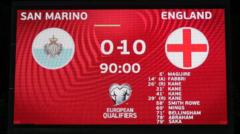
Every time a traditional powerhouse puts seven or eight goals past a part-time squad in World Cup qualifying, the same predictable chorus rises from the commentary boxes. They decry the "dilution of quality." They weep for the television broadcasters forced to endure one-sided matches. They demand a closed-shop preliminary round to spare the elite nations the indignity of traveling to micro-states.
The competitor argument is simple, lazy, and entirely wrong: separate the major and minor nations to protect the entertainment value of the sport.
This view is not just elitist; it misunderstands the fundamental economics and developmental mechanics of global football. The so-called "split" between the footballing aristocracy and the developing nations is not a plague on the international break. It is the lifeblood of the global game. Blocking smaller nations from playing the elite to preserve television ratings is a short-sighted strategy that would permanently stunt the growth of football outside of Western Europe and South America.
The Closed-Shop Fallacy
The central premise of the "split" argument relies on a flawed question: How do we eliminate uncompetitive matches? That is the wrong question. The correct question is: How do we elevate the baseline of global football?
You do not improve by playing within your own echo chamber. When UEFA or FIFA bureaucrats suggest forcing lower-ranked nations into secondary leagues or pre-qualifying tournaments, they are advocating for footballing segregation.
I have spent decades analyzing the operational structures of sports federations. When a small nation like San Marino, Andorra, or Gibraltar plays a powerhouse like Germany or England, the scoreline is often brutal. But the scoreline is the least important data point.
The revenue generated from those fixtures—television rights, ticket sales, commercial sponsorships—funds the pitches, coaching badges, and youth academies in developing nations for the next four years. Cut off the top-tier fixtures, and you cut off the financial oxygen supply to these federations.
The Data Contradicts the Narrative
The narrative states that these matches are useless for both sides. The data suggests otherwise.
Look at the historical trajectory of nations that were once considered whipping boys. In the 1990s, Iceland was a reliable three points for any established European side. They played the giants, absorbed the tactical lessons, reinvested the gate receipts, built indoor football pitches, and eventually qualified for Euro 2016 and the 2018 World Cup, famously eliminating England along the way.
The same progression applies to nations like Venezuela in South America, once the automatic victory in CONMEBOL, now a highly competitive side capable of taking points off Brazil and Argentina.
The Evolution of the "Mina" Nations
| Nation | 1990s Status | Current Reality | Development Driver |
|---|---|---|---|
| Iceland | European Whipping Boy | Major Tournament Regulars | Direct exposure to elite competition & infrastructure reinvestment |
| Venezuela | CONMEBOL Doormat | Legitimate Qualification Contenders | Continuous matches against world-class opposition |
| Japan | Regional Contender | Top 20 Global Powerhouse | Structural integration with global football standards |
If the elite had successfully walled themselves off thirty years ago, these footballing renaissances would never have happened. The elite would play the same ten teams in perpetuity, creating a stagnant, predictable product that would eventually alienate fans far more than a occasional 7-0 blowout.
Dismantling the Player Fatigue Argument
The secondary defense of the major-minor split revolves around player welfare. Managers of elite club teams complain bitterly that their multimillion-dollar assets are risking injury against semi-professional players on sub-standard pitches.
Let us be brutally honest: this is club protectionism disguised as altruism.
Elite players pull hamstrings because the European club calendar is bloated with expanded formats, pre-season commercial tours across multiple continents, and meaningless super-cups. Blaming a World Cup qualifier against a minor nation for a player's burnout is a misdirection tactic.
Furthermore, these matches offer elite national team managers something rare in the modern game: a low-stakes environment to test tactical variations, integrate teenage prospects, and manage the minutes of returning players. It is an international training ground with competitive intensity.
The Brutal Truth About Entertainment Value
People who want to eliminate minor nations from qualifying assume that sports entertainment is purely about competitive parity. They are wrong.
Sport relies on the narrative arc of the underdog. The mathematical probability of a miracle is what keeps audiences engaged. When Saudi Arabia defeated Argentina in the 2022 World Cup, or when North Macedonia knocked Italy out of the 2022 World Cup playoffs, the global sporting landscape shook.
Those moments cannot exist without a system that allows the small to share the pitch with the great. If you create a multi-tiered qualifying system where minor nations only play other minor nations, you kill the romance of the sport entirely. You replace it with a sterile, corporate corporate ladder where the rich stay rich and the poor are denied the tools to climb.
The Downside of the Open System
To be fair, maintaining an open qualification system has distinct disadvantages.
- Fixture Congestion: It adds matches to an already crowded calendar.
- Commercial Imbalance: Broadcasters struggle to market games where the outcome is statistically certain before kickoff.
- Metric Distortion: International goal-scoring records become skewed, as modern forwards accumulate statistics against part-time defenders that historical greats never faced.
But these downsides are operational inconveniences, not structural flaws. They can be managed through smarter scheduling and reformed international breaks. They do not justify blowing up the democratic foundations of global sport.
Fix the Schedule, Not the Seeding
Stop trying to fix international football by banning the lower tier. The current system is not broken because San Marino is allowed to dream; it is strained because the governing bodies refuse to prioritize player rest over commercial expansion at the club level.
If you want to protect the integrity of the World Cup, you do not achieve it by narrowing the gate. You achieve it by forcing the elite to defend their status on the pitch, anywhere in the world, against anyone who earns the right to line up opposite them.
The major-minor split is not a problem to be solved. It is the defining characteristic that makes football the global game. If the elites do not like traveling to small stadiums on a rainy Tuesday night, there is a simple solution: play better, win the game, and go home. You do not get to rewrite the rules of the sport just because you do not want to share the field with the people who built it from the ground up.