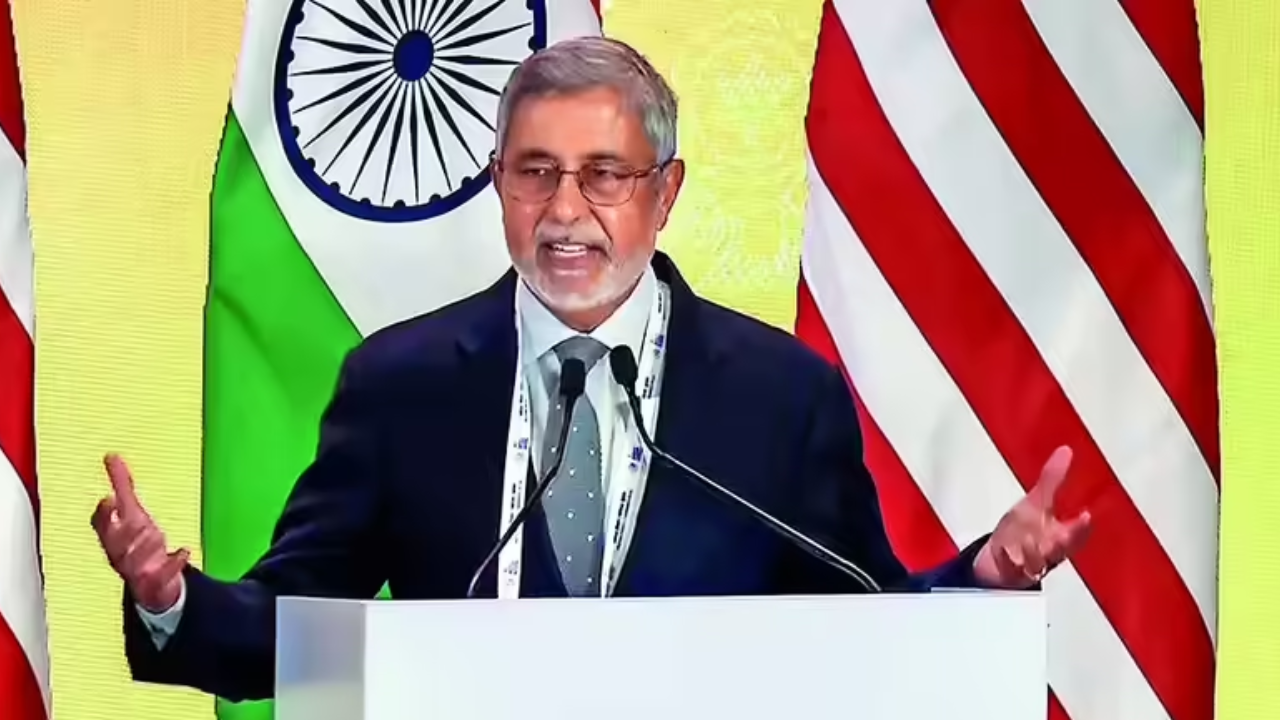
Sanjay Mehrotra was rejected for a US visa three times. Now he runs Micron Technology, a company sitting comfortably in the elite tiers of global tech valuation.
Cue the violins. Cue the inspirational LinkedIn posts about grit, resilience, and triumphing over a broken immigration system.
The media loves this narrative. It bundles Mehrotra with Satya Nadella and Sundar Pichai, wraps them in a flag of "immigrant perseverance," and sells it as a heartwarming tale of beating the odds.
It is a comforting story. It is also completely wrong.
By focusing on the bureaucratic speedbumps of the 1970s, commentators miss the actual mechanics of how hardware empires are built. Mehrotra did not become a titan because he survived an embassy interview. He became a titan because he spent four decades mastering the brutal, cyclical, and deeply unsexy world of semiconductor engineering and supply chain warfare.
Stop looking at the visa stamp. Look at the silicon.
The Lazy Consensus of the Trillion Dollar Club
The mainstream press views tech leadership through the lens of software. They see Microsoft and Alphabet conquering the world with code, search bars, and cloud subscriptions—high-margin businesses with infinite scalability and virtually zero physical footprint.
When Micron surged into the upper echelons of market valuation, fueled by the insatiable demand for High Bandwidth Memory (HBM) in AI data centers, the media applied the same lazy template. They saw a high-flying tech stock and assumed Mehrotra belongs in the exact same bucket as Pichai and Nadella.
They do not operate in the same universe.
Nadella and Pichai manage software ecosystems where margins are fat and capital expenditures, while massive in data centers, do not require reinventing physical chemistry every eighteen months. Micron operates in the memory chip market—a notoriously cutthroat, capital-intensive cyclical meat grinder.
In software, if you make a mistake, you push a patch at midnight. In semiconductors, if you miscalculate demand or mess up a fabrication process, you sit on billions of dollars of obsolete, depreciating hardware.
To lump Mehrotra into a generic "tech executive club" based on his country of origin or his valuation milestones is an insult to the specific, grueling nature of hardware manufacturing. Software might eat the world, but hardware decides how fast it can chew.
The Visa Rejection is a Distraction
Let’s dismantle the foundational myth of the competitor's piece: the idea that a triple visa rejection is a defining hurdle of a global CEO's career.
In 1970s India, getting a US student visa was not a pure meritocracy; it was a bureaucratic lottery. Millions of highly qualified students faced arbitrary rejections based on consular whims, shifting quotas, and geopolitical tensions. Mehrotra’s father famously walked into the consulate to advocate for his son, a move that eventually secured the visa.
It’s a great anecdote for a biography. It has zero operational relevance to why Micron is winning the AI memory war today.
I have spent twenty years advising and observing hardware firms navigate global supply chains. I have seen companies throw tens of millions of dollars at brilliant executives who possessed incredible backstories but lacked the stomach for cyclical market downturns. The visa story is a classic case of survivorship bias. For every Sanjay Mehrotra who overcame a visa rejection to build SanDisk and lead Micron, there are thousands of equally brilliant engineers who got their visas on the first try and faded into corporate obscurity, or who never got their visas and built empires elsewhere.
The focus on immigration struggles commoditizes the executive. It implies that their core value lies in their ability to endure bureaucratic friction, rather than their strategic foresight in capital allocation.
The Brutal Reality of Memory Cycles
To understand why Micron is valued where it is today, you have to ignore the human-interest angles and look at the brutal mechanics of DRAM and NAND flash memory.
Memory is a commodity. Unlike Apple, which can charge a premium for its brand, or Microsoft, which locks users into an enterprise ecosystem, Micron sells components that must adhere to strict global standards. When supply is low and demand is high, memory manufacturers print money. When supply outpaces demand by even a fraction of a percent, prices collapse, margins turn negative, and companies bleed cash.
Look at the catastrophic memory downturn of 2022 and 2023. Samsung, SK Hynix, and Micron were caught in a perfect storm of post-pandemic PC slowdowns and massive inventory gluts. Micron suffered its worst quarterly losses in history.
How did Mehrotra respond? Not by giving inspirational speeches about overcoming adversity. He responded with cold, calculated corporate surgery:
- Cutting executive salaries.
- Slashing capital expenditures by billions.
- Reducing wafer starts to artificially constrain supply and force prices back up.
- Holding the line on R&D for next-generation HBM3E technology.
That last point is the kicker. While the company was bleeding cash, Mehrotra gambled on the engineering pipeline. He bet that when the market recovered, Nvidia and its peers would desperately need faster, more power-efficient memory to feed their AI GPUs.
Imagine a scenario where a CEO panics during a downturn and cuts the R&D budget for unreleased, unproven tech to make the quarterly balance sheet look better. That company dies in the next cycle. Mehrotra didn't panic. That is why Micron’s HBM3E is now integrated into Nvidia’s H200 and Blackwell architectures.
That isn't "grit." That is high-stakes capital allocation in a market that punishes mistakes with corporate death.
Dismantling the HBM Premise: What the Public Misses
The current hype cycle suggests that Micron’s ascent is an unstoppable, linear rocket ship powered by the AI boom. If you read the standard business profiles, you would think the company has solved the cyclicality problem forever.
This is a dangerous misunderstanding of semiconductor physics and market dynamics.
High Bandwidth Memory (HBM) is not just regular DRAM stacked on top of each other like pancakes. It requires Through-Silicon Vias (TSVs)—microscopic vertical tunnels bored through the silicon to connect the layers. The manufacturing yield for HBM is notoriously low compared to standard DDR5 memory.
When a competitor article hypes up Micron's valuation, they gloss over the technical risk. If Micron’s yield rates drop by even a few percentage points due to manufacturing defects or packaging complications, their margins evaporate. Furthermore, Micron is locked in a ferocious three-way war with SK Hynix (the early pioneer of HBM) and Samsung (the undisputed volume giant).
SK Hynix had a massive head start in provisioning memory for Nvidia's early AI hardware. Micron didn't catch up by being a plucky underdog; they caught up by leapfrogging a technological generation, skipping HBM3 to go straight to HBM3E.
It was a brilliant tactical maneuver, but it leaves no room for error. The moment Samsung stabilizes its own high-volume HBM3E production, the supply constraints will ease, prices will normalize, and the insane valuation multiples the market is currently assigning to memory makers will contract.
The media celebrates the milestone. The insider watches the yield curves.
People Also Ask: The Flawed Questions Surrounding Tech Titans
When people search for information on executives like Mehrotra, Nadella, and Pichai, their queries reveal a deeply flawed premise about how global business works. Let’s answer them honestly.
Do Indian-American CEOs have a unique playbook for success?
No. There is no secret cultural playbook. The overrepresentation of Indian-born executives at the top of American tech companies is the result of a highly specific demographic and educational pipeline.
The Indian Institutes of Technology (IITs) and similar institutions filter out millions of applicants to select the absolute top fraction of a percent in mathematical and engineering aptitude. The individuals who survive this sorting mechanism, move to the US for graduate school, and enter corporate America are already outliers among outliers.
Their success is driven by rigorous technical training and the survival skills required to navigate intensely competitive environments. Packaging this as a monolithic cultural trait or a specific "management style" ignores the grueling individual merit and corporate politicking required to climb the ladder at places like SanDisk, Intel, or Microsoft.
Is Micron a safe long-term investment compared to software stocks?
Absolutely not. If you buy Micron expecting the steady, predictable, recurring revenue of a Microsoft 365 subscription, you do not understand the hardware business.
Micron is a cyclical beast. You buy memory stocks when they look expensive on a Price-to-Earnings (P/E) basis because earnings are depressed at the bottom of the cycle. You sell them when they look incredibly cheap on a P/E basis because earnings are temporarily inflated at the peak of the cycle.
The current AI boom has extended the peak and altered the slope of the curve, but it has not eliminated the gravity of supply and demand. Eventually, data center buildouts will slow, or supply will catch up. When that happens, the correction will be swift and merciless.
The Cost of the Counter-Intuitive Approach
Let's be completely transparent about the downsides of looking at business through this cold, analytical lens.
When you strip away the human-interest narratives—the visa rejections, the immigrant journey, the personal triumphs—you lose the emotional core that inspires people. Corporate storytelling exists for a reason. It builds internal morale, softens a company's public image, and pleases institutional investors who want to feel good about the leadership teams they back.
If you run a company solely by the numbers, ignoring the narrative, you risk becoming blind to the cultural factors that keep engineers working eighty-hour weeks during a crisis. Mehrotra’s story matters to his workforce. It matters to the global engineering community.
But as an analytical tool for predicting market dominance or evaluating corporate health? It is worse than useless. It is a sentimental fog that hides the structural realities of the industry.
Stop Celebrating the Entry, Evaluate the Execution
We need to stop writing business profiles that read like motivational posters.
Sanjay Mehrotra’s journey from a rejected student applicant to the head of a massive semiconductor firm is an impressive human achievement. But it is not the reason Micron is a critical pillar of the infrastructure powering the next era of computing.
Micron is winning because its leadership team understood the physics of silicon packaging better than its competitors at a critical junction in technological history. They won because they had the guts to fund expensive R&D while their balance sheet was bleeding red ink. They won because they managed the brutal, unyielding cycles of the hardware commodity market without flinching.
Stop looking for inspiration in the immigration office. The real lessons are found on the factory floor, in the yield percentages, and in the high-stakes gamble of capital expenditure cycles. Everything else is just noise designed to sell clicks to people who don't know the difference between a software patch and a silicon wafer.


