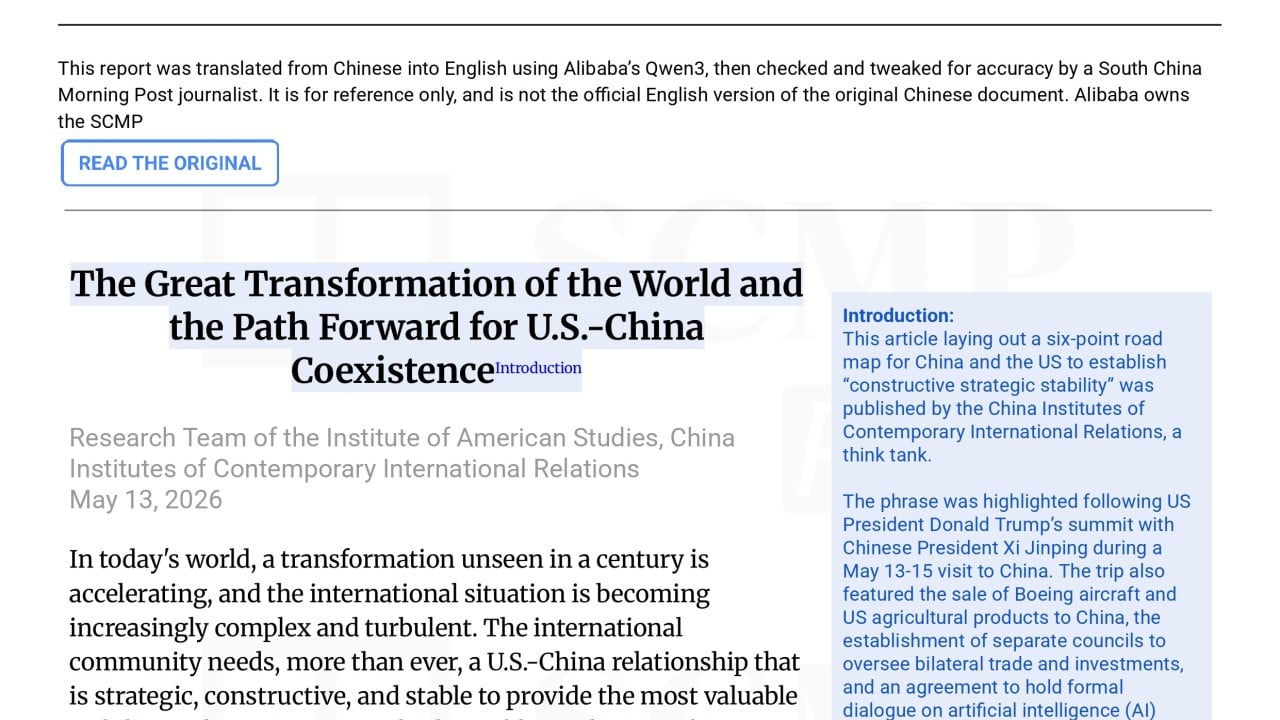
The Grand Illusion of Constructive Ties
Foreign policy circles love a comfortable lie. For years, the consensus among Western think tanks and state departments has been wrapped around a singular, desperate hope: that with enough high-level dialogue, economic guardrails, and climate cooperation, the United States and China can build "constructive, strategic, and stable ties."
It is a comforting bedtime story. It is also completely wrong.
The premise that Beijing genuinely desires a stable, status-quo relationship with Washington misunderstands the core mechanics of modern geopolitics. Stability, in the eyes of the Chinese Communist Party (CCP), is not an end goal; it is a tactical smokescreen. While American diplomats fly across the Pacific to "manage competition" and prevent miscalculation, Beijing utilizes these very periods of engineered calm to aggressively rewrite the rules of global commerce, supply chains, and territorial boundaries.
I have spent over fifteen years analyzing trade flows and supply chain shifts inside East Asia. I have watched multinational corporations dump billions of dollars into facilities under the assumption that diplomatic "guardrails" would protect their investments. They learned the hard way that when Washington talks about stability, it means predictability. When Beijing talks about stability, it means the uninterrupted acquisition of leverage.
Dismantling the Three Pillars of Diplomatic Naivety
The conventional analysis breaks down the path to US-China harmony into three pillars: constructive engagement, strategic clarity, and economic interdependence. Let us dissect why each of these pillars is structurally hollow.
1. The Fallacy of Constructive Engagement
The prevailing wisdom dictates that regular communication between top military and civilian leaders prevents conflict. The logic follows that if the US Secretary of Defense can call his counterpart in Beijing during a crisis, accidental war is averted.
This view ignores a fundamental asymmetry in how communication is valued. The United States views crisis hotlines as safety valves. China views them as bargaining chips.
During periods of heightened tension in the South China Sea, Beijing routinely cuts military-to-military communications. This is not an emotional tantrum; it is a calculated strategy. By removing the safety valve, China intentionally increases the risk of escalation, forcing Washington to exercise restraint out of fear of an accident. The "constructive" dialogue Western analysts crave only happens when China wants to lock in a geopolitical gain, using the meetings to project global statesmanship while conceding nothing on the ground.
2. The Illusion of Mutual Strategic Stability
Mainstream scholars argue that both nations must find a strategic equilibrium, particularly regarding Taiwan and the first island chain. They suggest a return to the deliberate ambiguity that defined the late 20th century.
This ignores the reality that China's strategic objective is explicitly revisionist. You cannot achieve equilibrium with a power whose stated goal is to displace you. The concept of "Strategic Stability" implies a mutual desire to maintain the current balance of power. Beijing views the current balance as a historical aberration that needs correcting. Every diplomatic agreement signed under the guise of stability is used by China as a ceiling to restrict Western actions, while its own domestic defense production and naval expansion continue at a wartime pace.
3. Interdependence is Not a Shield; It is a Weapon
The final defense of the status-quo crowd is economic interdependence. The argument goes that because our economies are deeply intertwined, mutual assured economic destruction prevents real conflict.
This is outdated thinking. Beijing recognized its economic vulnerabilities years ago and initiated a aggressive decoupling strategy under the banner of "Dual Circulation" and "Made in China 2025." While the West debated whether decoupling was even possible, China systematically reduced its reliance on foreign technology while increasing the world's reliance on Chinese manufacturing.
| Aspect | Western Assumption | Beijing's Reality |
|---|---|---|
| Supply Chains | Mutual dependence ensures peace. | Asymmetric dependence yields political leverage. |
| Technology | Open markets foster global innovation. | Domestically controlled IP secures systemic dominance. |
| Diplomacy | Communication prevents miscalculation. | Silence increases adversary anxiety and caution. |
People Also Ask: The Wrong Questions, Answered Brutally
When evaluating this geopolitical friction, the public and business leaders frequently ask questions based on flawed premises. Let us correct the record.
Can the US and China coexist peacefully in a multipolar world?
No, because the premise assumes both powers agree on what "peaceful" means. To the West, peace means adherence to international law, open sea lanes, and territorial integrity. To Beijing, peace means a regional hegemony where neighbors defer to Chinese core interests without the interference of American alliances. These two definitions are irreconcilable. One side must ultimately yield.
Will economic decoupling cause a global depression?
It will cause severe pain, but the alternative is worse. The choice is not between friction and harmony; it is between controlled, proactive diversification now or catastrophic, reactive chaos later. Companies that refuse to accept this reality are gambling their survival on the hope that a totalitarian state will prioritize global market health over its own geopolitical ambitions.
Does China want to replace the US as the global superpower?
Not in the way the Soviet Union did. Beijing has no desire to police the global commons or project military force into every corner of the earth at its own expense. Instead, China wants to control the global architecture—the financial clearing systems, the telecommunications infrastructure, the critical mineral supply chains, and the standards for emerging technology. They do not want to run the world; they want to own the plumbing.
The Danger of Managing Competition
The current American strategy of "managing competition" is perhaps the most insidious threat to long-term Western competitiveness. It sounds responsible. It sounds mature. In practice, it is a recipe for managed decline.
When you manage competition with an adversary that is playing a zero-sum game, you effectively agree to lose at a slower pace. While Western bureaucrats spend months preparing agendas for bilateral working groups on artificial intelligence or fentanyl trafficking, Chinese state-backed entities continue their relentless campaign of intellectual property theft and industrial espionage.
Consider the commercial aviation sector. For decades, Western aerospace giants believed that transferring technology and setting up joint ventures in China would guarantee them access to a massive growing market. They assumed the "stable" relationship would protect their market share. Instead, China extracted the necessary technical expertise to build the Comac C919, a direct competitor to Western narrow-body aircraft. The "managed competition" simply facilitated the birth of a state-subsidized rival designed to eventually squeeze Western companies out of the region entirely.
A Note on the Risks of This Perspective: Adopting this adversarial view requires a total re-engineering of corporate strategy. It means walking away from immediate quarterly profits in the Chinese consumer market to build expensive, redundant supply chains elsewhere. It means accepting higher input costs in the short term. The downside is clear: lower margins today. But the upside is survival tomorrow.
Stop Chasing Stability. Weaponize Unpredictability.
The pursuit of stable ties is a strategic trap. By constantly signaling a desire for stability, Washington gives Beijing the upper hand. The Chinese leadership knows exactly how far they can push—whether via cyber warfare, economic coercion of US allies, or maritime aggression—without triggering a major American response, because they know Washington's priority is to keep the relationship "stable."
To break this cycle, the United States and its allies must abandon the obsession with diplomatic predictability.
Instead of setting up guardrails, the West needs to build leverage. This means aggressively blocking Chinese investments in critical infrastructure, imposing immediate and severe financial penalties on companies utilizing stolen IP, and decoupled access to Western capital markets for any entity tied to the People's Liberation Army.
Stop trying to fix the relationship. The relationship is fundamentally broken because the foundational goals of the two nations are completely diametric.
Accept the friction. Embrace the discomfort of confrontation. The illusion of stability is a luxury we can no longer afford.


