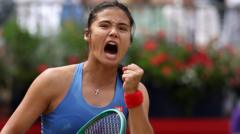
Emma Raducanu will not win Wimbledon this year because a run to the final at Queen’s Club cannot erase the structural volatility that has defined her career since 2021. While mainstream tennis pundits rush to frame her flawless path to the Queen’s final as the birth of a reformed athlete, a cold look at the numbers and her technical configuration reveals a familiar narrative of short-term momentum masking long-term fragility. Her 6-0, 7-6 defeat to Donna Vekic in the final was not an uncharacteristic stumble. It was a precise exposure of the performance ceiling that occurs when an elite athlete tries to shortcut structural stability with nostalgia.
The British public wants to believe that reuniting with Andrew Richardson, the coach who guided her to that surreal US Open title five years ago, has magically solved the riddle of her development. It has not. By looking beneath the optimistic headlines following her victories over Iva Jovic and Kamilla Rakhimova, we can see the tactical modifications, the underlying physical realities, and the institutional pressure cooker that make a deep run at the All England Club highly improbable.
The Queen’s Illusion
Grass-court tennis is a deceptive surface because it rewards instinct and punishes hesitation. For a player like Raducanu, who has spent the last year oscillating between tactical philosophies under a revolving door of coaches, the slick lawns of the Andy Murray Arena provided a temporary reprieve from her deep-seated identity crisis on court. She did not drop a single set on her way to the final. She looked liberated, striking her backhand with the clean, early timing that made her a teenage sensation in New York.
But look at the quality of opposition. Beating an emerging junior like Iva Jovic or navigating past a baseline grinder like Rakhimova does not simulate the grueling tactical examinations presented by the top ten of the WTA tour. When Raducanu met Vekic on Sunday, the illusion shattered. Vekic, a seasoned grass-court specialist who understands the geometry of the surface, exposed Raducanu's lack of a defensive plan B.
The opening set was a 6-0 demolition. Raducanu won just 53% of her first-serve points during the match and won a catastrophic 25% on her second serve. Against Vekic’s flat, aggressive returns, Raducanu’s movement looked reactive rather than proactive. The second-set tiebreak showed admirable resilience, but relying on raw competitive adrenaline to survive is an unsustainable strategy over a fortnight at a Grand Slam.
The Nostalgia Trap in the Coaching Carousel
The headline of Raducanu’s grass-court season was her decision to rehire Richardson in May, ahead of the French Open buildup. This came after a turbulent start to the year that saw her part ways with Francisco Roig after a second-round exit at the Australian Open. Roig, who spent 17 years in Rafael Nadal’s camp, was supposed to bring elite tactical clarity. Instead, he became the ninth coach dismissed or departed from the Raducanu camp in five years.
Raducanu's Coaching Timeline (Selected History)
2021: Nigel Sears -> Andrew Richardson (Post-US Open Split)
2022: Torben Beltz -> Dmitry Tursunov (Trial ended over "red flags")
2023: Sebastian Sachs -> Nick Cavaday
2025-2026: Francisco Roig -> Mark Petchey (Ad-hoc) -> Andrew Richardson
Rehiring Richardson is less a strategic masterstroke and more a retreat into a psychological safe zone. When an athlete experiences post-viral illness, form slumps, and public criticism from legends like Kim Clijsters—who compared Raducanu’s camp to a panicking football club firing managers after a few bad matches—the natural impulse is to seek comfort. Raducanu admitted as much, stating she was grateful to reconnect with someone who has known her for over a decade.
But tennis evolution does not happen in reverse. The tactical framework that won the 2021 US Open as an unheralded qualifier cannot simply be superimposed onto a 23-year-old player with five years of scar tissue, physical setbacks, and a thoroughly scouted game. Richardson is an excellent developmental coach, but he must now fix fundamental technical regression that has crept into Raducanu’s game during his absence.
The Service Mechanics Breakdown
The most glaring issue Richardson faces is the deterioration of Raducanu’s serve under pressure. During her New York run, her serve was a fluid, rhythm-driven weapon that allowed her to dictate with her first groundstroke. Today, it is a liability that breaks down under physical fatigue.
In her loss against Diane Parry in Strasbourg and her first-round exit to Solana Sierra at the French Open, Raducanu hit nine and five double faults respectively. At Queen's, she managed to hide this deficiency behind low-bounce courts and passive returning from lower-ranked opponents. Vekic, however, stood inside the baseline and punished every second serve that sat up in the hitting zone. If Raducanu cannot generate free points with her serve, her movement must work twice as hard.
The Physical Debt of a Fragmented Season
We must look at the physical toll of her current trajectory. Raducanu's team frequently points to her lack of match fitness as a consequence of her long battle with a post-viral illness that kept her out of action between March and mid-May. While true, this fragmented schedule creates a vicious cycle.
Without a sustained block of tournament play, her body lacks the foundational endurance required for best-of-three-set tennis at a major tournament. At Queen’s, she was forced to play double duty on Saturday due to weather delays, defeating both Rakhimova and Jovic in a single day. While the British press hailed this as proof of her restored physical durability, it left her utterly spent for Sunday's final.
Grass court tennis demands a low center of gravity, constant knee flexion, and explosive lateral recovery. When a player enters a tournament with a deficit in match play, the lower back and hamstrings absorb the impact. The drop in Raducanu’s first-serve percentage from 90% in the final to winning just half of those points indicates that her legs were not driving through the ball. Expecting that physical profile to survive seven rounds on the slick, high-pressure courts of SW19 is a fundamental miscalculation of athletic recovery.
Managing the Corporate and Athletic Divergence
The structural problem of Raducanu's career remains the immense disparity between her commercial value and her athletic output. She is a global brand operating within the ranking tier of a journeyman. This creates an environment where every win is amplified into a renaissance and every loss is treated as a national crisis.
The narrative of "The New Emma" is a product of this commercial machinery. It requires a continuous stream of optimism to satisfy sponsors and keep the public engaged. The danger is that the player begins to internalize the hype generated by a few wins on home soil.
True development requires anonymity and the space to fail constructively. It requires working through a technical overhaul with a coach over twelve months, regardless of first-round exits in February. By bouncing from Roig's elite baseline philosophy back to Richardson's familiar environment, Raducanu is prioritizing emotional comfort over the uncomfortable friction required for technical growth.
Wimbledon will offer its usual raucous home support, and the draw may open up for her to win a round or two based on talent alone. But when she encounters a top-twenty player who possesses physical consistency and a settled tactical identity, the technical flaws exposed by Vekic will reappear. The path back to the top of women’s tennis is linear, boring, and requires deep, sustained work away from the spotlight. Until Raducanu stops chasing the ghost of 2021, she will remain trapped in a cycle of brilliant weeks and bruising realities.