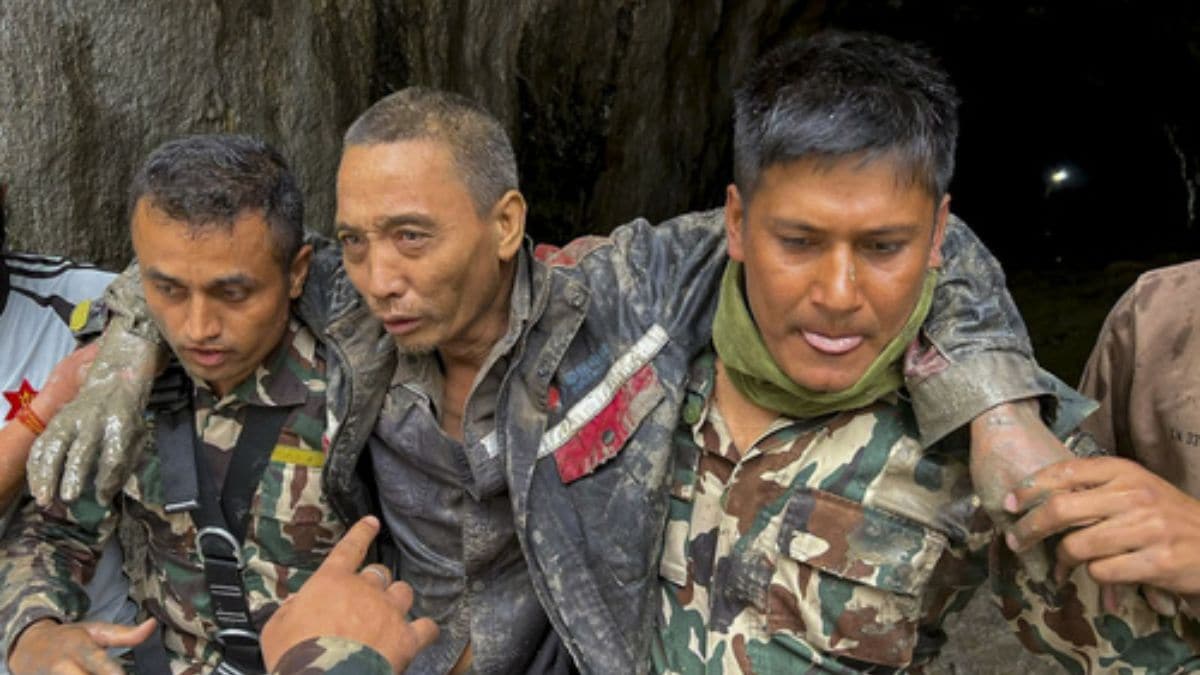
Every major newsroom is currently running the same breathless headline. A 64-year-old woman and a Chinese worker pulled from the rubble and subterranean tunnels of Nepal ten days after a glacial collapse unleashed hell across the Himalayas. It is framed as a triumph of the human spirit. A testament to resilience. A miraculous defiance of biology.
Let us stop romanticizing statistical anomalies.
When media outlets fawn over ten-day miraculous survivals, they are committing a dangerous journalistic sleight of hand. They are turning a systemic failure of hazard forecasting and underground engineering safety into a feel-good movie script. The lazy consensus of mainstream disaster reporting wants you to marvel at the sheer luck of Chandika Shrestha and the unidentified Chinese national. They want you to focus on the exception so you ignore the rule.
The rule is that over 1,300 people are dead and more than 5,000 remain missing because we are building multi-million-dollar hydro projects directly in the crosshairs of predictable, accelerating cryospheric collapse without proper subsurface evacuation architecture.
The Biology Of Ten Days Under Mud
Let us look at the hard science that the miraculous narrative glosses over. Surviving ten days without intentional water access in a crushed structural pocket or a dark, damp hydropower tunnel defies standard human physiological limits, but it is not magic. It is micro-climatology and sheer physiological lottery.
In subterranean cavities carved out by the Trishuli project, humidity approaches saturation. Evaporative water loss through the skin and lungs plummets compared to dry ambient air. If a survivor has access to even minor condensation, seepage, or damp clothing to lick, they can stave off acute renal failure long enough for core metabolic rates to drop into conservation mode.
But celebrating this ignores the thousands who died of positional asphyxiation, hypothermia, or rapid-onset trauma within the first six hours. For every person pulled out alive after a week and a half, hundreds suffocated in air pockets that ran out of oxygen on day two. We are treating survival statistics like lottery tickets, praising the winner while ignoring the rigged game design.
The Engineering Blind Spot In The Himalayas
The disaster was triggered by a glacier fracture at over 5,000 meters on Mount Langtang Lirung. This was not an unpredictable act of God. This is the new normal of high-altitude warming. Cryospheric destabilization in the Hindu Kush Himalaya region is well-documented. Yet, developers keep pouring concrete into narrow river gorges, stringing together tunnel networks with single-point egress routes that turn into death traps the second an ice-rock avalanche hits.
Imagine a scenario where a corporate board is forced to price the actual risk of glacial lake outburst floods and ice avalanches into the balance sheet of every run-of-the-river project. Those projects would become economically unviable overnight. So instead, they build with baseline historical data that no longer applies, install minimal early warning triggers, and rely on the Nepal Army and foreign disaster specialists from South Korea to perform high-risk extraction miracles after the catastrophe hits.
We have built an entire economic model around reactive heroics rather than proactive redundancy.
Dismantling The Resilience Myth
Every time a headline screams about a survivor found under meters of debris after 240 hours, it feeds a toxic narrative of systemic resilience. It suggests that infrastructure can fail, warning systems can sleep, and communities can be left completely blind, but somehow people will just tough it out in the mud until someone shows up with a helicopter.
Real resilience is boring. Real resilience looks like redundant, blast-hardened escape chambers in underground tunnel projects. Real resilience looks like automated seismic and acoustic sensors tied directly to regional evacuation klaxons, giving workers minutes instead of zero seconds to escape a debris flow. Real resilience means stopping the placement of massive industrial corridors in active glacial paths.
Stop looking at the ten-day miracle as a victory. It is an indictment of every engineer, bureaucrat, and planner who thought a mountain valley was a safe place to gamble with human lives. The survivors did not beat the odds because the system worked. They beat the odds in spite of a system that abandoned them the moment the ice broke.