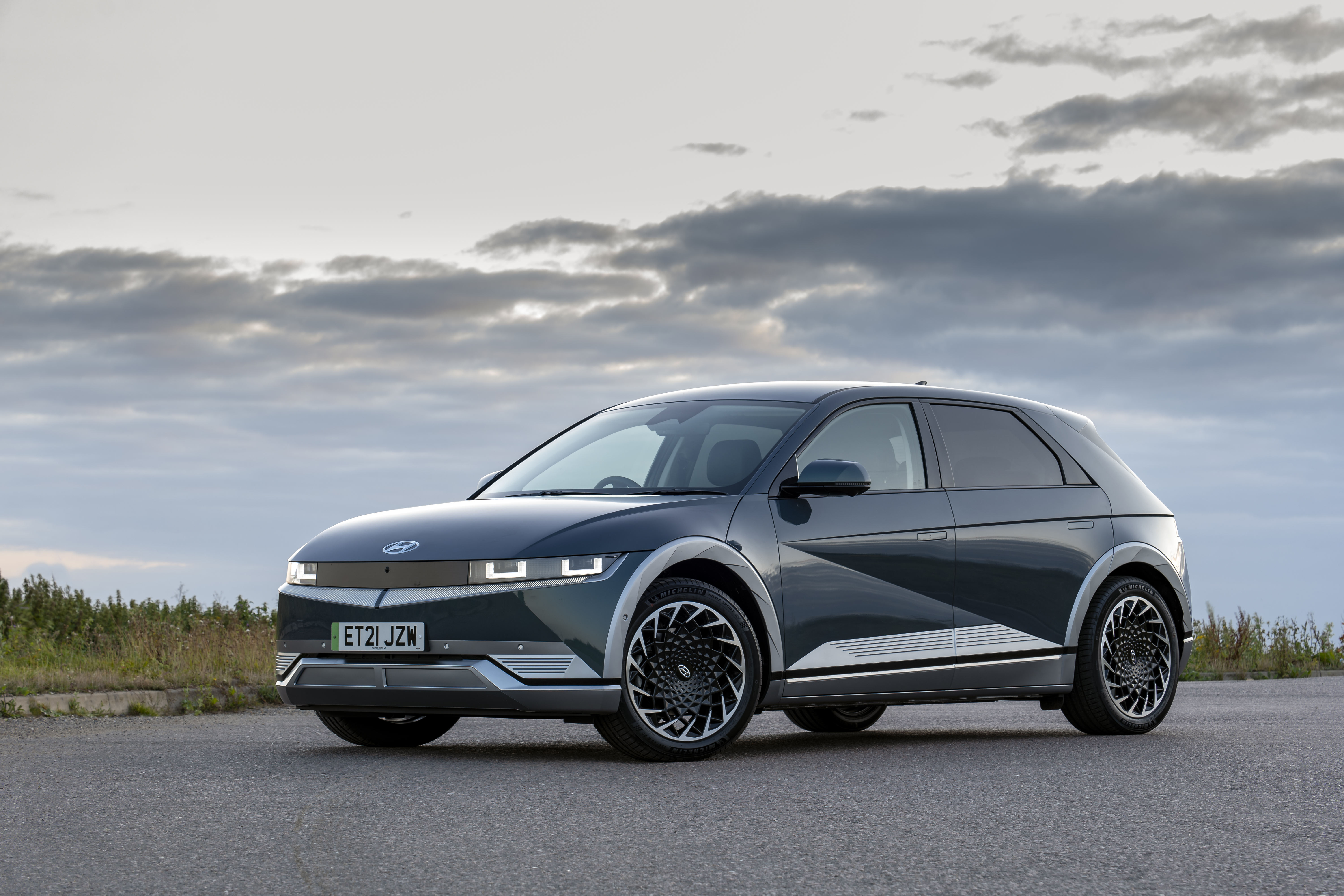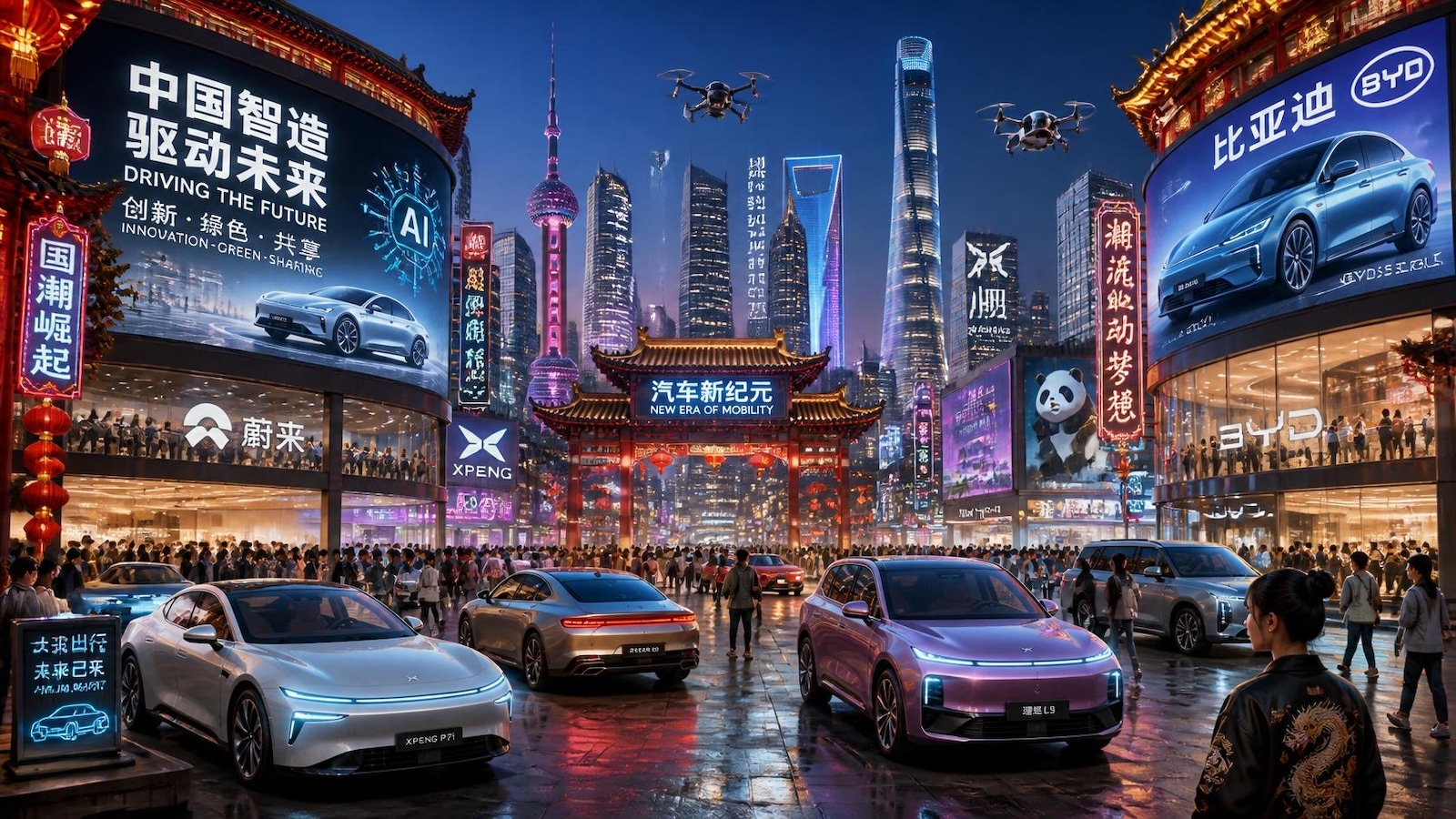
The floor of the assembly hall in Hefei smells of warm oil, ozone, and relentless ambition. Chen stands by the edge of the line, wiping a smudge of grease from his forearm, watching yet another immaculate white crossover glide silently into the testing bay. It is a good car. It has screens that curve like liquid glass, seats wrapped in vegan leather that feels softer than the hides of Bavaria, and a battery pack designed to outlive the financing on a starter home.
It is also, in a very literal sense, looking for a way out.
Outside these walls, the domestic market has turned into a grinding machine. Chen knows this intimately because his neighbors stopped buying new cars six months ago. Everyone is waiting for the floor to drop out. A brutal price war has bled the domestic dealerships dry, slicing margins to the bone and leaving showrooms echoing with the footsteps of cautious buyers. Domestic sales fell twenty-four percent in a violent correction, leaving factory yards choked with inventory that has nowhere to go at home.
Survive or die. There is no third option.
Look closer at the numbers, and the gravity of the shift becomes terrifyingly clear. Over forty major domestic brands are clawing at each other in a market that can barely sustain a dozen. Factories built to churn out millions of electric vehicles are running at blinding speeds, feeding an appetite that has suddenly turned hollow. When the living room is full, you look to the porch. When the country is saturated, you look to the sea.
So the ships are coming.
Imagine a massive, twelve-story car carrier sliding away from a foggy pier in Shanghai. Its belly is crammed with four thousand gleaming, battery-powered machines, all wired for destinations they have never seen: Antwerp, Sydney, Valparaiso, Veracruz. This is not just commerce. This is an industrial migration. Domestic sales are stumbling under the weight of an economic slowdown and a vicious race to the bottom on price, so the factories are exporting their way out of a trap. They are pushing cars across oceans at prices that make legacy manufacturers in Detroit, Wolfsburg, and Tokyo sweat through their bespoke suits.
To understand why this matters, you have to look past the spreadsheets and into the psychology of modern manufacturing. Scale is a hungry god. If you build a factory that costs billions of dollars, you cannot simply slow down when domestic buyers hesitate. Fixed costs do not sleep. Every day the assembly line pauses, millions of dollars evaporate into the damp air. The only way to feed the monster is volume. And if the domestic consumer is tightening their belt, the global consumer must become the relief valve.
Consider what happens when a market hyper-accelerates. China did not back into this position by accident. For a decade, the state poured rivers of capital into the entire electric ecosystem, from the lithium mines in the west to the software labs in the east. They built the supply chain vertically, efficiently, ruthlessly. By the time Western legacy automakers realized what was happening, Chinese firms had locked down the rare earths, mastered the cell chemistry, and figured out how to build a smart car for half the cost of a traditional combustion sedan.
Then the music stopped at home.
The domestic price war was supposed to be a consolidation phase. Instead, it became a crucible. Weak players vanished. Strong players grew leaner, meaner, and desperately eager for foreign cash. When domestic sales plunged nearly a quarter, those export numbers did not just tick upward—they exploded. Entire fleets are now being marshaled for international waters, landing in ports with aggressive price tags that rewrite the rules of global competition.
Walk through a port facility in Europe right now and you can sense the quiet panic. Executives from century-old car companies are wandering among rows of these newly arrived imports with clipboards and calipers, tearing them apart in secret warehouses to see how it is even possible to build such a machine so cheaply. They find integrated castings that replace dozens of welded parts. They find software architectures that update over the air like a smartphone. They find a level of industrial coordination that makes traditional supply chains look like a horse and buggy.
Yet, this export crusade is not without its own perilous shoals. Shipping thousands of cars across the world is easy compared to the political storm gathering on the horizon. Governments from Washington to Brussels are watching these gleaming metal hulls approach their shores with mounting alarm. Tariffs are being drafted. Protectionist walls are rising. The export strategy solves the immediate factory-floor crisis of overcapacity, but it runs headfirst into a wall of geopolitical resistance.
Chen does not worry about geopolitics while he is on shift. He worries about the red light on station four, indicating a misaligned door seal. He straightens his back, picks up his pneumatic torque gun, and drives another bolt home. He knows his livelihood depends on this car leaving the building. Whether it goes to a buyer in Chengdu or a buyer in Rotterdam matters very little to the motor turning in his chest.
What matters is the momentum. A vast industrial engine, caught in the sudden draft of a cooling domestic market, has pivoted outward with terrifying speed. It has found new horizons across the water, carrying with it a wave of affordable technology that will reshape driveways across the globe.
The ships are already past the breakwater. The horizon is full of sails made of steel.