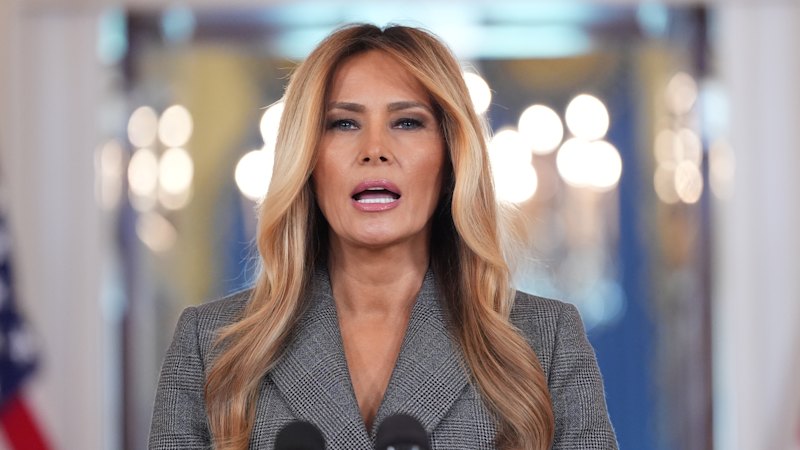
Melania Trump stood in the Grand Foyer of the White House on Thursday and attempted to bury a ghost that has haunted her husband’s political trajectory for a decade. In a scripted, five-minute address, the First Lady flatly denied any personal friendship with the late sex offender Jeffrey Epstein or his accomplice, Ghislaine Maxwell. She framed the persistent rumors of her involvement as "baseless lies" and "mean-spirited attempts to defame my reputation." By demanding that Congress hold public hearings for Epstein’s survivors, she attempted a high-stakes pivot from defensive target to empathetic advocate.
The address was a calculated gamble. While her words aimed to settle the score, the sheer optics of the event did something the West Wing has spent months trying to avoid. It dragged the Epstein saga back into the center of the American news cycle.
The Strategy of the Surprise Strike
Washington is a city of choreographed leaks and trial balloons, yet this address arrived with the blunt force of a surprise attack. For months, the Trump administration had successfully shifted the national conversation toward the escalating conflict in Iran. The Epstein files, once a daily headline, had begun to recede into the background of the 24-hour news cycle.
By stepping to the podium now, Melania Trump broke the first rule of political crisis management: don't feed the fire.
Insiders suggest the move was personal rather than political. The First Lady specifically targeted the "smears" regarding her origin story. For years, digital theorists and unverified reports have suggested a darker version of her arrival in the United States, hinting that Epstein or Maxwell played a role in her 1998 meeting with Donald Trump. She dismantled this narrative with surgical precision, stating she met her husband at a party in New York City and had no prior contact with the financier.
Her legal team has already drawn blood in this arena. They recently secured a retraction and apology from HarperCollins UK over a book that suggested Epstein introduced the couple. This address was the public exclamation point on those private legal victories.
The Paper Trail and the "Dear G" Problem
Despite the denials, the First Lady had to address the physical evidence that keeps the story alive in the public imagination. Specifically, she confronted the "Dear G" email.
Released earlier this year as part of a massive Justice Department document dump, the October 2002 exchange features a sender identified as "Melania" writing to a recipient "G." The tone is strikingly familiar. "I know you are very busy flying all over the world," the email reads. "How was Palm Beach? I cannot wait to go down. Give me a call when you are back in NY." It concludes with "Love, Melania."
The First Lady dismissed the exchange as "casual correspondence" and "trivial." In the social ecosystem of early-2000s Manhattan and Palm Beach, such notes were the currency of the elite. High-society figures often maintained "polite" relationships with people who would later become pariahs.
However, the timing of that specific email is inconvenient. It was sent the same week New York Magazine published a glowing profile of Epstein—an article the sender of the email praised. It suggests that even if there was no "relationship," there was certainly an awareness and an endorsement of the social circle Epstein commanded.
Weaponizing the Congressional Record
The most aggressive element of the address was the call for public hearings. Melania Trump didn't just defend herself; she challenged the legislative branch to put Epstein’s victims on the record.
"Each and every woman should have her day to tell her story in public if she wishes," she said. "Then, and only then, we will have the truth."
This is a double-edged sword for the administration. While it aligns the First Lady with the #MeToo movement and the pursuit of justice, it also creates a platform for testimony that could be unpredictable. Congressional hearings are rarely contained affairs. If survivors testify about the parties at Mar-a-Lago or the social gatherings in New York, the distinction between "being in the same circle" and "being a friend" might blur in the eyes of the public.
By calling for these hearings, she is betting that the truth—whatever remains of it in the redacted DOJ files—will ultimately exonerate her and her husband. It is a bold move to claim the moral high ground on an issue that has primarily been used as a cudgel against the Trump family.
Why Now
The timing remains the biggest unanswered question in the capital. Was there a pending investigative report about to drop? Or did the First Lady simply reach a breaking point with the social media vitriol that has intensified since the "Epstein Files Transparency Act" began unearthing millions of pages of documents?
The West Wing was reportedly aware of the address, but the content appeared to be driven by the First Lady’s office. This independence is a hallmark of her tenure, but in this instance, it has forced the administration back into a defensive crouch regarding a topic they thought they had outrun.
Melania Trump has made her position clear. She is not a victim, she was not a recruiter, and she was not a friend. She is a woman who shared a zip code and a social calendar with a monster, and she is done apologizing for the overlap. Whether the public—or the survivors she has now invited to the halls of power—will accept that distinction remains the ultimate test of her standing.
The ghost of Jeffrey Epstein isn't gone. It’s just been invited into the light.