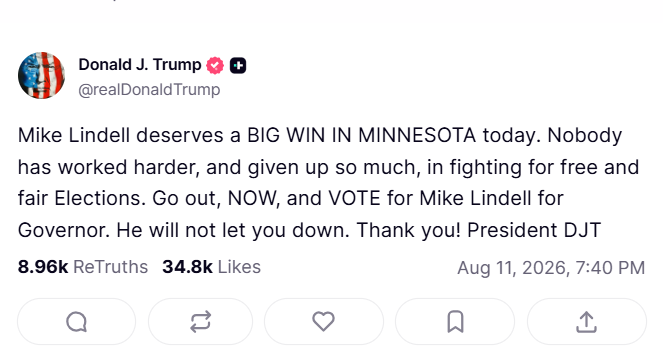
Every primary cycle, political pundits roll out the exact same tired script. They track Donald Trump’s endorsements like Wall Street analysts watching quarterly earnings, eager to declare the former president's kingmaking power either dead or omnipotent. When a backed candidate wins, they scream about ironclad control. When a backed candidate loses, they run breathless headlines declaring the myth shattered.
It is lazy journalism at its finest. Meanwhile, you can find other stories here: Diplomatic Friction Points and the Mechanics of Bilateral Shift.
The lazy consensus says Trump endorsements deliver mixed results. That simple binary misses the entire mechanics of how political power actually operates in contemporary America. Evaluating a primary endorsement purely on a win-loss record is like judging a master chess player by how many pawns they sacrifice. You are looking at the scoreboard while completely ignoring the board state.
I have spent years watching campaigns burn millions of dollars chasing the wrong metrics, misunderstanding how endorsements function, and misinterpreting voter psychology. The truth is much sharper, more uncomfortable, and entirely ignored by mainstream analysis. To see the bigger picture, check out the recent article by Al Jazeera.
The Flaw in the Win-Loss Fallacy
Let us look at how the establishment evaluates these endorsements. They tally up the victories, count the defeats, and spit out a percentage. If a candidate endorsed by Trump wins an open seat, it is chalked up as proof of dominance. If a Trump pick loses in a crowded suburban district against a well-funded incumbent, the media pounces.
This metric assumes every primary district is created equal. It assumes a primary voter in a deep-red rural district behaves identically to a voter in a swing-state suburb. They do not.
Trump does not endorse to pad a winning percentage. He endorses to shape the ideological boundaries of the party and, more importantly, to force opponents to bend the knee. Treating a primary endorsement as a traditional local campaign asset misunderstands the entire point. A Trump endorsement is not a localized lawn sign. It is an ideological force field.
When the media claims the results are mixed, they are usually looking at races where the endorsement was either redundant or strategically impossible to convert. If an incumbent is deeply entrenched with local establishment money, a late-stage endorsement cannot always overcome structural disadvantages. But pretending that loss means the endorsement failed is political illiteracy.
The Coercion Economy
Here is the part the pundits refuse to say out loud. The primary value of a Trump endorsement is often realized before the votes are even cast.
Think about the sheer gravitational pull of his backing. Long before election day, potential challengers look at the landscape, see the writing on the wall, and decide not to run at all. Others radically alter their policy platforms to appease the base, adopting populist stances they privately despise simply to preempt a devastating endorsement against them.
You cannot measure that impact in a post-election win-loss column. You cannot count the candidates who dropped out, the policies that shifted, or the establishment figures who bent the knee behind closed doors.
Imagine a scenario where a high-profile challenger bows out of a race because internal polling shows a potential Trump endorsement would annihilate their path forward. The media records zero races won, zero races lost. Yet, a massive political outcome was achieved entirely through preemptive deterrence.
Political science has long studied power as something exercised visibly. The reality of modern American politics is that the most potent power is invisible. It is preventive.
Why Suburban Primaries Break the Mold
The narrative of mixed results usually hinges on suburban districts. This is where the media finds its favorite counter-examples. They point to moderate or establishment-friendly districts where a populist, Trump-endorsed candidate stumbled in a general-leaning primary.
Let us be brutally honest about why that happens. It has nothing to do with Trump’s baseline popularity among committed primary voters. It has everything to do with local candidate quality and demographic mismatch.
Trump’s brand is unapologetic, hyper-nationalist populism. That brand plays exceptionally well in districts where the median voter is working-class, culturally aggrieved, and skeptical of institutional gatekeepers. Drop that exact same endorsement template into a wealthy, college-educated suburb where the primary electorate still harbors memories of traditional fiscal conservatism, and the friction becomes obvious.
The mistake is assuming the endorsement is a universal solvent. It is not. It is a specialized chemical. Pour it on the right material, and it melts through the opposition. Pour it on the wrong material, and it sizzles out.
Blaming the endorsement for failing to bridge an impossible demographic gap is like blaming a chainsaw for being a poor tool for shaving. The tool works fine. You are just using it on the wrong wood.
The Real Metrics That Matter
If you want to understand what a primary endorsement actually achieves, stop looking at the final vote tally on election night. Look at these three indicators instead:
- Fundraising Velocity: Watch the twenty-four hours immediately following an endorsement. The digital fundraising haul tells you whether the base actually cares. If small-dollar donations flatline, the endorsement was a dud. If the server crashes, the machine is alive.
- Opponent Contortion: Watch what the opposing candidates do after the endorsement drops. Do they double down on their own platform, or do they immediately release frantic videos trying to prove they love Trump just as much? If they start pivoting, the endorsement has already won the psychological war.
- Agenda Compliance: Look at what happens to the legislative priorities of the winner once they take office. Do they act like independent operators, or do they recognize where their political survival originates?
When you grade endorsements by these real-world mechanics, the picture changes entirely. The results are not mixed. They are ruthlessly efficient.
The Downside Nobody Admits
To be completely fair to the critics, this system comes with a massive structural cost. The obsession with primary purity tests often saddles general election ballots with candidates who struggle to win over independent, median voters in swing districts.
This is the trade-off. Populist dominance in a primary can easily translate into general election vulnerability. By prioritizing absolute ideological alignment and personal loyalty over broad-market appeal, the movement occasionally sacrifices winnable seats for the sake of ideological purity.
It is a high-stakes gamble. Win the primary decisively, lose the independent middle in November.
Mainstream analysts love to point this out as proof of failure. They are wrong about the cause, but they have stumbled onto a genuine strategic risk. The difference is that the architects of these endorsements view that risk as acceptable collateral damage. They care less about holding a slim, ideologically fractured congressional majority and more about ensuring that the party they control speaks with one unwavering voice.
The Uncomfortable Truth
The media wants you to believe that political endorsements work like consumer products. Get the big name, watch the sales spike. When the numbers fluctuate, they declare the product broken.
Politics is not retail. It is asymmetric warfare.
The Trump endorsement machine does not need a hundred percent win rate to be effective. It needs to command attention, dictate terms, and keep the entire ecosystem off balance. As long as elected officials and aspiring candidates wake up every morning checking their phones to see who caught a digital nod from Mar-a-Lago, the myth of the mixed result is exposed for what it is: wishful thinking from an establishment that refuses to admit it no longer holds the pen.
Stop counting losses. Start watching who is bending the knee.