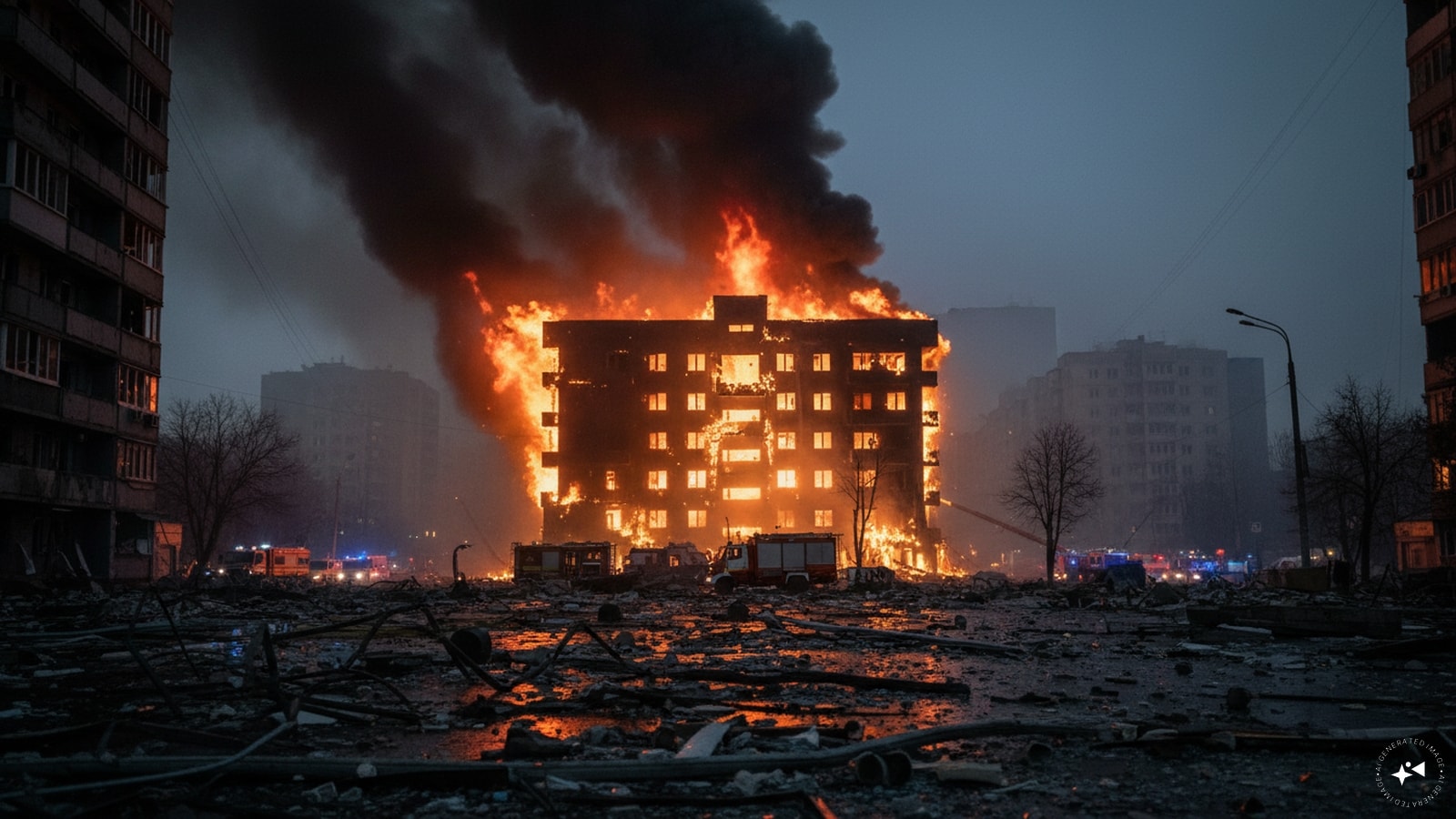
Every single headline follows the exact same template. A loud crash echoes across the Ukrainian capital. Sirens wail. Smoke billows from a residential block or an industrial yard. Officials step in front of microphones to condemn the barbarity, cite minor casualties, and demand more air defense batteries from Western allies.
Then the news cycle rolls on.
This lazy consensus treats every incoming barrage as an isolated tragedy or a random act of terror. That framing is comfortable. It fits neatly into a television package. It is also fundamentally wrong.
When you strip away the emotional rhetoric and look at the cold, hard mechanics of modern attrition warfare, these strikes are not about terror. They are a deliberate, calculated ledger entry in an economic war of exhaustion.
The Real Economics Of Attrition
I have spent years analyzing defense procurement cycles and supply chain bottlenecks. The standard narrative claims Russia launches missiles at Kyiv simply to break civilian morale. If that were true, the strategy has failed miserably for years. Ukrainian resilience under fire is well-documented. Moscow is not stupid; their military planners know this.
So why keep firing million-dollar precision munitions at heavily defended urban centers?
The answer lies in cost asymmetry. A single Patriot or NASAMS interceptor missile does not cost a few thousand dollars. We are talking about hundreds of thousands to several million dollars per round. When an inbound projectile forces the launch of multiple defensive interceptors to guarantee a kill, the defender burns through finite, highly specialized stockpiles at a rate that industrial manufacturing cannot match.
This is the attrition trap. Moscow does not need every missile to hit a strategic target to win. They just need the replacement cost for the defender to outpace the production capacity of the West. Every time a Kyiv strike makes the evening news because of a shattered balcony or a localized fire, everyone focuses on the immediate property damage. They completely ignore the quiet depletion happening in the supply depots behind the front lines.
Dismantling The Air Defense Fallacy
Let us address the most common refrain in modern security reporting: "Ukraine just needs more air defense."
It sounds logical. It is emotionally satisfying. It is also operationally incomplete.
Air defense is a finite resource, not an infinite shield. Western defense contractors like Lockheed Martin and Raytheon are ramping up production lines, but the lead time required to manufacture complex radar components, rocket motors, and guidance systems is measured in years, not quarters. You cannot simply flip a switch and manufacture a thousand interceptors next Tuesday.
By framing every missile attack as a failure to supply enough hardware, commentators miss the structural bottleneck. The West is trying to fight a protracted industrial war using an expeditionary, low-volume procurement model. Russia, meanwhile, has shifted its entire domestic economy onto a wartime footing. They are producing lower-tech, cheaper cruise and ballistic missiles faster than Western defense ministries can fund and deliver high-end countermeasures.
Ignoring this math is journalistic malpractice. Pretending that the problem can be solved by simply writing another aid check treats a complex systemic vulnerability like a customer service complaint.
The Geography Of Resilience
Another glaring flaw in standard reporting is the obsession with Kyiv as a static symbol rather than a dynamic economic node.
When a missile strike sparks fires in the city, the immediate assumption is that the government center or critical command nodes are wobbling. But centralized command and control structures in modern conflicts are redundant, dispersed, and heavily encrypted. A strike on an industrial suburb or an empty lot near a rail junction rarely cripples national capability.
Instead, it serves a psychological signaling function directed outward, not inward. It reminds international capital markets that Ukraine remains an active war zone, complicating long-term investment, insurance rates, and reconstruction financing. The physical damage is often secondary to the financial friction it creates.
If you want to understand why these strikes persist, stop looking at the fire department reports. Look at the balance sheets of international reinsurance firms. Look at the capacity utilization rates of European artillery and missile factories. That is where the actual war is being decided.
What Real Strategic Adaptation Looks Like
If the conventional approach of begging for more interceptors is a losing game of catch-up, what is the alternative?
It requires a total pivot from reactive defense to proactive disruption. You do not win an attrition war by standing in the batter's box and catching every pitch thrown at you. You win by taking out the pitcher.
That means prioritizing long-range strike capabilities over defensive umbrellas. It means moving production lines of asymmetric counter-systems inside Ukrainian borders, shielded and decentralized, rather than waiting for transatlantic shipments of multi-million-dollar interceptors. It means starving the aggressor of the microelectronics and dual-use components that keep their missile assembly lines humming, rather than merely reacting to the final product when it detonates over a Kyiv skyline.
The next time a headline blares about smoke over the capital and injured civilians, look past the flames. The real story isn't the fire burning on the ground. It's the silent ticking clock of industrial capacity running out in the background.
Stop counting the craters. Start counting the factories.