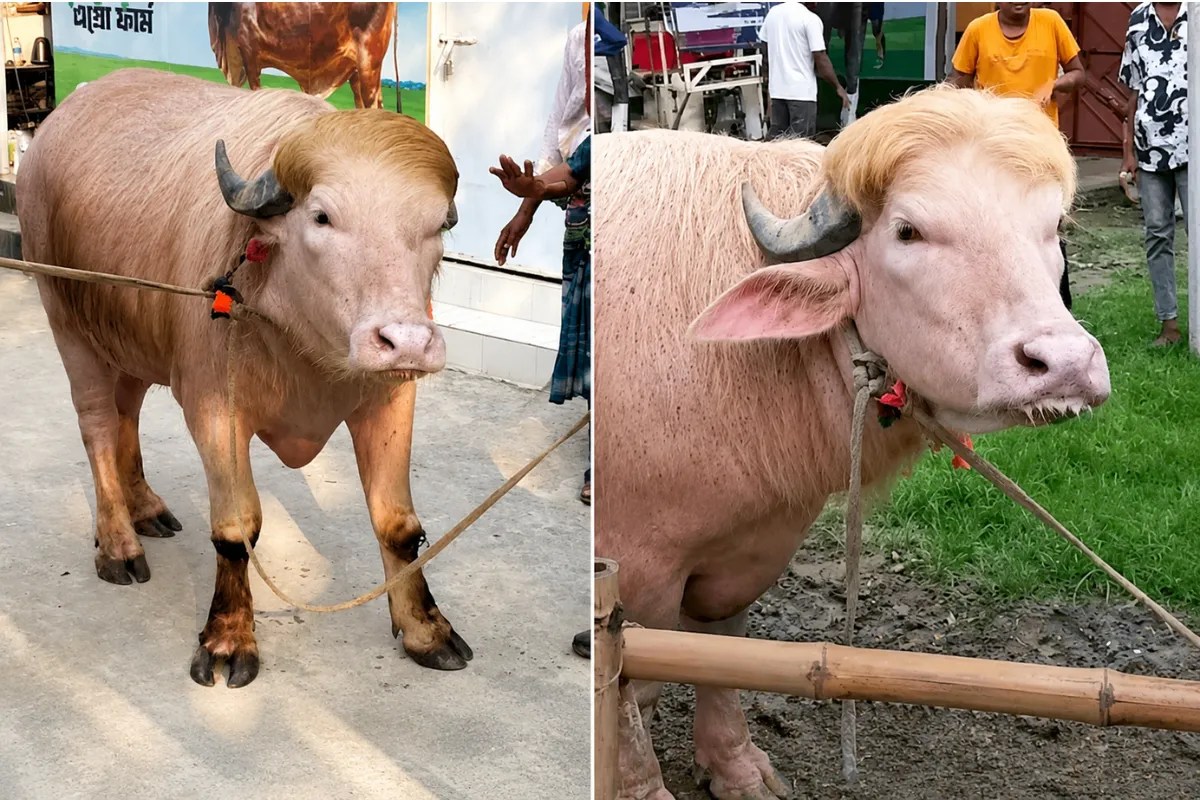
The convergence of cultural reverence, localized media amplification, and speculative commodity pricing creates a highly volatile micro-economy in the weeks preceding Eid al-Adha. The phenomenon of the 700-kilogram breeding bull named "Donald Trump" in Bangladesh is not merely a novelty news item; it serves as a textbook study in asymmetric market valuation, consumer psychology, and the monetization of novelty in agricultural markets.
Standard livestock valuations rely strictly on utility-based metrics: carcass yield, lean-meat-to-fat ratios, age, and breed purity. However, when an asset transitions from a agricultural commodity to a cultural spectacle, standard pricing models collapse. The value of the asset decouples from its intrinsic meat yield and becomes driven by experiential premium, social signaling, and localized viral marketing. Deconstructing this asset valuation requires analyzing the specific economic pillars that transform a 700-kilogram animal into a high-yield marketing vehicle.
The Three Pillars of Spectacle Pricing in Livestock Markets
The pricing anomaly observed in high-profile livestock depends on three distinct vectors. When these vectors intersect, they generate an exponential premium over the baseline commodity price of beef per kilogram.
1. The Nomenclature Premium and Geopolitical Mimicry
Naming a high-weight bull after a polarizing, globally recognized public figure is a deliberate strategy to exploit the attention economy. In rural and semi-urban markets, this creates immediate cognitive shorthand. The name "Donald Trump" functions as a brand anchor. It signals attributes of scale, dominance, and unorthodoxy without requiring the seller to explain the animal’s genetic lineage. This linguistic branding drastically reduces the cost of customer acquisition, drawing crowds who would otherwise ignore a standard livestock listing.
2. Anthropomorphic Valuation and the Selfie Economy
The transformation of a utility asset into a tourist attraction introduces the "selfie economy" to traditional agricultural spaces. When crowds travel significant distances to photograph themselves with an animal, the asset’s primary yield shifts from caloric value (meat weight) to experiential value (social media capital). Every shared image acts as zero-cost decentralized marketing, expanding the geographical footprint of the asset beyond local market boundaries. The owner of the asset ceases to be a simple farmer and becomes an attention broker.
3. Asymmetric Weight and the Scale Disruption
A weight profile of 700 kilograms positions an animal far outside the standard distribution curve for regional livestock. In Bangladesh, where the average sacrificial animal weighs between 150 to 300 kilograms, a 700-kilogram asset represents a massive scale disruption. This sheer physical mass creates a scarcity effect. Buyers who purchase these hyper-weight animals are not buying food security; they are purchasing prestige. The transaction becomes an exercise in high-net-worth social signaling during a major religious festival.
The Cost Function of Maintaining High-Weight Speculative Assets
The primary vulnerability missed by casual observers is the highly compressed margin and extreme operational risk associated with maintaining a 700-kilogram biological asset. The cost function of developing and preserving a bull of this scale is non-linear, meaning costs accelerate much faster than the animal's weight gain.
Standard maintenance models fail because a animal of this mass requires specialized inputs to prevent rapid depreciation:
- Caloric Escalation: The metabolic demands of a 700-kilogram bull require high-density, specialized feed matrices. This includes a mix of balanced grains, legumes, silage, and vitamin supplements, bypassing standard grazing methods.
- Thermal Regulation Infrastructure: Large bovine structures possess low surface-area-to-volume ratios, making them highly susceptible to heat stress, particularly in humid tropical climates like Bangladesh. Maintenance requires mechanical ventilation, constant water cooling, and dedicated labor to prevent sudden cardiovascular collapse or weight loss.
- Risk of Immobile Depreciation: If a hyper-weight animal suffers a joint injury or hoof infection due to its immense mass, its market value drops to zero instantly. The risk profile increases every day the animal is held past its peak physical readiness.
This creates a high-stakes bottleneck for the seller. The asset must be liquidated during a narrow window—specifically the days leading up to Eid al-Adha. Holding the asset past this date results in a market collapse where the speculative premium evaporates, leaving the seller with a high-overhead commodity that can only be sold at standard meat prices.
Market Realities and the Illiquidity of Celebrity Livestock
While media reports emphasize the massive crowds and high speculative interest, a structural disconnect exists between public attention and actual transaction liquidity.
The attention-to-transaction ratio for novelty livestock is exceptionally low. Thousands of individuals seeking selfies create operational friction, overcrowding the farm and potentially stressing the animal, yet none of these participants represent a viable buyer. The asset faces a thin market problem: the number of individuals willing to look at a 700-kilogram bull is vast, but the pool of buyers with the capital and desire to purchase a luxury-priced animal for sacrifice is microscopic.
This thin market exposes the seller to the winner's curse. To realize the true premium, the seller must find a buyer who values the prestige of the name and scale more than the market value of the meat. If no such buyer emerges, the seller must lower their expectations rapidly as the festival deadline approaches, converting the asset back into standard commercial beef and absorbing a massive loss on the specialized feed and infrastructure investments.
Systemic Optimization Strategies for High-Value Livestock Producers
For agricultural enterprises seeking to replicate or capitalize on this viral valuation model, relying on accidental social media fame is an unstable business practice. A structured framework must be implemented to predictably capture and monetize these anomalies.
First, producers must treat high-weight livestock as a distinct asset class, separating them from the standard commercial herd from an early developmental stage. This involves identifying calves with superior genetic potential for skeletal frame growth and applying intensive nutritional regimens.
Second, the marketing phase must be institutionalized. Instead of waiting for local reporters to discover the animal, producers should leverage targeted digital campaigns weeks before the traditional markets open. The deployment of culturally resonant names or themes should be calibrated to current media trends, ensuring maximum algorithmic reach on digital platforms.
Finally, risk mitigation requires immediate securing of pre-sale contracts or non-refundable deposits from high-net-worth individuals. Allowing an asset of this scale to enter an open, chaotic physical market without a baseline price agreement exposes the producer to extreme downside risk, including physical injury to the animal during transport or acute market manipulation by cartel buyers.
The ultimate strategic play for the producer is the decoupling of the asset from the physical marketplace through digital bidding. By running a private, closed-loop auction for certified premium livestock, a seller eliminates the logistical hazards of transport and the operational drag of curiosity-seeking crowds. This shifts the point of sale from a chaotic public market to a controlled environment, maximizing the competitive tension among high-net-worth buyers and securing the highest possible premium before the asset ever leaves the farm gates.


