The current American electoral framework operates under a prisoner’s dilemma where the strategic utility of partisan gerrymandering is inversely proportional to the number of participants practicing neutrality. When a political actor calls for Democrat-leaning states to redraw election maps following unfavorable Supreme Court rulings and aggressive GOP redistricting, they are attempting to solve a systemic imbalance through localized escalation. This strategy rests on the premise that the aggregate national outcome is determined by the sum of individual state-level maneuvers, and that unilateral adherence to non-partisan redistricting functions as a tactical tax on the party practicing it.
To evaluate the efficacy of this call for map redrawing, one must examine the operational mechanics of the "efficiency gap," the legal constraints imposed by the Rucho v. Common Cause decision, and the structural friction inherent in state-level legislative processes.
The Asymmetry of Redistricting Control
Electoral outcomes are governed by the distribution of voters across geographic boundaries. When one party controls the redistricting process in a state—a condition known as trifecta control—they can employ two primary techniques: cracking and packing.
- Cracking: Diluting the voting power of the opposing party's supporters across many districts so that they fall just short of a majority in each.
- Packing: Concentrating the opposing party's supporters into a few districts to maximize their influence in those specific areas while minimizing it elsewhere.
The strategic misalignment occurs because Republican-led states have historically demonstrated a higher propensity for utilizing partisan redistricting as a core legislative priority. Democrat-led states, conversely, have moved toward independent redistricting commissions (IRCs) or court-mandated neutral maps. This creates a structural deficit. If State A (Republican) optimizes for a 70% seat share with 50% of the vote, and State B (Democrat) uses a commission to achieve a 50% seat share with 50% of the vote, the net national result is a structural bias that favors the party willing to exercise map-making power.
The Legal Inflection Point: Rucho v. Common Cause
The Supreme Court’s ruling in Rucho v. Common Cause (2019) fundamentally altered the risk-reward calculus of redistricting. By declaring that partisan gerrymandering claims present non-justiciable political questions beyond the reach of federal courts, the Court effectively removed the federal "safety valve" that previously deterred extreme maps.
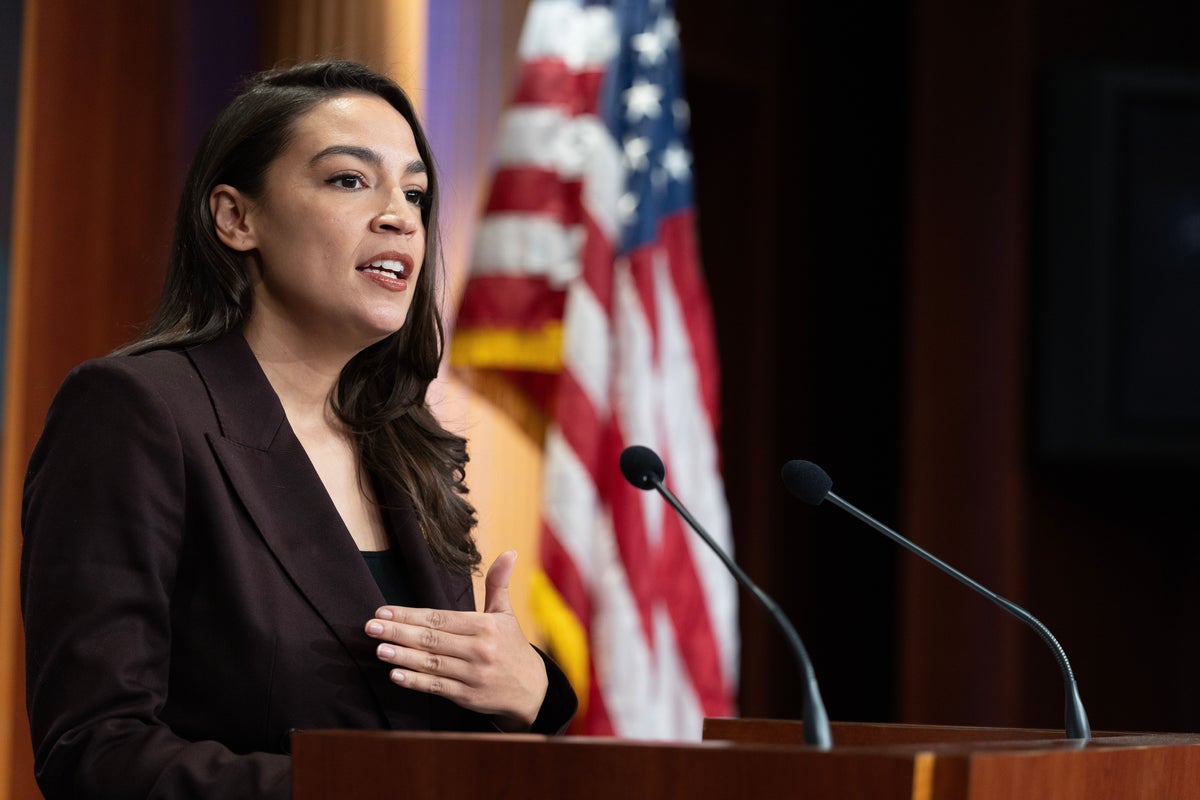
The removal of federal oversight created a vacuum filled by state-level judicial and legislative volatility. The strategy proposed by figures like Representative Ocasio-Cortez is a direct response to this deregulation. Without a federal standard, the only remaining counterweight to an optimized map in one state is an equally optimized map in another. This is the "tit-for-tat" strategy in game theory applied to constitutional law.
Quantifying the Efficiency Gap
The efficiency gap measures the difference between the "wasted votes" cast by each party. A wasted vote is any vote cast for a losing candidate or any vote cast for a winning candidate in excess of what was needed to win.
$EG = \frac{W_a - W_b}{Total Votes}$
Where $W_a$ represents wasted votes for Party A and $W_b$ represents wasted votes for Party B. In a perfectly competitive environment, the efficiency gap would approach zero. However, when states like North Carolina or Ohio produce maps with high efficiency gaps favoring Republicans, the only way to balance the national "wasted vote" tally is for states like New York or Illinois to produce maps with an equivalent efficiency gap favoring Democrats.
The friction in this logic arises from the varying state constitutions. While some states allow the legislature to override maps via simple majority, others have embedded IRCs into their constitutions. Thus, a call to "redraw the maps" is not a uniform command; it is a request to navigate a complex web of state-specific legal hurdles that the opposing party may not face.
The Three Pillars of Partisan Recalibration
For a state to successfully execute a map redrawing that counters a national imbalance, three conditions must be met:
1. Legislative or Executive Path of Least Resistance
In states where Democrats hold a trifecta (the governorship and both chambers of the legislature), the primary obstacle is often internal consensus rather than external opposition. However, many Democrat-leaning states have self-imposed constraints. For example, California and Michigan utilize independent commissions that are insulated from legislative directives. In these jurisdictions, "calling for a redraw" is functionally impossible without a constitutional amendment.
2. Judicial Deference
Even if a legislature produces a more aggressive map, the state’s high court must be willing to uphold it. We observed this tension in New York during the 2022 cycle, where the State Court of Appeals struck down a Democrat-drawn map as a violation of the state constitution’s anti-gerrymandering provisions. This highlights a critical asymmetry: Republican-leaning state courts have shown a higher degree of tolerance for partisan maps (as seen in North Carolina’s judicial shifts) compared to the more proceduralist or liberal-leaning courts in Democrat states.
3. Demographic Clustering and Geography
Geography acts as a natural constraint on redistricting. Democratic voters tend to cluster in high-density urban areas, which creates a natural "packing" effect. Republican voters are more efficiently distributed across suburban and rural areas. To draw a map that favors Democrats, map-makers must often create "spokes" that link urban cores to distant rural areas—a practice that is easily challenged in court on the grounds of "compactness" and "contiguity."
The Cost Function of Unilateral Neutrality
There is a measurable political cost to maintaining neutral redistricting processes while an opponent does not. This cost is paid in legislative capacity and the ability to pass national policy.
If the House of Representatives is decided by a margin of five seats, and those five seats were lost due to "fair" maps in New York and California while Florida and Texas utilized "unfair" maps, the policy outcome is a national agenda that does not reflect the popular vote. This is the core of the argument for aggressive redrawing: the preservation of a fair national outcome requires the abandonment of fair local processes.
The risks of this strategy include:
- Long-term Institutional Decay: Normalizing aggressive gerrymandering at the state level further erodes public trust in electoral outcomes.
- Judicial Backlash: Aggressive maps may trigger new legal theories that could lead the Supreme Court to further restrict state-level map-making, potentially in ways that favor the current majority.
- Primary Volatility: Maps drawn for partisan advantage often create "safe" seats, which shifts the real competition to the primaries. This tends to pull candidates toward ideological extremes, reducing the possibility of bipartisan governance.
Tactical Realignment and the Path Forward
The call for redrawing maps is less about a single election and more about establishing a credible threat. In legislative bargaining, a party that refuses to use its available leverage is at a permanent disadvantage. By signaled a willingness to play by the "new rules" established by the Rucho decision, Democrats are attempting to force a return to the negotiating table for a federal solution—the John Lewis Voting Rights Act or similar legislation.
However, the execution of this strategy requires more than rhetoric. It requires a state-by-state audit of constitutional provisions and a willingness to appoint partisan-aligned judges to state supreme courts. The transition from "procedural fairness" to "outcome-based competition" marks a significant shift in the Democratic party’s strategic doctrine.
The immediate tactical play for states with Democratic control is to identify districts where "cracking" can be reversed or "packing" can be diffused without violating the Voting Rights Act’s protections for minority representation. This is a delicate balancing act; the VRA requires the maintenance of majority-minority districts, which often naturally "packs" Democratic voters. Navigating this intersection of partisan gain and racial equity is the primary technical challenge for Democrat map-makers.
The focus must shift toward "Symmetric Partisanship." This involves drafting maps that are not necessarily "fair" in the vacuum of a single state, but are "corrective" in the context of the national aggregate. If the GOP has secured a 10-seat advantage through redistricting in the South and Midwest, Democratic legislatures in the Northeast and West Coast view it as a strategic necessity to manufacture a 10-seat advantage of their own.
This leads to a locked system. Until both parties perceive that the cost of gerrymandering (legal fees, public backlash, and the risk of "dips" in voter turnout due to uncompetitive races) outweighs the benefits, the escalation will continue. The strategic recommendation for Democrat-leaning states is to pursue a dual-track approach: maximize partisan advantage in states where it is legally permissible while simultaneously using that leverage to demand a federal "truce" that reinstates non-partisan standards across all 50 states. Failure to do both ensures a permanent structural minority, regardless of the popular will.