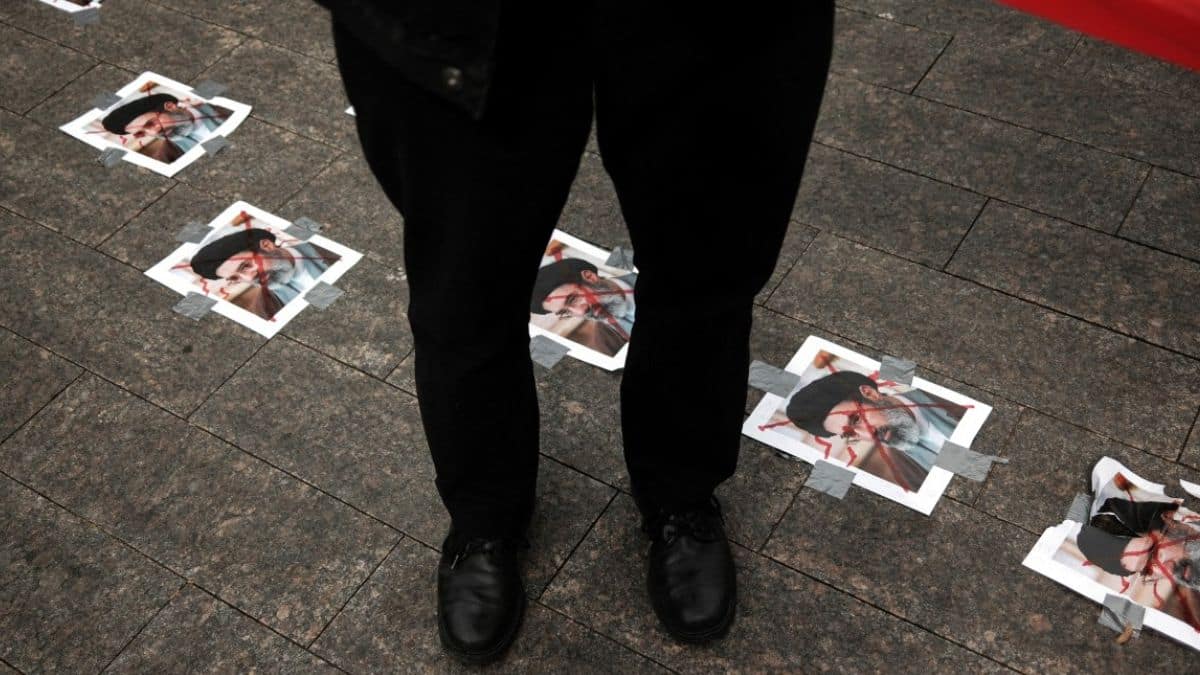
The survival of an authoritarian regime during a period of regional kinetic conflict depends on its ability to synchronize internal kinetic suppression with external digital and physical coercion. As geopolitical tensions escalate, the Iranian state has transitioned from a localized model of domestic policing to a distributed model of transnational repression. This shift transforms the act of dissent from a localized risk into a global cost-benefit calculation for the individual. Understanding this transition requires deconstructing the Iranian security apparatus not as a monolithic ideological entity, but as a sophisticated logistics and intelligence network designed to maximize the friction of opposition while minimizing the state's visibility in foreign jurisdictions.
The Architecture of Distributed Coercion
The traditional understanding of political crackdown focuses on the "Point of Friction"—the physical encounter between a protester and a security officer. Modern Iranian strategy has evolved to prioritize "Persistent Psychological Friction," which operates independently of geographical borders. This architecture relies on three distinct operational layers.
1. The Domestic Filter and Data Harvesting
The initial phase of suppression begins with the systematic extraction of social graphs from detained individuals. During the "Woman, Life, Freedom" movement and subsequent crackdowns, the Islamic Revolutionary Guard Corps (IRGC) utilized forensic extraction tools to map non-linear connections between activists. This data serves as the foundation for "guilt by association" frameworks, where the state leverages the safety of family members remaining within Iran to dictate the behavior of those who have reached Europe or North America.
2. The Digital Panopticon and Signal Noise
The state employs a dual-track digital strategy. First, it utilizes targeted malware and phishing campaigns to compromise the communication channels of diaspora leaders. Second, it orchestrates large-scale "signal noise" via botnets to de-platform or shadow-ban dissident voices on Western social media. By triggering automated reporting mechanisms on platforms like Instagram and X, the regime effectively outsources its censorship to the algorithms of Silicon Valley.
3. Kinetic Transnational Repression
When digital friction fails, the state moves to physical intervention. This includes the recruitment of non-state actors or organized crime syndicates to conduct surveillance or intimidation on foreign soil. The objective is rarely the immediate elimination of the target; rather, it is the demonstration of reach. The "Long Arm" doctrine aims to prove that no distance provides absolute sanctuary, thereby inducing a state of permanent hyper-vigilance in the subject.
The Cost Function of Exile
For the activist in exile, the decision to maintain visibility is governed by a complex cost function. Unlike domestic protesters who face a binary outcome—arrest or escape—the exiled dissident faces a multifaceted risk profile that impacts their entire social and professional ecosystem.
- The Proximity Tax: The risk to an activist is inversely proportional to the distance of their immediate family from Iranian soil. The state uses family members as "hostage capital," forcing the activist to choose between their political voice and the physical safety of their parents or siblings.
- The Information Asymmetry: Exiled activists often operate with fragmented intelligence. They must distinguish between legitimate threats and state-sponsored disinformation designed to cause paranoia. This psychological load results in "activist burnout," a primary objective of the Iranian Ministry of Intelligence and Security (MOIS).
- The Integration Barrier: Many activists arrive in host countries with significant trauma and limited resources. The state exploits this vulnerability by circulating rumors that certain activists are actually regime "plants," effectively poisoning the well of the diaspora community and preventing the formation of a unified opposition front.
Structural Vulnerabilities in Western Response Frameworks
Western democracies currently lack a standardized protocol for addressing transnational repression, creating a "security vacuum" that the Iranian state exploits. Current responses are generally reactive, occurring only after a specific threat or assassination plot is uncovered by intelligence agencies.
A primary bottleneck is the legal definition of harassment versus state-sponsored coercion. Many tactics used by Iranian operatives—such as persistent filming of protesters in London or Washington D.C., or targeted online character assassination—fall into a legal gray area where local police forces are ill-equipped to intervene. This failure to categorize these actions as components of a foreign intelligence operation allows the Iranian state to maintain a low-cost, high-impact presence in the heart of Western capitals.
Furthermore, the "War Fatigue" in global media cycles often deprioritizes the human rights status of Iranians in favor of broader regional security narratives. When the focus shifts entirely to kinetic warfare or nuclear negotiations, the regime views this as a "permissive window" to accelerate its internal and external purges with minimal diplomatic blowback.
The Mechanized Process of Exile and Identity Erasure
The transition from activist to refugee is not merely a change in legal status; it is a mechanized process of identity erasure orchestrated by the state. By forcing the most articulate and organized elements of the opposition into exile, the regime achieves two goals:
- Intellectual Capital Flight: The domestic movement is stripped of its experienced organizers, forcing every new wave of protest to "start from zero" in terms of tactical learning.
- The "Foreign Agent" Narrative: Once an activist is abroad, the state's propaganda machine characterizes them as a tool of Western intelligence. This creates a rhetorical barrier that prevents the activist's message from resonating with the more conservative or nationalist segments of the Iranian population who may be dissatisfied with the government but are wary of foreign intervention.
Strategic Shift Toward Asymmetric Resilience
To counter the state’s distributed coercion model, the diaspora and its allies must move toward a strategy of asymmetric resilience. This involves decentralizing leadership to minimize the impact of individual arrests or intimidations and developing robust, encrypted communication infrastructures that do not rely on centralized Western platforms vulnerable to state-sponsored reporting.
The Iranian state has demonstrated that it views the diaspora not as a separate entity, but as an extended front in its domestic security theater. As long as Western policy treats transnational repression as a series of isolated criminal incidents rather than a coordinated intelligence strategy, the Iranian state will continue to drive the cost of dissent to unsustainable levels.
The final strategic play for international stakeholders is the formalization of a "Transnational Defense Protocol." This requires the creation of a specialized, multi-jurisdictional task force dedicated to mapping the financial and logistical networks of Iranian "proxies" in the West. By targeting the enablers—the shell companies, the local recruits, and the digital service providers—Western states can flip the cost function, making it prohibitively expensive for the Iranian regime to maintain its global surveillance and intimidation network. Until the state's reach is physically and digitally truncated, the "hell" described by activists will continue to expand beyond the borders of Iran.