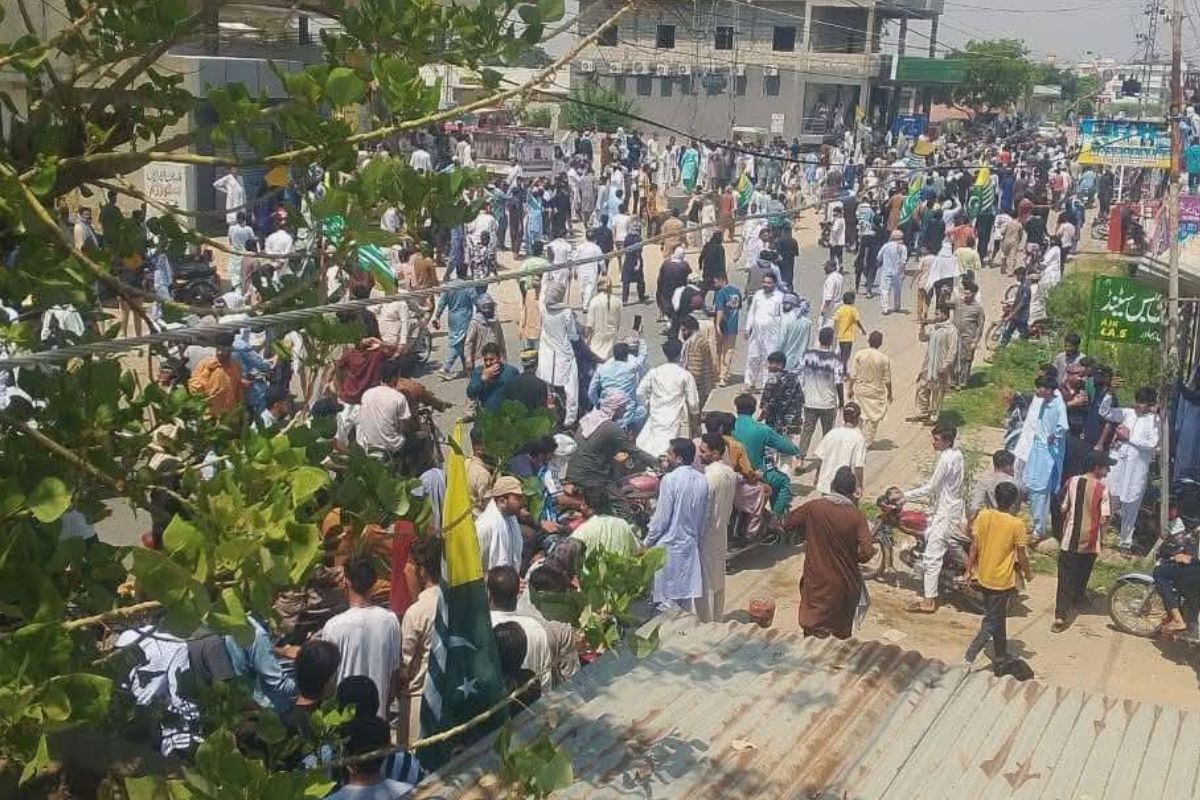
The escalation of fatal violence in Pakistan-administered Jammu and Kashmir (PaJK) signals a structural breakdown in the region’s governance framework, moving far beyond localized civic unrest. The immediate catalyst—clashes in Rawalakot and Muzaffarabad that resulted in at least 11 verified civilian deaths, alongside a blanket communications blackout—unveils a deeper systemic crisis. This crisis is defined by a fundamental misalignment between federal fiscal impositions and local political representation.
The standard narrative frames these events as spontaneous riots driven by inflation. In reality, the friction is a predictable consequence of an asymmetric constitutional arrangement. Local groups, organized under the Jammu Kashmir Joint Awami Action Committee (JKJAAC), are actively contesting both resource extraction models and the structural engineering of upcoming legislative elections.
The Economics of Resource Extraction and Subsidy Deprivation
The underlying structural instability of the region stems from an asymmetrical fiscal relationship between the federal government of Pakistan and the local administration. This dynamic is best understood through a sub-national extraction framework, where the region acts as a net exporter of low-cost primary resources but functions as a high-cost importer of finished public utilities.
+----------------------------------------+
|       Regional Resource Base (PaJK)    |
|  - Generates ~3,000 MW Hydroelectric  |
+----------------------------------------+
                    |
                    v (Low-Cost Export)
+----------------------------------------+
|       Federal Grid / Central State     |
|  - Absorbs cheap power production     |
+----------------------------------------+
                    |
                    v (High-Tariff Re-Import)
+----------------------------------------+
|       Local End-Consumers (PaJK)      |
|  - Charged ~5x cost of generation     |
+----------------------------------------+
The Hydroelectric Fiscal Imbalance
The territory generates approximately 3,000 megawatts of clean, low-cost hydroelectric power, contributing significantly to Pakistan’s national grid. However, local consumers face electricity tariffs calculated on national generation averages, which incorporate expensive fossil-fuel thermal plants. This means local populations effectively pay up to five times the actual cost of regional production.
This creates a structural bottleneck: the local economy bears the ecological and geographic costs of infrastructure development but is decoupled from the financial dividends.
The Breakdown of the Subsidy Model
Following major long marches in May 2024 and subsequent shutdowns in October 2025, the federal government attempted to stabilize the region via an 82-million-dollar (23 billion PKR) ad-hoc fiscal grant intended to subsidize wheat flour and electricity. This intervention failed because it treated a structural defect as a temporary liquidity crisis.
When structural inflation outpaced the fixed grant, the subsidy mechanism collapsed. This triggered the current 38-point charter of demands by the JKJAAC, which seeks permanent constitutional guarantees for subsidized goods rather than discretionary federal outlays.
Electoral Engineering and the Representation Deficit
While economic grievances provided the momentum, the immediate flashpoint for the June 2026 escalation is an institutional dispute over the legislative composition ahead of the July 27 regional elections.
The administration’s decision to maintain 12 reserved seats in the 45-member legislative assembly for refugees residing outside the geographic boundaries of the territory alters the local balance of power. The JKJAAC and local civic bodies demand the complete abolition of this arrangement due to two main structural distortions:
- Executive Overreach and Safe Seats: These 12 seats, elected by diaspora populations living across mainstream Pakistani provinces, consistently act as a structural swing block. Whichever political party controls the federal apparatus in Islamabad routinely wins these external seats, allowing the central government to engineer the local regional cabinet regardless of the domestic vote within the territory.
- Dilution of Local Franchise: Retaining these seats dilutes the voting power of resident citizens. It detaches the legislative majority from local accountability, meaning the ruling coalition in the regional capital answers to external federal patrons rather than local taxpayers.
The Coercion Function: State Responses and Information Asymmetry
The state’s strategy to contain the crisis relies on a standard internal security framework designed to achieve compliance through two main vectors: increasing the physical costs of assembly and enforcing absolute information asymmetry.
+-----------------------------------------------------------------+
|                    STATE COERCION FUNCTION                      |
+-----------------------------------------------------------------+
|   1. Kinetic Interventions         2. Information Asymmetry    |
|   - Banning of JKJAAC             - Regional "Sealing"        |
|   - Live ammunition deployment    - 7-Day Communications Ban  |
+-----------------------------------------------------------------+
                                |
                                v
+-----------------------------------------------------------------+
|                       STRUCTURAL OUTCOMES                       |
|   - Complete suppression of domestic monitoring                 |
|   - Proliferation of unverified reports and diaspora backlash    |
+-----------------------------------------------------------------+
Kinetic Interventions
The designation of the JKJAAC as an outlawed or "terrorist" organization under public order laws marks a major shift from political negotiation to counter-insurgency tactics. Deploying paramilitary forces equipped with automatic rifles to disperse a crowd of over 10,000 demonstrators in Rawalakot indicates an institutional choice to accept higher casualty rates over protracted political deadlocks.
Enforced Information Asymmetry
The formal suspension of mobile and internet networks from June 5 to June 12 functions as a systematic mechanism to prevent coordinated mobilization. However, this strategy introduces a significant operational vulnerability.
Sealing the region and cutting off communications eliminates independent reporting, creating an information vacuum. Instead of dampening unrest, this structural blackout creates an environment where unverified data proliferates, driving international backlash and fueling mobilization among the global diaspora.
Geopolitical Friction and International Scrutiny
The internal governance failures of the territory have quickly escalated into broader geopolitical friction, creating distinct diplomatic issues for both neighboring states and international legislative bodies.
The Indian Diplomatic Counter-Offensive
The Ministry of External Affairs (MEA) in New Delhi has leveraged the crisis to advance its strategic narrative regarding territorial integrity and human rights accountability. By characterizing the state response as structural brutality and a "desperate attempt to cover up its own failings," India uses these governance failures to challenge the legitimacy of the administrative framework.
This strategy shifts the bilateral discourse from a territorial dispute to a human rights issue, seeking to build international consensus around the systemic instability of the territory's current administration.
International Legislative Mobilization
The crisis has also triggered unexpected diplomatic pressure from Western legislative bodies, driven primarily by diaspora demographics. The mobilization of approximately 50 British Members of Parliament—led by the All-Party Parliamentary Group on Kashmir—highlights how domestic constituent demographics directly influence foreign policy.
The formal appeal to the UK Foreign Office emphasizes specific violations of civil liberties:
- The arbitrary detention of dual British-Pakistani nationals present in the territory during the sweeps.
- The humanitarian risks associated with cutting off communication lines, which prevents families from confirming the safety of relatives.
- The violation of basic international standards regarding the right to peaceful assembly and proportional use of state force.
Structural Limitations of Current De-escalation Frameworks
The primary limitation of current stabilization efforts is the reliance on short-term financial adjustments and kinetic containment to manage deeply entrenched structural issues. A sustainable resolution remains out of reach due to three main structural bottlenecks.
First, the federal government faces severe macroeconomic constraints under international structural adjustment programs, which strictly limit its capacity to offer permanent, long-term subsidies on energy and food staples. Second, the regional ruling elite depends on the 12 reserved external seats to maintain its political survival, making any domestic legislative reform highly unlikely. Third, using counter-terrorism frameworks against grassroots economic movements eliminates the middle ground necessary for credible political mediation.
Consequently, the scheduled July 27 elections will lack institutional legitimacy if conducted under the current communication blackouts and political bans. The current strategy of suppressing dissent through force manages to clear the streets in the short term, but it deepens the underlying political alienation, ensuring that future economic shocks will trigger even more intense cycles of regional unrest.