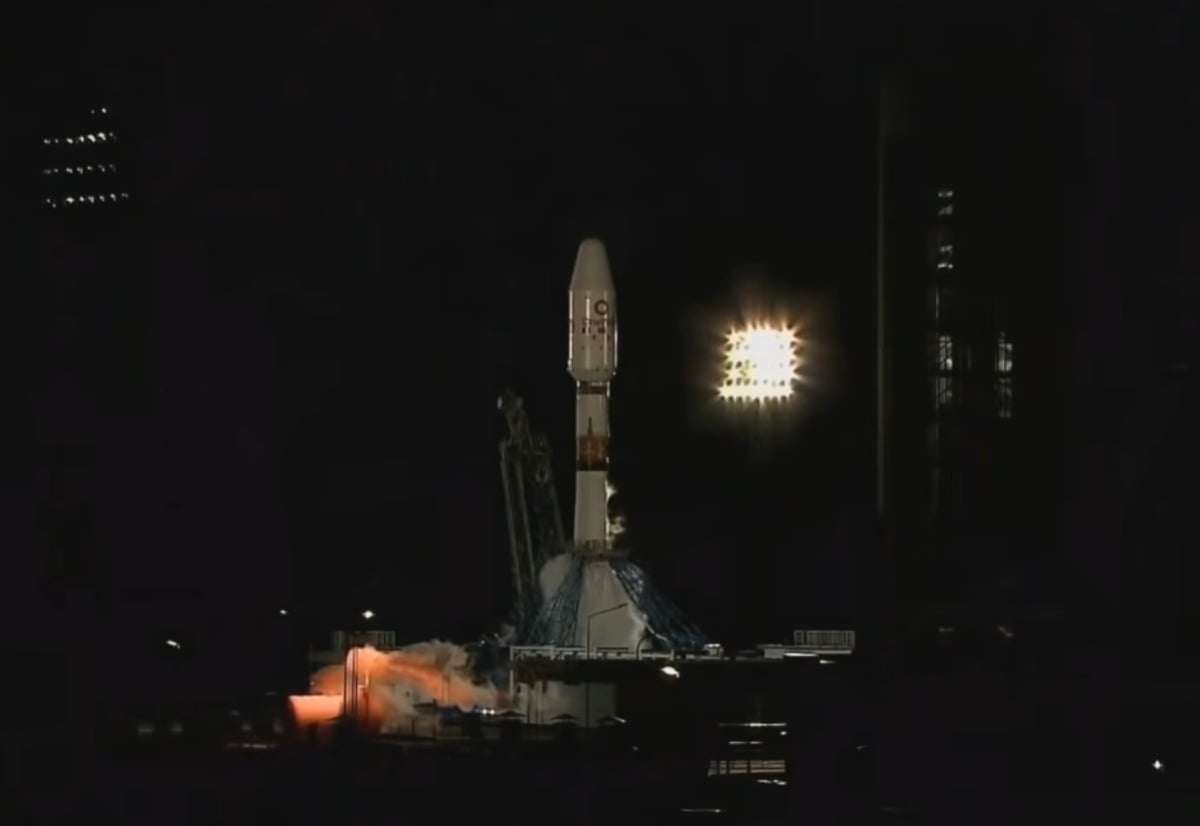
The recent deorbit and total loss of Russia’s Rassvet-2 satellite—part of the Bureau 1440 initiative marketed as the nation’s domestic counterpart to SpaceX’s Starlink—exposes a critical structural vulnerability in the Russian Federation's aerospace supply chain and orbital manufacturing capabilities. This is not merely an isolated engineering failure. It is a manifestation of systemic constraints across three distinct vectors: component starvation due to international sanctions, the architectural vulnerability of low Earth orbit (LEO) constellations, and the acute lack of automated mass-production infrastructure for space hardware.
Western analyses frequently dismiss these failures as a lack of technical expertise. This is a misdiagnosis. The Russian aerospace sector possesses deeply rooted fundamental competencies in rocketry and orbital mechanics. The actual bottleneck is economic and logistical: Russia is attempting to transition from a legacy paradigm of low-volume, bespoke, high-cost military-grade satellite production to a high-volume, commoditized, low-cost mega-constellation manufacturing model while completely severed from global semiconductor supply chains.
The loss of the Rassvet-2 demonstrates that without access to precise industrial-grade components, the structural reliability of a LEO constellation approaches zero.
The Three Imperatives of LEO Megaconstellations
To understand why the Bureau 1440 initiative is faltering, one must evaluate it against the strict mathematical realities of LEO communication architectures. Unlike geostationary (GEO) satellites that sit 35,786 kilometers above the Earth and provide broad, static coverage, LEO satellites orbit between 300 and 1,200 kilometers. This proximity drastically reduces latency and signal attenuation, but it requires hundreds or thousands of individual nodes to maintain continuous global coverage.
A viable LEO constellation requires three interlocking operational capabilities.
1. The Mass-Production Cost Function
A GEO satellite is designed to last 15 to 20 years, justifying a price tag of hundreds of millions of dollars. A LEO satellite is an inherently sacrificial asset with an operational lifespan of 3 to 5 years due to atmospheric drag and atomic oxygen degradation. Consequently, the viability of a constellation relies entirely on driving the unit cost down to a fraction of traditional aerospace expenditures. SpaceX achieved this by vertical integration and building an assembly-line factory model. Russia’s aerospace sector, historically reliant on the state-owned Roscosmos enterprise, remains optimized for handcrafted, slow-cycle production. Bureau 1440 cannot achieve the required economies of scale under its current industrial footprint.
2. High-Yield Launch Cadence
Deploying a LEO network demands an unprecedented volume of successful launches. Replacing degraded assets or building out initial operational capability requires heavy-lift vehicles capable of deploying dozens of satellites per insertion. While Russia possesses the reliable Soyuz and the newer Angara rocket families, its launch cadence is severely restricted. The lack of reusable first-stage boosters introduces a linear cost scaling that makes constellation maintenance economically unsustainable over a multi-year horizon.
3. High-Speed Inter-Satellite Links (ISL)
A modern LEO constellation does not merely relay signals from the ground to a user; it routes data through space via coherent optical laser links. Without robust ISL, a constellation requires a dense, global network of ground stations. Because Russia lacks the geopolitical access required to place ground stations evenly across the globe—particularly in the Southern Hemisphere and ocean basins—their satellites must carry sophisticated, radiation-hardened routing hardware and laser transceivers to pass data horizontally across the orbital shell.
Component Starvation and the Asymmetric Failure Mode
The primary technical vulnerability of the Rassvet-2 satellite lies in its internal electronic components. The Russian aerospace industry relies heavily on Foreign Component Base (Inostrannaya Komponentnaya Baza - IKB). Following the escalation of economic sanctions, access to aerospace-grade and industrial-grade microelectronics from Western manufacturers was officially cut off.
To bypass these restrictions, Russian state and private aerospace entities migrated to alternative procurement pipelines, primarily sourcing commercial-off-the-shelf (COTS) components from Asian markets or utilizing gray-market diversion networks. This pivot introduced a lethal vulnerability: the loss of rigorous quality assurance and component traceability.
The COTS Radiation Dilemma in LEO
While LEO orbits sit partially within the protection of the Earth's magnetosphere, they are subject to severe radiation environments, particularly within the South Atlantic Anomaly (SAA). True aerospace-grade components undergo specialized manufacturing processes, such as silicon-on-insulator (SOI) substrates, to achieve radiation hardening (Rad-Hard).
When an aerospace firm substitutes these with unvetted COTS components, the system becomes highly susceptible to two specific categories of radiation-induced failures:
- Single-Event Effects (SEEs): High-energy cosmic rays or solar protons strike a semiconductor, depositing a charge that causes a transient voltage spike. If this occurs in a critical logic gate or memory register (a Single-Event Upset), it can corrupt the flight software. If it triggers a Single-Event Latchup (SEL), it creates a high-current short circuit that permanently destroys the integrated circuit.
- Total Ionizing Dose (TID): The cumulative radiation exposure over time gradually degrades the oxide layers within the satellite's microcontrollers. This shifts threshold voltages, increases leakage currents, and ultimately causes catastrophic component failure well before the nominal end-of-life target.
The telemetry profile of the Rassvet-2 prior to its uncontrolled deorbit indicates a sudden, non-recoverable loss of the primary flight computer or attitude determination and control system (ADCS). This signature is highly indicative of an unmitigated SEL that knocked out the power distribution node, rendering the satellite unresponsive to ground commands and incapable of firing its onboard electric propulsion system to maintain orbit.
Architectural Vulnerabilities: Starlink vs. Bureau 1440
Evaluating Russia's orbital strategy requires a direct comparative analysis against the benchmark established by SpaceX. The differences are not merely quantitative; they are fundamentally architectural.
| Vector | SpaceX Starlink (V2 Mini / V3) | Bureau 1440 (Rassvet Series) |
|---|---|---|
| Component Sourcing | Domestic vertical integration; custom-designed proprietary ASICs. | Heavy reliance on gray-market COTS; vulnerable to supply chain interdiction. |
| Launch Vehicle Integration | Native optimization with Falcon 9 / Starship; rapid reusability. | Secondary payloads on expendable Soyuz-2.1b or Angara-A5; high per-kilogram insertion cost. |
| Propulsion System | Custom krypton or argon-fed Hall-effect thrusters. | Standard xenon-fed stationary plasma thrusters (SPT); restricted by global xenon supply and cost. |
| Production Scale | Automated manufacturing producing dozens of units per week. | Batch-prototyping; manual assembly lines with low throughput. |
The structural bottleneck for Russia is the launch vehicle economic equation. SpaceX uses its own internally billed, highly reusable launch fleet to deploy payloads. Bureau 1440 must compete for space on state-allocated launches or pay premium rates for expendable vehicles. This means every single satellite failure represents a catastrophic loss of capital that cannot be easily amortized across a high-volume launch schedule.
The Geopolitical Ground Segment Bottleneck
A satellite constellation is only as effective as its integration with terrestrial infrastructure. Even if Bureau 1440 resolves its component-level reliability issues, the system faces an insurmountable geographical constraint.
Because the Russian Federation cannot establish ground stations in Western allied nations, neutral territories, or critical oceanic zones, its satellites experience massive "blind spots." When a Rassvet satellite passes outside the line of sight of Russian terrestrial teleport facilities, it must store data locally or rely on inter-satellite routing.
If the onboard routing processors lack the computational density required to calculate dynamic routing paths across a shifting orbital mesh—a capability that requires high-performance, power-efficient chips currently restricted by export controls—the entire network reverts to a fragmented, store-and-forward architecture. This completely invalidates the low-latency, real-time value proposition required to compete with Western systems or to provide viable tactical communications for modern theater operations.
Strategic Forecast and Hard Realities
The loss of the Rassvet-2 establishes a clear trajectory for Russia’s domestic orbital ambitions. The Bureau 1440 initiative will not achieve its stated goal of a fully operational, globally competitive LEO communication network by 2030. The capital requirements, combined with the ongoing component blockade, make the current timeline untenable.
Instead, the program will likely bifurcate into a heavily subsidized, low-density military communications network. Rather than attempting a global broadband constellation consisting of thousands of nodes, Russian planners will narrow their focus to a highly regionalized, highly resilient Molniya-style or low-node LEO architecture designed strictly for secure state and military data relay within the Eurasian landmass.
To achieve even this scaled-down objective, the Russian aerospace sector must execute a radical structural pivot. It must abandon attempts to replicate Western commercial mega-constellations using black-market components. Operators must design custom, highly redundant, heavier satellite architectures that utilize older, larger, but natively produced radiation-tolerant silicon chips. This design philosophy will result in heavier payloads and fewer satellites per launch, but it represents the only viable path to orbital survivability given the current geopolitical and macroeconomic realities.