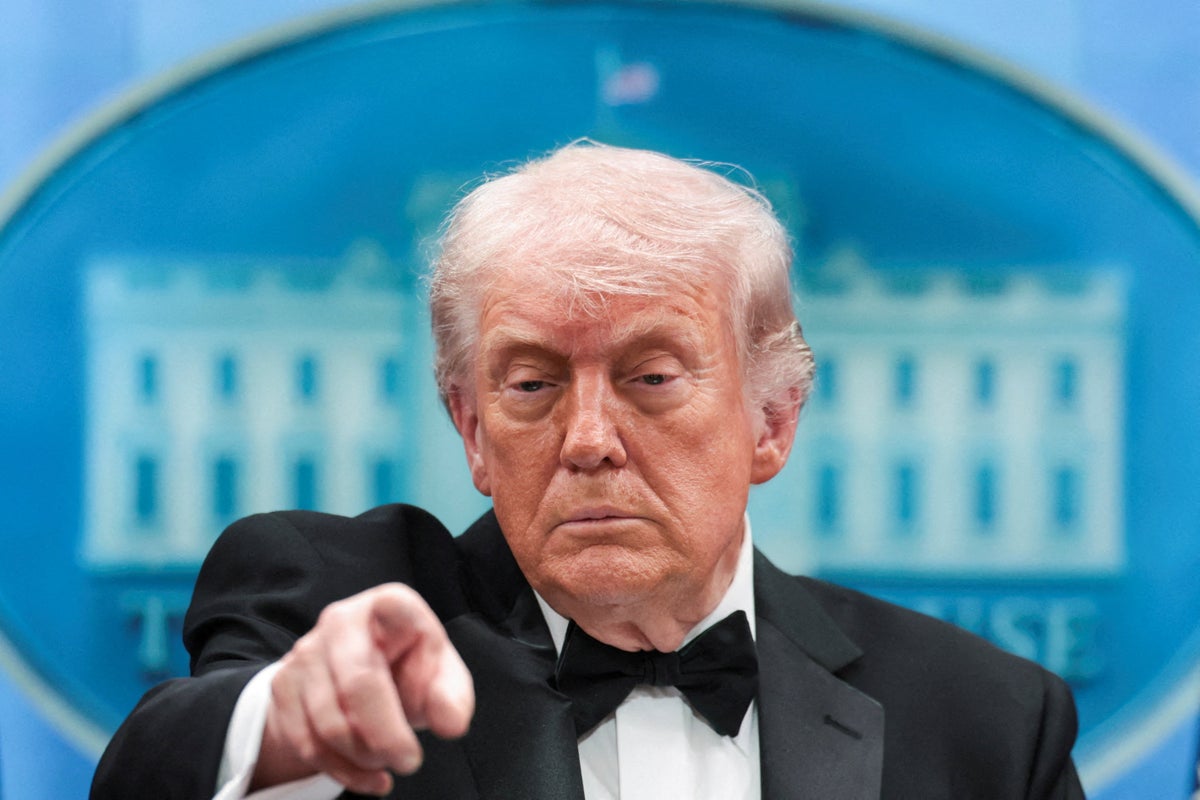
The immediate aftermath of a high-profile assassination attempt or political shooting functions as a temporary market disruption in the political economy, forcing a sudden, non-negotiable pivot from partisan friction to institutional stability. The call for unity issued by Donald Trump following the correspondents’ dinner shooting is not a moral shift but a predictable strategic recalquisition. In the immediate wake of kinetic violence directed at the state or its high-level actors, the cost of continued aggression spikes for all parties, creating a brief window where "unity" becomes the highest-value currency for both the victim and the opposition. However, the durability of this cohesion is governed by three specific structural variables: the half-life of public shock, the primary-cycle incentives of the legislative body, and the fundamental absence of a shared threat perception beyond the immediate shooter.
The Tripartite Architecture of Political Shock Responses
Political unity following a catastrophe is often mistaken for a change in sentiment. It is more accurately described as a tactical retreat into "safety signaling." This behavior is driven by three distinct pillars that dictate how long the rhetoric of cooperation persists before reverting to a state of hyper-partisan competition.
1. The Institutional Preservation Reflex
When an attack occurs at a venue like a correspondents’ dinner—an event defined by the intersection of the executive branch, the press, and the lobbying class—the attack is perceived as an existential threat to the "political class" itself. The resulting call for unity serves as a fortification of the system. For the victim, Trump, it provides a unique opportunity to seize the moral high ground and neutralize the "incitement" critiques often leveled against him. For his opponents, a failure to echo the call for unity carries a heavy penalty in moderate voting blocs, making compliance the path of least resistance.
2. The Information Vacuum and Narrative Dominance
In the first 48 to 72 hours of a crisis, the absence of verified motive regarding the perpetrator creates an ideological vacuum. During this period, the "unity" narrative serves as a placeholder. Until the shooter’s biography is fully mapped and politicized, neither side can effectively weaponize the event without risking a public relations backlash. The duration of unity is therefore inversely proportional to the speed at which the investigation produces "usable" partisan data points.
3. The Rally Around the Flag Effect
Sociologically, external threats trigger an automated increase in approval for the targeted leader, known as the Rally Around the Flag effect. This is a quantifiable bump in polling that typically persists for 30 to 60 days. The call for unity is a mechanism to extend this bump by projecting a "presidential" or "statesmanlike" image that contrasts with the previous campaign-trail persona.
The Decay Function of Bipartisan Cooperation
To understand why this unity rarely lasts, we must analyze the "Cost-Benefit Decay Function" of political rhetoric. Political actors operate within a zero-sum environment where the goal is the capture of marginal voters and the mobilization of the base.
The initial call for unity lowers the "Conflict Temperature," but it does not resolve the "Structural Divergence" between the two parties.
- The Incentive Gap: In a primary-driven electoral system, any politician who maintains a posture of unity for too long risks being "primaried" from the flank. The base of each party views extended cooperation as capitulation.
- Media Revenue Models: The modern media ecosystem is optimized for high-arousal content. "Unity" is a low-arousal state. As viewership or engagement numbers drop following the initial crisis reporting, media outlets face an economic imperative to return to conflict-based narratives.
- The Policy Deadlock: Unity in rhetoric does not translate to unity in policy. While both sides can agree that shooting people is wrong, they remain fundamentally misaligned on the causes (e.g., mental health vs. firearm access) and the solutions.
Measuring the Half-Life of a Unity Mandate
Predicting the expiration of the "unity" phase requires looking at the technical triggers that force a return to the status quo. These triggers act as catalysts that dissolve the veneer of cooperation.
The Identification of the Perpetrator
Once the perpetrator's ideology is identified, the event is immediately re-contextualized. If the shooter had radical left-wing ties, the right will use the event to demand crackdowns on "anti-state" rhetoric. If the shooter had right-wing or accelerationist ties, the left will frame the event as a byproduct of the very rhetoric Trump has used in the past. The moment a label is attached to the shooter, the "Unity Window" closes.
Legislative Friction Points
The return to business-as-usual is often signaled by the first major vote following the event. For instance, if a bill regarding federal funding or judicial appointments reaches the floor, the need to satisfy donors and the party platform overrides the temporary mandate of harmony. In the current US climate, the legislative calendar is the ultimate arbiter of political behavior.
The Return of the Campaign Trail
Unity is a static state; campaigning is a kinetic state. Trump’s political identity is built on high-velocity conflict and the identification of "enemies." Maintaining a stance of unity is a high-energy expenditure task for a candidate whose primary asset is disruptive energy. Eventually, the need to define the opponent as an existential threat becomes necessary to drive turnout, rendering the unity call obsolete.
The Strategic Miscalculation of "Unity" as a Solution
Many analysts view unity as a tool for healing the national psyche. From a data-driven perspective, this is a misidentification of the variable. Unity is not a solution; it is a cooling period that allows the state to process the trauma without immediate collapse.
The limitation of the "Unity Strategy" is that it addresses the symptom (the shooting) rather than the underlying volatility (the polarization). Because the structural drivers of the current American political divide remain unaddressed—specifically, geographical sorting, the echo-chamber effect of algorithmic social media, and the decline of local news—any unity born of a tragedy is fragile by design.
A call for unity that does not include a tangible policy concession is merely a performance of de-escalation. Without a shared legislative goal or a bipartisan commission with actual enforcement power, the rhetoric acts as a "buffer" rather than a "bridge."
The Risk Assessment of Continued Rhetorical Shifts
For the Trump campaign, the "Unity Pivot" carries specific risks and rewards that can be quantified based on historical precedent.
- Reward: Expansion of the Median Voter Base. By appearing restrained and conciliatory, Trump appeals to the 5–7% of undecided voters who are repelled by political chaos.
- Risk: De-mobilization of the Core Base. The "MAGA" movement is fueled by the perception of an insurgent battle against a corrupt establishment. Prolonged unity signals a peace treaty with that establishment, which can lead to a drop in volunteer enthusiasm and small-dollar donations.
- Risk: Ceding the Narrative. In the absence of aggressive counter-attacks, the opposition has more room to frame the narrative of the event through their own lenses (e.g., safety failures or the need for new laws).
The Inevitable Pivot to Conflict
The shift back to partisan hostility will not be a sudden break, but a series of tactical escalations. The first phase is the "Proximal Shift," where surrogates begin to blame the opposition while the principal (Trump) remains above the fray. The second phase is the "Conditional Unity" phase, where the leader demands specific concessions (e.g., "I want unity, but only if they stop the witch hunts") as a prerequisite for peace. Finally, the "Return to Baseline" occurs when the principal resumes direct attacks, citing the "unwillingness of the other side to be fair."
The shooting at the correspondents’ dinner was a systemic shock that temporarily paused the standard operations of political friction. While the call for unity is functionally necessary for immediate stabilization, it operates against the massive gravitational pull of the current electoral and media incentives. The shelf life of this unity is likely no longer than 14 to 21 days, after which the economic and political costs of cooperation will outweigh the benefits of the "statesman" persona.
The strategic play for any entity observing this cycle is to front-load all high-value bipartisan negotiations into this narrow window. Once the shooter’s motive is categorized and the 24-hour news cycle pivots to the next fiscal or social controversy, the opportunity for systemic change evaporates. Expect a return to the baseline level of polarization by the next major primary or televised debate, as the structural incentives for conflict remain the dominant force in the American political system.