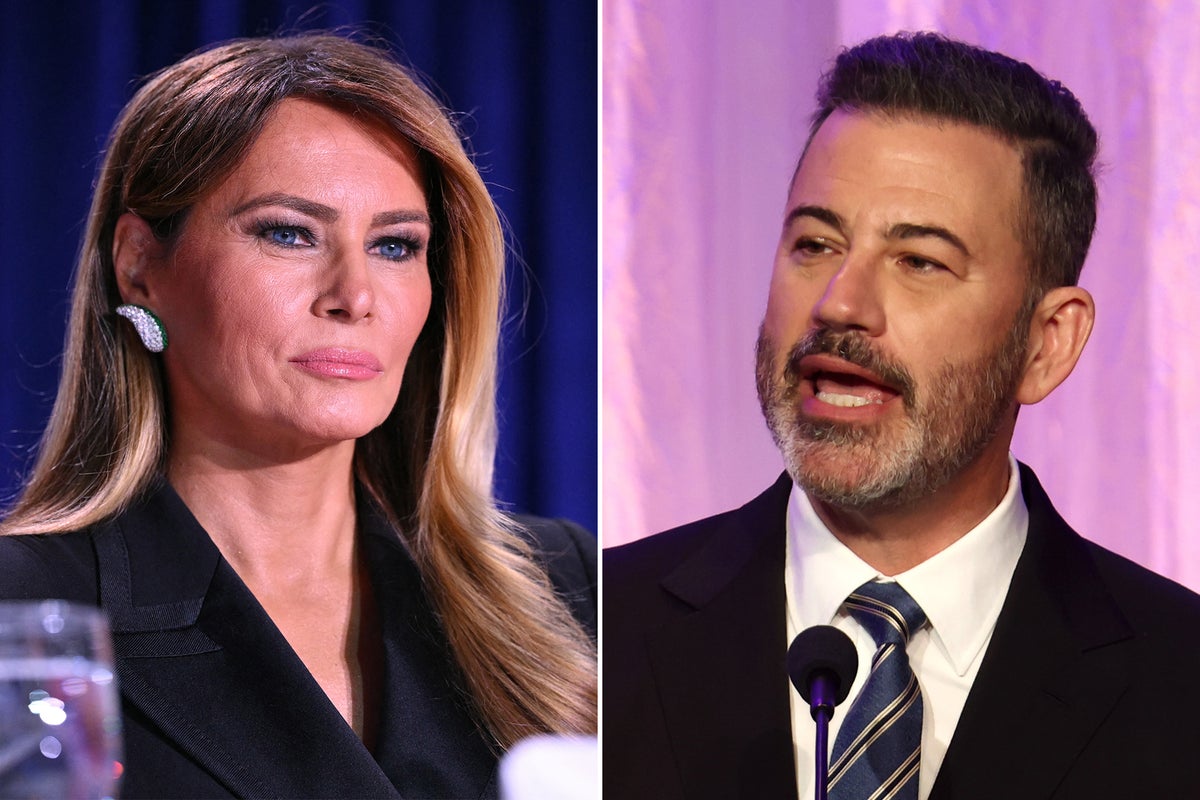
The assassination attempt on Donald Trump has triggered a predictable but analytically significant escalation in the feedback loop between political violence and media-driven accountability. This dynamic is not merely a clash of opinions but a structural phenomenon where rhetorical inputs directly influence social volatility. By dissecting the exchange between Jimmy Kimmel and Melania Trump, one can observe a microcosm of the modern discourse crisis: the shift from debating policy to debating the moral culpability of language itself.
The Causal Chain of Rhetorical Responsibility
To understand the current tension, we must define the Attribution Framework. This is the logic used by public figures to link speech to physical action. Kimmel’s critique rests on the premise that a political environment is a "closed system" where the density of aggressive metaphors increases the probability of extremist outliers acting on those metaphors.
This framework operates on three primary vectors:
- Normalization of Dehumanization: When opponents are categorized as existential threats rather than political rivals, the social cost of violence decreases.
- Validation through Silence: The argument suggests that a failure to condemn specific aggressive tropes serves as a tacit endorsement for radicalized individuals.
- The Incitement Gradient: This measures the distance between a public figure’s call to "fight" and a follower’s decision to utilize kinetic force.
Kimmel’s rebuttal to Melania Trump’s plea for unity highlights a perceived hypocrisy in this chain. His logic dictates that a call for civility is functionally void if the individual issuing it (or their closest political allies) has historically utilized the very rhetoric they now condemn. This creates a Rhetorical Debt, where past statements act as a high-interest liability that undermines current attempts at mediation.
Analyzing the Melania-Kimmel Dialectic
The interaction between the former First Lady and the late-night host can be mapped as a failure of Consensus Signaling. Melania Trump’s statement attempted to establish a "Humanity First" baseline—a strategy designed to de-escalate by appealing to shared biological and familial values. However, from a strategic communication standpoint, this maneuver failed to account for the Contextual Anchor.
Kimmel’s response functioned as an anchor-check. He moved the conversation from the immediate trauma of the shooting back to a ten-year timeline of political discourse. This serves a specific analytical function: it prevents the "resetting" of the narrative. By attributing the "hateful and violent rhetoric" back to the victim of the shooting, Kimmel utilizes a Feedback Attribution Model. In this model, the originator of a specific communication style is held responsible for the eventual systemic output of that style, even when that output targets them directly.
This creates a logic gate for the public:
- Path A: The shooting is an isolated failure of security and a symptom of mental health crises, requiring universal sympathy.
- Path B: The shooting is the inevitable byproduct of a toxic ecosystem cultivated by the political actors themselves, requiring a reckoning with their own language.
The Economic Cost of Polarized Media Output
Late-night comedy has transitioned from a general-interest entertainment product to a specialized Ideological Verification Service. Shows like Jimmy Kimmel Live! do not seek to maximize reach across all demographics; they optimize for high retention within a specific ideological segment. This pivot is driven by the following market forces:
- Fragmented Audience Retention: In a high-choice environment, neutrality is a liability. Precision-targeted outrage drives higher engagement metrics than broad-spectrum humor.
- Social Currency Generation: Clips of Kimmel "hitting back" function as digital assets for viewers to share, confirming their own internal biases and strengthening social cohesion within their in-group.
- The Outrage Arbitrage: Media entities capitalize on the spread between an event (the shooting) and the reaction to that event. The more polarized the reaction, the higher the volume of interactions.
This shift has effectively dismantled the "Common Square" function of late-night television. Where hosts once acted as cultural unifiers, they now function as Border Guards of Discourse, defining the limits of acceptable sympathy and the grounds for moral disqualification.
Structural Failures in the Unity Narrative
The plea for "unity" in the wake of political violence is often a structural impossibility due to the Incentive Gap. For political actors and media personalities, there is no immediate benefit to lowering the rhetorical temperature.
- Fundraising Velocity: Conflict-driven emails and segments generate significantly higher revenue than calls for moderate dialogue.
- Primary Protection: In a polarized primary system, appearing "soft" on the opposition—even after a tragedy—creates a vulnerability to more aggressive challengers.
- Algorithmic Preference: Social media distribution systems prioritize content that elicits high-arousal emotions (anger, fear) over low-arousal ones (sadness, reflection).
Because these incentives remain unchanged, the rhetorical cycle continues to accelerate. Kimmel’s critique of the Trump campaign’s rhetoric is technically an observation of a Self-Reinforcing Loop. When one side increases the intensity of their language, the other side perceives a necessity to match that intensity to maintain visibility. Over time, this leads to Rhetorical Inflation, where words that once carried significant weight lose their impact, requiring even more extreme language to penetrate the public consciousness.
The Security-Rhetoric Intersection
A critical oversight in the standard media analysis of the Trump shooting is the failure to link Information Environment Hazards with Physical Security Vulnerabilities. High-intensity rhetoric does more than just hurt feelings; it creates a "Noise Floor" that makes it difficult for security agencies to identify genuine threats.
When thousands of individuals are using violent metaphors online, the signal-to-noise ratio for intelligence gathering collapses. This creates a Systemic Blindness. Security failures are often viewed as purely tactical—a missed rooftop, a slow response time—but the environmental factor of mass-scale rhetorical aggression plays a role in the saturation of threat data. Kimmel’s assertion that the rhetoric is to blame touches on this, though he approaches it from a moral standpoint rather than a data-management one.
Cognitive Dissonance in Public Mourning
The conflict between Melania Trump’s statement and Kimmel’s rebuttal illustrates a profound Cognitive Dissonance in the American electorate. The brain struggles to hold two competing truths simultaneously: that political violence is categorically wrong, and that the victim may have contributed to the environment that spawned the violence.
To resolve this dissonance, individuals typically default to Selective Empathy. They filter the event through their pre-existing loyalty frameworks.
- Supporters of the former president view Kimmel’s comments as an "attack on the victim," which reinforces their sense of being besieged by a hostile media.
- Critics of the former president view Melania’s statement as "gaslighting," which reinforces their belief that the movement is fundamentally insincere.
This divergence ensures that the event, rather than being a catalyst for cooling the temperature, becomes a high-octane fuel for further polarization. The "unity" phase of the post-assassination attempt lasted less than 48 hours before the standard Conflict Protocols resumed.
Operational Strategy for Political Communication
For any political entity or public figure navigating this environment, the following strategic constraints must be acknowledged:
- The Permanence of the Archive: No statement exists in a vacuum. Every call for peace will be cross-referenced against the speaker’s most aggressive past statements. Credibility is now calculated as a rolling average of a person’s entire digital history.
- The Asymmetry of Outrage: It takes significantly more energy to de-escalate a narrative than it does to inflame it. A 30-second clip of a host "hitting back" can undo weeks of diplomatic messaging.
- The Credibility Gap: Melania Trump’s appeal fell into a credibility gap not because of its content, but because of its source. In a low-trust environment, the messenger is the message.
The logical conclusion of this trajectory is a state of Permanent Mobilization, where the discourse never returns to a "baseline" level of civility. Instead, the "crisis mode" becomes the standard operating procedure. Kimmel’s willingness to directly challenge the former First Lady during a period of national shock signals that the traditional "grace period" after a tragedy has been eliminated by the speed of the digital news cycle.
The strategic play for stakeholders in the political and media sectors is to move beyond the binary of "unity vs. blame." Real stabilization requires an Audit of Language Metrics. Entities must evaluate their rhetorical output based on its potential to incite "unmanaged volatility"—actions that fall outside the control of the political party or media organization. Until the cost of unmanaged volatility outweighs the revenue generated by high-arousal rhetoric, the feedback loop between speech and violence will remain unbroken.
Political actors must recognize that while aggressive rhetoric may win a primary or drive a ratings spike, it simultaneously degrades the structural stability of the system they are attempting to lead. The immediate objective is to decouple "strength" from "aggression" in public branding. This is not a moral imperative but a survival one; a system that cannot distinguish between debate and existential combat eventually loses the ability to govern itself.
The move by Kimmel to place the blame on the rhetoric of the victim is a tactical execution of Narrative Reclamation. It is an attempt to ensure that the shooting does not grant the opposition a "moral monopoly" on the conversation. This competition for moral high ground, conducted in the immediate aftermath of a violent act, is the clearest indicator of a fractured sociopolitical architecture.
Observers should monitor the subsequent polling data not for "support levels," but for "intensification markers." The goal is to see if the event has pushed moderate voters into the high-intensity camps. If the data shows a hollowing out of the middle, the rhetoric-violence loop has achieved another successful revolution. The strategy for the upcoming election cycle must now account for a "Volatile Baseline," where physical security and digital communication are treated as a single, integrated risk profile.