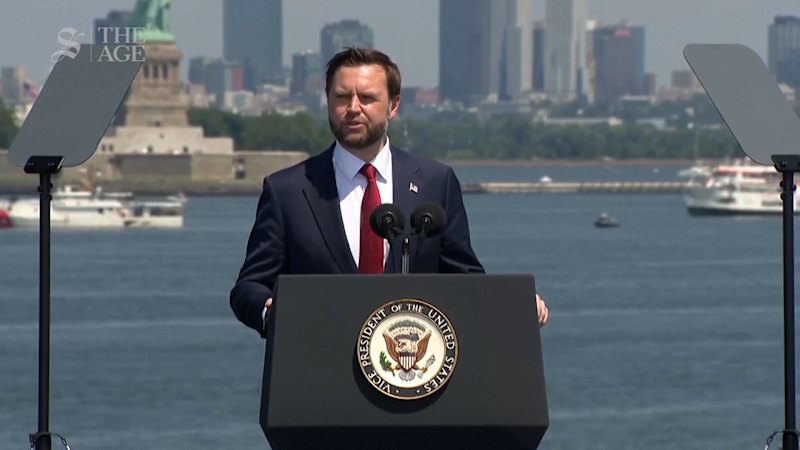
National anniversaries serve as primary mechanisms for states to recalibrate their internal cohesion and project structural permanence. The address delivered by Vice President JD Vance from the deck of the USS Kearsarge during the United States Semiquincentennial in New York Harbor provides a distinct case study in the structural deployment of historical narrative. Rather than treating the milestone as a static commemorative event, the presentation structured a counter-narrative against institutional critics, utilizing maritime symbolism to reinforce domestic political alignment.
An objective decomposition of the event reveals that public ceremonies of this scale are governed by three distinct structural variables: geopolitical posture, domestic narrative optimization, and the material realities of infrastructure. When these variables intersect during a period of deep domestic polarization, the resulting communication operates less as a unifying civic exercise and more as a competitive framework designed to capture rhetorical dominance.
The Tri-Partite Structure of Civic Mobilization
State rhetoric during historic milestones operates within a measurable framework designed to maximize political capital. The address in New York Harbor utilized three specific vectors to achieve this optimization.
- The External Power Vector: Staging the address aboard an amphibious assault ship, framed by an international naval parade involving 55 nations, anchors the domestic message within a framework of military capability. The presence of foreign naval vessels provides immediate validation of global hegemony, establishing a visual baseline of structural strength that complicates internal criticism.
- The Internal Divergence Vector: By explicitly identifying and isolating domestic critics—described as a small but vocal cohort focused entirely on institutional imperfections—the rhetoric creates a binary choice for the population. This mechanism functions by pathologizing systemic criticism as a lack of historical scale, reframing political dissent as a mathematical misunderstanding of the country's aggregate historical output.
- The Theological Continuity Vector: The invocation of religious structural concepts, specifically the juxtaposition of the "anger and zeal of a brimstone preacher" against "grace or forgiveness," imports a specific ethical architecture. This framework shifts the debate from a policy-level dispute to a moral binary, categorizing critics as dogmatic and the state apparatus as inherently resilient.
The Cause-and-Effect Constraints of National Anniversaries
The execution of a massive civic milestone, such as America 250, induces specific operational bottlenecks that media narratives typically obscure. The primary friction points manifest in the divergence between idealized state messaging and concrete logistical limits.
The first limitation is the climate constraint. While the state attempted to project structural continuity and untroubled celebration, a severe heatwave throughout the eastern United States, driving heat indices to 105 degrees Fahrenheit in New York, forced the structural contraction of synchronized events in Washington, D.C. This environmental variable illustrates how physical infrastructure and public safety thresholds can instantly truncate the reach of centralized civic programming. The state can control the distribution of symbols, but it remains fully constrained by material conditions.
The second bottleneck involves the structural polarization of the administrative apparatus itself. The organizational reality of the Semiquincentennial reveals a fractured administrative foundation. The celebration was not directed by a singular, unified entity, but split between two separate organizations with distinct operational roots:
- The America250 Commission: A non-partisan, congressional body established in 2016 designed to manage long-term civic programming across all 50 states.
- Freedom 250: A distinct White House Task Force established via executive order in 2025, operating under direct executive authority to shape the definitive, high-visibility presidential moments of the anniversary.
This dual-tracked organizational architecture introduces systemic inefficiencies. The friction between a long-term, decentralized congressional body and a highly centralized, executive-driven task force creates a competitive environment for funding, narrative control, and public execution. This structural division explains the divergent tone observed throughout the weekend, where localized, decentralized events like the nationwide "America's Potluck" emphasized communal cohesion, while centralized executive speeches leaned heavily into aggressive political differentiation.
The Rhetorical Cost Function of Narrative Defense
When a state leader utilizes an international naval review to engage domestic critics, a distinct trade-off occurs. The strategic calculus behind this approach relies on a specific cost function. The immediate benefit is the consolidation of the core political base through the deployment of high-contrast patriotic imagery. The countervailing cost is the compounding of institutional alienation among the targeted demographics.
The mechanism driving this polarization is the reduction of nuanced historical analysis into a binary system. By defining institutional critique as an absolute rejection of national greatness, the rhetoric inadvertently validates the core premise of the critics: that the state is resistant to internal reform. The long-term risk of this strategy is the degradation of the center-ground civic space required to pass major legislative initiatives or maintain consensus during periods of geopolitical crisis.
The strategic play for future civic communications requires a deliberate decoupling of institutional defense from partisan divergence. If the objective is to build a durable foundation for the next phase of state development, the narrative must incorporate internal critique as a structural component of progress, rather than treating it as an existential threat to the state's legitimacy.