China’s diplomatic posture in the Iran-Israel theater functions not as a peace-seeking mission in the Western liberal sense, but as a risk-mitigation strategy designed to protect a massive energy-security deficit. While Washington operates as a security guarantor through active military deterrence, Beijing utilizes a model of Passive Mediation. This approach prioritizes the preservation of the Status Quo Overstretch—a condition where the United States is forced to drain resources into Middle Eastern stability while China extracts the economic benefits of a low-risk environment.
The fundamental tension driving China’s involvement is the contradiction between its rhetoric of "non-interference" and its absolute dependence on the Persian Gulf for 40% of its crude oil imports. This creates a specific Geopolitical Hedging Cost: Beijing must support Tehran enough to maintain its foothold in the region and counter U.S. hegemony, but not so much that it triggers a regional conflagration that would disrupt the Strait of Hormuz.
The Tri-Vector Strategic Framework
China’s influence in Iran-centric diplomacy is governed by three distinct operational vectors. Each serves a specific utility in maintaining regional equilibrium without requiring Chinese military footprints.
1. The Energy-Sovereignty Exchange
Beijing serves as Iran’s primary economic lifeline, purchasing sanctioned oil through a network of "teapot" refineries and dark-fleet tankers. This is not merely trade; it is a calculated provision of Liquid Sovereignty. By ensuring the Iranian regime does not face total economic collapse, China prevents a vacuum that would lead to either a pro-Western revolution or a desperate, full-scale regional war. The $400 billion, 25-year Comprehensive Strategic Partnership Agreement acts more as a psychological floor for the Iranian economy than a functional investment ledger.
2. The Arbitrage of Neutrality
Unlike the United States, China maintains functional, high-level diplomatic channels with all primary actors: Tehran, Riyadh, and Tel Aviv. This creates a Communication Arbitrage. During periods of escalation, Beijing uses this position to transmit messages that Western powers cannot. In the aftermath of the April 2024 exchange between Iran and Israel, China’s primary goal was the "de-escalation of optics." By validating Iran's "restraint" publicly, Beijing provided Tehran with a face-saving exit that avoided further kinetic cycles.
3. Institutional Multi-Alignment
China integrates Iran into non-Western structures like the Shanghai Cooperation Organization (SCO) and BRICS+. This serves a dual-purpose strategy:
- Dilution of Sanctions Power: It creates a parallel institutional world where U.S. financial leverage is diminished.
- Behavioral Constraints: By bringing Iran into these organizations, Beijing imposes a layer of "social pressure" from other member states (like India or Brazil) who also desire stability, effectively outsourcing the "policing" of Iranian behavior.
The Cost Function of Involvement
Every diplomatic move Beijing makes is measured against a strict cost-benefit analysis. The "China Model" of diplomacy avoids the "security-for-influence" trade that characterizes U.S. foreign policy. Instead, it follows a Free-Rider Optimization logic.
The primary constraint on Chinese mediation is its inability to offer security guarantees. If Iran faces an existential threat, China will not intervene militarily. This creates a credibility ceiling. Tehran understands that Beijing is a fair-weather partner, leading to a transactional relationship where neither side fully trusts the other's long-term commitments.
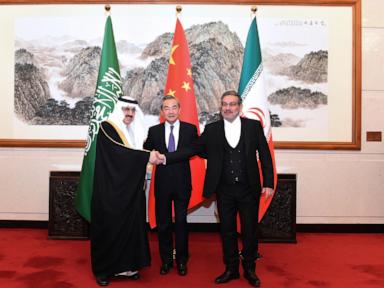
The "Saudi-Iran Rapprochement" brokered in 2023 was a low-cost, high-reward victory for this model. China did not create the conditions for peace; it merely provided the room in which both parties—already exhausted by the Yemen conflict—could sign a pre-negotiated truce. The success of that deal established a precedent for Minimalist Mediation, where China steps in at the final 10% of a process to claim 90% of the symbolic credit.
Structural Bottlenecks in the Beijing-Tehran Axis
Despite the appearance of a unified front against Western interests, several friction points limit the depth of this partnership.
- The Technology-Investment Gap: Iran seeks high-level infrastructure and semiconductor investment. China, fearing secondary U.S. sanctions, has been hesitant to move beyond energy and low-tech sectors. This creates a "commitment lag" that frustrates Iranian hardliners.
- The Gulf Monarchy Balance: China cannot afford to alienate the GCC (Gulf Cooperation Council) states, particularly Saudi Arabia and the UAE, which are more significant long-term economic partners than Iran. Any tilt toward Iran that threatens Saudi security is immediately corrected through high-level visits or increased investment in Riyadh.
- The Red Sea Disruption: The Houthi attacks on shipping present a direct challenge to China’s "Belt and Road" logistics. The fact that Chinese vessels have been targeted, or at least disrupted, reveals the limits of China’s influence over Iran’s proxies. Beijing’s inability to stop the Houthi blockade through its Tehran channel exposes a significant gap in its "Regional Powerbroker" narrative.
The Mechanism of "Calculated Ambiguity"
China’s statements regarding Iranian "sovereignty" are often misinterpreted as full support. In practice, Beijing utilizes a linguistic toolset of Strategic Elasticity. When China "supports Iran’s right to defend its interests," it deliberately avoids defining what those interests are. This allows Beijing to pivot if Iran overreaches.
The second layer of this mechanism is the use of the United Nations Security Council (UNSC). China uses its veto power or the threat of it not to protect Iran, but to maintain a Multipolar Friction. By slowing down the consensus for sanctions or military action, Beijing ensures that the U.S. remains bogged down in procedural and diplomatic quagmires, preventing a rapid shift in the regional power balance that could disadvantage Chinese energy interests.
The Asymmetric Deterrence Problem
A critical missing link in standard analyses of Chinese-Iranian relations is the role of Israel. China is one of Israel's largest trading partners, particularly in the tech and port management sectors (notably the Haifa port). Beijing views Israel as a crucial node in the "Digital Silk Road."
This creates a Dual-Incentive Deterrence:
- To Iran: Beijing signals that if Iran goes too far, China will allow harsher international measures to pass or reduce its oil purchases.
- To Israel: Beijing signals that if Israel ignores Chinese calls for restraint, it risks losing critical infrastructure investment and access to the Chinese market.
This is not a "peace" strategy; it is an Escalation Management strategy. China does not want to solve the Iran-Israel conflict; it wants to manage the heat of the fire so that it never becomes a forest fire that burns down the global energy market.
Strategic Forecast: The Shift to Aggressive Neutrality
As the U.S. pivots toward the Indo-Pacific, the Middle Eastern security vacuum will force China to evolve from a passive observer to an "Aggressive Neutral." This does not mean military intervention, but rather the deployment of Economic Compellence.
We should expect China to move toward a "Pay-to-Play" security model. Beijing may begin offering "Security for Energy" packages, where it provides defensive technology (drones, EW systems, satellite surveillance) to both sides of the Persian Gulf in exchange for guaranteed energy prices and the exclusion of Western firms from critical infrastructure.
The ultimate strategic play is the displacement of the Dollar in energy settlements. Every diplomatic mediation led by Beijing is a vehicle for the Petroyuan. By positioning itself as the only "honest broker" that talks to both Tehran and Riyadh, China is laying the groundwork for a regional financial architecture that bypasses the SWIFT system entirely.
The real indicator of Chinese success in Iran diplomacy will not be the absence of war, but the percentage of Iranian and Saudi oil traded in Renminbi. The diplomacy is the wrapper; the de-dollarization of the world’s most critical energy corridor is the product. Beijing will continue to play the role of the "reluctant mediator" precisely because it allows them to extract concessions from all sides while the United States bears the physical and political cost of maintaining the regional security architecture.