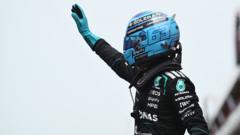
George Russell secured a stunning pole position at the Canadian Grand Prix, edging out Mercedes prodigy Andrea Kimi Antonelli by the barest of margins in a qualifying session that turned the Formula 1 paddock upside down. While casual observers labeled the result a miracle turnaround for a struggling Brackley squad, the reality tracking across the telemetry data tells a completely different story. This was not a sudden burst of developmental genius. It was a perfect storm of thermal management, track evolution, and a high-stakes setup gamble that exposed the fragile operational windows of modern ground-effect machinery.
The standard narrative suggests Mercedes simply found a magic button overnight. They did not. Instead, the Circuit Gilles Villeneuve presented a unique micro-climate and track surface combination that masked the persistent aerodynamic flaws of the W17 chassis while punishing the over-engineered platforms of their rivals.
The Myth of the Out of Nowhere Turnaround
Formula 1 teams do not stumble into pace by accident anymore. The cost cap era dictates that upgrades are metered, simulated, and validated months before they touch the tarmac. To understand how Russell outpaced Antonelli—who was piloting the sister car with an identical floor specification—one must look at the asphalt rather than the wind tunnel.
Montreal’s freshly resurfaced track offered notoriously low grip during the early practice sessions. When a track surface is slick, cars that inherently struggle to generate tire carcass temperature are suddenly thrust into an optimal operating window. The Mercedes chassis has spent the last two seasons overheating its rear tires over a race stint. On Saturday afternoon, that exact flaw became a superpower.
While Red Bull and McLaren scrambled to bleed off tire temperature to prevent blistering in the final sector, Russell could push aggressively through the opening sequence of corners. His tires were ready immediately. The car was not fundamentally faster than it was two weeks ago in Monaco; it was simply operating in an environmental sweet spot that occurs once a season.
The Micro Sector Mastery That Settled the Front Row
The final timing sheets showed a gap measured in thousandths of a second. Antonelli looked to have the upper hand after the second intermediate timing beam, showing immense bravery through the high-speed chicanes.
Telemetry reveals exactly where the veteran out-schooled the rookie. It came down to the approach to the infamous Wall of Champions.
- Antonelli Line: The young Italian carried more entry speed, utilizing a aggressive geometric arc that required a heavy snap of correction over the first kerb. This destabilized the rear diffuser floor edge, costing him traction on exit.
- Russell Line: The British driver sacrificed 4 km/h at the apex, keeping the platform flat. By preventing the floor from sealing prematurely against the track limit, he achieved a cleaner deployment of hybrid clipping power down the straight.
This distinction is crucial. It proves that experience in managing the delicate aerodynamics of these current cars matters more than raw, unadulterated speed. Antonelli has the reflexes, but Russell possesses the data archive in his head.
The Technical Compromise Driving the New Grid Order
The current generation of cars rely entirely on venturi tunnels running beneath the sidepods. To extract maximum downforce, teams must run the cars low and stiff. This creates a brutal ride quality that punishes drivers over the bumps of a semi-permanent street circuit.
Mercedes chose a setup direction that many deemed too risky for the race on Sunday. They softened the mechanical spring rates while stiffening the anti-roll bars.
+-------------------+-----------------------+-------------------------+
| Setup Parameter   | Mercedes Strategy     | Red Bull / McLaren      |
+-------------------+-----------------------+-------------------------+
| Front Ride Height | Ultra-Low (Risk)      | Conservative (Bumping)  |
| Rear Spring Rate  | Soft (Traction)       | Stiff (Platform Stability)|
| Tire Pressure     | Minimum Legal Limit   | Staggered For Wear      |
+-------------------+-----------------------+-------------------------+
This compromise allowed Russell to abuse the kerbs in a way that Max Verstappen simply could not match without risking floor damage. The Red Bull RB22 is an aerodynamic masterpiece, but its suspension compliance remains its Achilles' heel. When forced onto a track that demands aggressive kerb-riding, the Milton Keynes machine becomes a bucking bronco.
Why the Rookie Missed Out
Antonelli’s performance cannot be understated. To sit on the front row in these conditions is a monumental achievement for a driver whose career is still in its infancy. Yet, the telemetry shows a distinct hesitation during the shifting wind conditions of Q3.
A sudden tailwind blew into Turn 10 during the final runs. Russell anticipated this, adjusting his brake migration balance two clicks rearward on his steering wheel dial before he even arrived at the braking zone. Antonelli kept his standard baseline strategy. The resulting front-lockup cost the teenager precisely the margin that separated him from his first pole position. It is these microscopic operational adjustments that separate the good days from the historic ones.
The Looming Sunday Reality Check
Qualifying is an exercise in single-lap extremism. The fuel loads are empty, the engine modes are turned to maximum deployment, and the tires only need to survive for 90 seconds. The race presents an entirely different set of physics.
The soft mechanical setup that gave Mercedes the front row will face a severe test when 100 kilograms of fuel are loaded into the cell. The car will ride significantly lower, increasing the risk of plank wear beneath the skid block. If the stewards find the titanium blocks have worn down by more than the legally permitted millimeter, disqualification awaits.
Furthermore, the tire heating characteristic that worked in Russell's favor during the cool qualifying hour could easily transition into thermal degradation during a long race stint. If track temperatures rise even three degrees, the rear tires will begin to slide, destroying the surface rubber within five laps.
The competition knows this. Both McLaren and Ferrari opted for setups geared toward race pace, sacrificing ultimate single-lap performance to ensure their tire profiles remain stable over a 70-lap distance. They played the long game, betting that the Mercedes frontline will crumble once the heavy-fuel stints begin.
Russell took a massive gamble to secure the headlines today. The true test of whether Mercedes has actually solved their developmental puzzle lies not in the euphoria of a Saturday afternoon, but in the brutal, degrading reality of the tire stints on Sunday afternoon. The data suggests the celebrations may be short-lived.