Natural disasters test the limits of regional infrastructure, revealing the structural weaknesses of coastal development and emergency response systems. When a 7.7-magnitude earthquake struck off the northern coast of Indonesia's Flores Island at a shallow depth of 10 kilometers, it exposed the compounding variables that turn high-magnitude tectonic events into regional humanitarian crises. Deconstructing the mechanics of this event requires analyzing three core vectors: the energy dissipation profile of shallow focal depths, the hydrodynamic triggers of localized tsunamis, and the operational bottlenecks of remote disaster logistics.
The Mechanics of Shallow Focal Depth Energy Release
Seismic destructiveness is not dictated solely by magnitude on the Richter or moment magnitude scale. Depth plays an exponential role in surface acceleration. The 10-kilometer hypocenter recorded by the United States Geological Survey placed this event firmly in the shallow-focus category.
Energy attenuation follows an inverse-square law relative to distance from the hypocenter. When a rupture occurs at shallow depths, seismic waves—specifically high-frequency shear waves—travel a minimal vertical distance before hitting the Earth's crustal surface. This drastically reduces geometric energy loss.
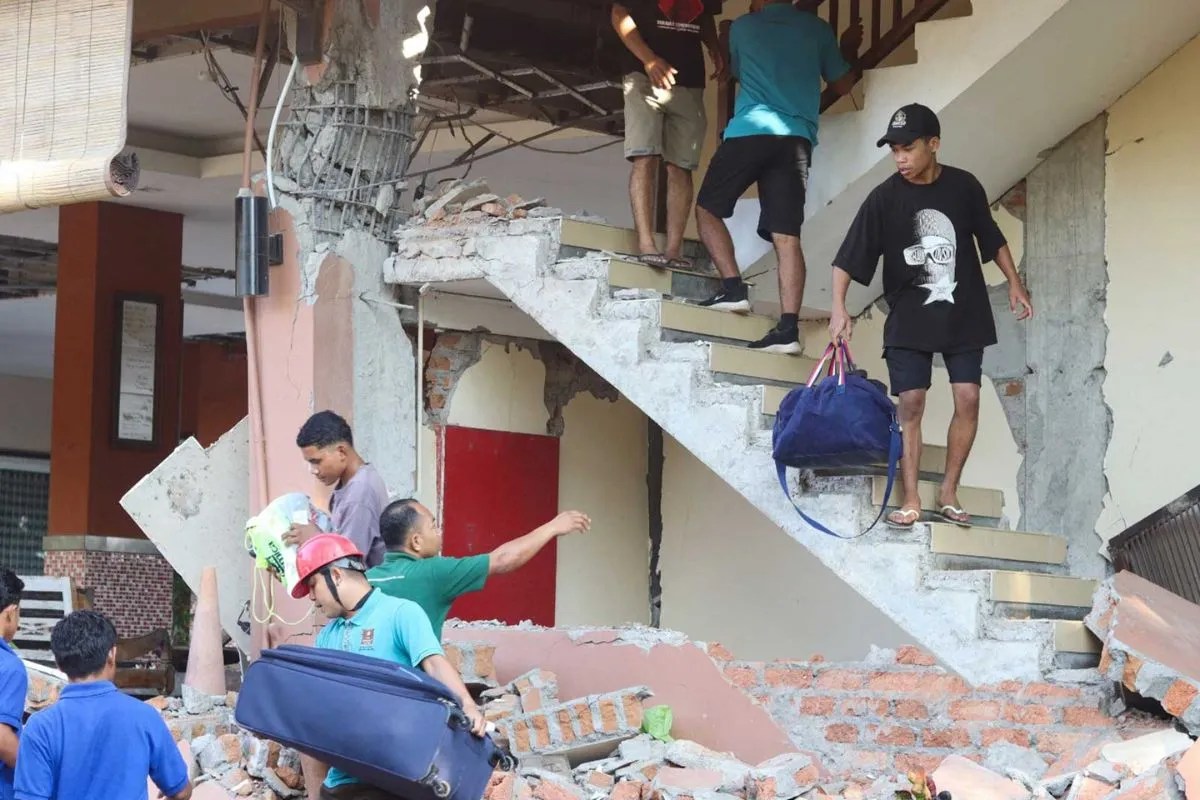
The resulting surface ground acceleration exceeds what standard masonry and non-engineered structures can absorb. Ground motion behaves similarly to a high-frequency shockwave, translating sub-surface tectonic displacement directly into structural shear stress. Unreinforced concrete and masonry structures lack the ductility required to dissipate this kinetic load, leading to progressive collapse patterns observed across the Sikka and Nagekeo regencies.
Hydrodynamic Displacement and Tsunami Generation Logic
Earthquakes occurring beneath marine shelves introduce a secondary vector of destruction: vertical seafloor displacement. When tectonic plates rupture beneath a shallow water column, the sudden vertical heave or drop displaces an equivalent volume of water, translating potential energy into long-period kinetic gravity waves.
The Indonesian Meteorology, Climatology, and Geophysics Agency (BMKG) issued immediate warnings following the 5:58 AM local time tremor. While open-ocean wave amplitudes remain small, wave shoaling effects amplify height drastically as they approach shallow coastal shelves. The physical mechanism operates through wave compression: as the leading edge of the wave enters shallow bathymetry, its velocity decreases, causing subsequent water mass to pile up vertically.
Observed wave heights reaching up to 1.61 meters in specific coastal pockets like Ngada and smaller surges across adjacent shores demonstrate how local bathymetry acts as a natural funnel. Even modest tsunami heights exert immense hydrostatic and hydrodynamic pressure against coastal architecture. A cubic meter of water weighs approximately one metric ton; a continuous surge moving at high velocity generates dynamic structural loads capable of scouring foundations and turning debris into battering rams.
Cascading Infrastructure Failures and Logistical Bottlenecks
Emergency response efficacy relies on functional redundancy across transport and communication networks. The Flores Island event disrupted this operational framework through cascading infrastructural failures.
Landslides triggered by intense ground shaking severed primary arterial links, notably blocking sections of the Trans-Flores highway. When mountain terrain fails under seismic stress, debris flows cover asphalt networks, isolating epicentral zones from mechanized rescue teams. Simultaneously, electrical grid failures knocked out regional power substations, blinding emergency coordination centers and disabling telecommunication towers.
Without real-time telemetry or clear cellular routing, regional disaster mitigation agencies faced severe situational awareness deficits during the critical golden hours following impact. Logistics management under such conditions shifts from a planned deployment model to an ad-hoc recovery phase, forcing reliance on maritime ferries and heavy rotorcraft to bypass compromised terrestrial corridors.
Deploy structural seismic retrofitting mandates across all public facilities within high-risk subduction zones, prioritizing elastomeric bearing pads and steel-reinforced framing to absorb high-frequency shear acceleration before the next tectonic cycle.