The sound of a golf ball being struck perfectly is not a "thwack." It is a click. It is a high-frequency snap that signals a transfer of violent energy into a tiny, dimpled sphere. When Rory McIlroy stands on a tee box, he isn't just hitting a ball; he is trying to solve a kinetic equation that involves his entire skeleton, from the crown of his head to the tips of his toes.
Lately, one of those toes has been talking back.
In the sanitized world of sports journalism, we call this a "minor fitness concern." We list it in a ticker tape at the bottom of the screen. We say a player is "totally fine" because that is what the player says into a microphone while standing in front of a wall of sponsor logos. But the reality of a professional golfer’s body is a fragile ecosystem. One millimeter of swelling in a joint can alter the weight distribution of a swing that moves at over 120 miles per hour.
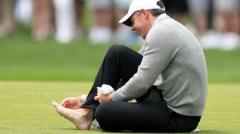
Rory arrived at Valhalla for the PGA Championship with a secret hitch in his step. A toe issue, born from the repetitive stress of a thousand practice rounds, threatened to be the silent protagonist of his weekend. If you have ever tried to walk eighteen holes with a blister, you know the distraction. Now, imagine trying to win a Major with that same sensation while the eyes of the world track your every flinch.
The Anatomy of the Pivot
To understand why a toe matters, you have to understand the violence of the Rory McIlroy swing. He is not a large man, yet he generates power that rivals the giants of the game. He does this through torque. He plants his feet into the turf like anchors, winds his torso against the resistance of his hips, and then releases that tension in a burst of rotational speed.
At the moment of impact, his lead foot—the left—undergoes immense pressure. It must act as a brake and a pivot point simultaneously. If the toes on that foot cannot grip, or if they send a sharp signal of pain to the brain during that split second of peak force, the subconscious takes over. The brain, in its infinite desire to protect the body from pain, will subtly "short" the swing. It will pull back. It will steer.
In golf, steering is death.
When the reports first surfaced that McIlroy was dealing with a foot ailment, the narrative was one of dismissal. He told the press he was "totally fine." He looked relaxed. But those who have followed his career know that Rory’s greatest strength—and occasionally his greatest weakness—is his transparency. When he is hurt, he usually looks it. When he is confident, he radiates it. At Valhalla, there was a strange tension between the two.
The Ghost of 2014
Valhalla isn't just another course on the calendar for Rory. It is a haunting ground. This is where he won the PGA Championship in 2014, a victory that felt like the beginning of a dynasty. Back then, he was the undisputed king of the sport. He was young, seemingly indestructible, and possessed a swing that felt like a force of nature.
Returning to the site of your greatest triumph while carrying a physical "niggling" injury creates a psychological weight. You aren't just playing against the field. You are playing against the ghost of your younger, healthier self. You remember how easy it felt when nothing hurt. You remember when you didn't have to spend two hours in the physiotherapist's trailer before you even touched a club.
Consider a hypothetical golfer—let's call him Elias. Elias is 35, the same age as Rory. He has spent twenty years twisting his spine and ankles in the same direction. One morning, he wakes up and his big toe is throbbing. It seems ridiculous. It's a toe. But as Elias stands over a four-foot putt, he realizes he can’t find his balance. He feels like he’s leaning toward his heels. He misses the putt. He misses the cut. He loses his tour card.
The margins are that thin.
For Rory, the stakes are vastly higher, but the physical reality is identical. The "toe issue" wasn't just a medical footnote; it was a variable that could have derailed his pursuit of a fifth Major title before the first ball was even teed up.
The Science of Survival
The modern golfer is an athlete in the most literal sense. The days of John Daly-style lunch menus are largely over. McIlroy’s preparation involves a meticulous blend of mobility work and strength training. When a toe injury occurs, the team around him—the trainers, the physios, the caddie—enters a state of managed crisis.
They aren't just looking for painkillers. They are looking for structural support. They experiment with different shoe inserts. They change the lacing pattern of his spikes. They use kinesiology tape to offload the pressure from the affected joint. Every adjustment is a gamble. Change the shoe, change the feel. Change the feel, change the result.
Throughout the practice rounds, the cameras caught him walking with a deliberate, almost cautious gait between shots. But the moment he stepped into the "address" position, that caution vanished. This is the hallmark of the elite competitor: the ability to compartmentalize physical discomfort until the job is done.
"I’m totally fine," he repeated. It became a mantra. If he said it enough, perhaps the nerves in his foot would believe him. Or perhaps, more importantly, his competitors would believe him. Golf is a game of intimidation as much as it is a game of skill. To show a limp is to show blood in the water.
The Invisible Stakes
Why do we care about a millionaire's sore foot?
We care because Rory McIlroy represents a specific kind of human struggle. He is the wunderkind who reached the summit and has spent a decade trying to find the path back to the very top. Since 2014, the year of his Valhalla victory, he has been "close" more times than any other player in history. He has the most top-ten finishes in Majors without a win during that span.
Every time he enters a tournament, he carries the collective hope of a fanbase that wants to see the "old Rory" return. Every minor injury feels like a cosmic joke, another barrier placed in the way of a long-overdue coronation. The toe wasn't just a medical problem; it was a metaphor for the friction he has faced for ten years.
When he finally took the course, the limp seemed to vanish. The swing was there. The click was back. He played with a ferocity that suggested he had found a way to move the pain into a different part of his mind. He was no longer a man with a toe issue; he was a man with a target.
The crowds at Valhalla didn't see the ice packs or the tape. They didn't see the grimaces in the locker room. They saw the ball screaming off the face of the driver, disappearing into the Kentucky sky. They saw the result of a thousand hours of recovery distilled into a single, effortless motion.
The Price of the Pivot
We often forget that sports are played by people who are essentially breaking themselves for our entertainment. Every golf swing is a controlled car crash for the joints. To do it as well as Rory does requires a level of physical commitment that borders on the masochistic.
He didn't just play through a toe issue. He mastered it. He integrated it into his reality and refused to let it define his performance. In doing so, he reminded us that being "totally fine" isn't about the absence of pain. It’s about the presence of will.
The sun began to set over the rolling hills of Valhalla, casting long, distorted shadows across the fairways. Rory walked toward the clubhouse, his gait still rhythmic, still steady. He had survived the first test. The foot held. The dream stayed alive.
As he disappeared into the tunnel of fans, one thing was clear: the greatest obstacles aren't the bunkers or the water hazards. They are the tiny, invisible fractures in our own foundations that we must learn to ignore if we ever want to touch greatness again.
He moved forward, one step at a time, toward a destiny that remained just out of reach, but never out of sight.