The basic reproduction number ($R_0$) of the measles virus is universally calculated between 12 and 18. This structural biological reality dictates that in a fully susceptible population, a single infected individual will transmit the disease to up to 18 others, making measles one of the most contagious pathogens known to medical science. To completely halt transmission and achieve herd immunity, a population must maintain a homogeneous critical immunization threshold ($P_c$) defined by the mathematical relationship:
$$P_c = 1 - \frac{1}{R_0}$$
Given an $R_0$ of 18, the required vaccine coverage threshold is 94.4%. When actual population immunity falls below this clear mathematical boundary, an epidemic is not merely a risk; it is a mathematical certainty.
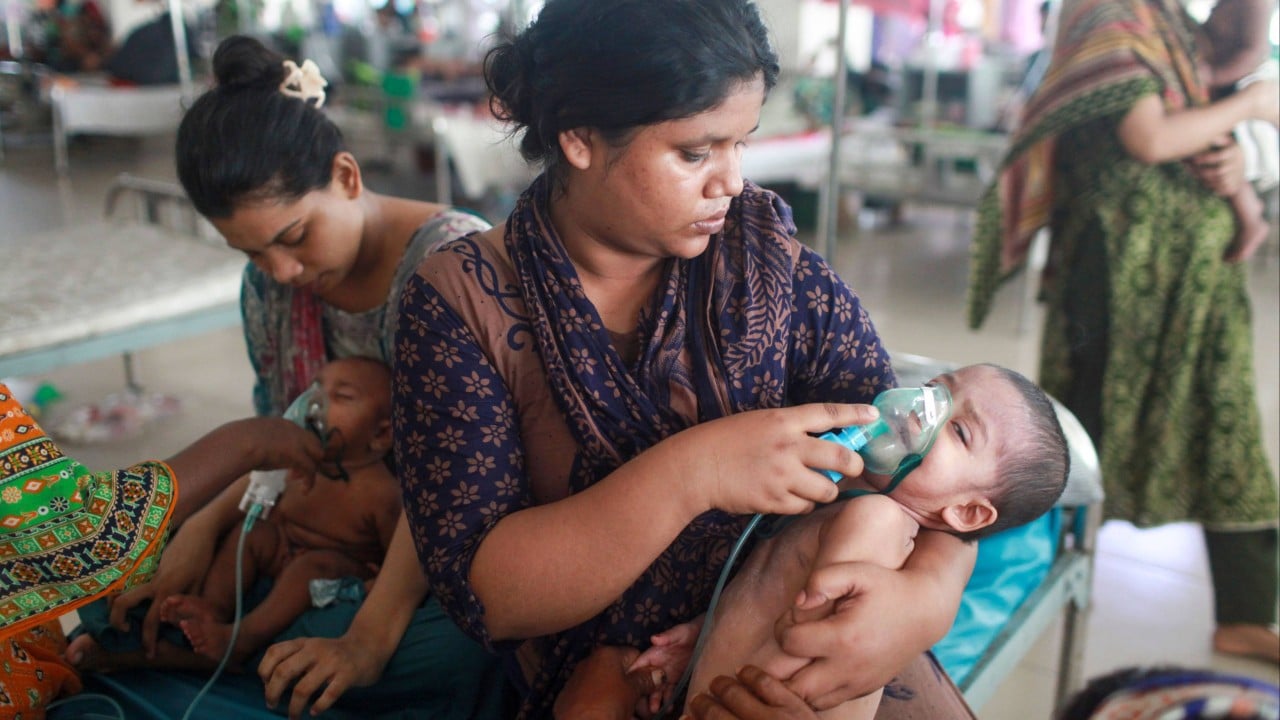
Data from the Directorate General of Health Services (DGHS) reveals that Bangladesh is confronting this structural reality, with recorded infections approaching 71,000 and suspected fatalities reaching 585. The crisis highlights a severe breakdown in public health infrastructure rather than a simple failure of medicine. Analyzing this epidemic requires breaking down the crisis into three distinct operational bottlenecks: the accumulation of immunity gaps, mass holiday migration velocity, and the limitations of single-dose reactive vaccination strategies.
The Three Pillars of Population Susceptibility
Epidemic logic dictates that an outbreak cannot sustain itself without a continuous supply of susceptible hosts. In Bangladesh, this supply was generated by three distinct structural failures that occurred between 2024 and 2026.
1. Political Unrest and Routine Disruption
Bangladesh historically maintained strong routine immunization metrics. However, political instability in 2024 and subsequent governance transitions through early 2026 disrupted established cold chains and delivery schedules for the two-dose Measles-Rubella (MR) vaccine. The primary operational consequence was the systemic omission of the first dose (MR1, typically given at 9 months) and the second dose (MR2, given at 15 months). This created a birth-cohort backlog of unprotected children.
2. The Dwindling Vaccine Inventory
Public health warnings from international bodies, including UNICEF, the World Health Organization (WHO), and Gavi, indicated that vaccine stock levels were dropping dangerously low as early as 2024. The failure to launch supplementary immunization activities during governance shifts created a steady rise in the number of "zero-dose" children. This pool of susceptible individuals eventually grew large enough to trigger an outbreak.
3. The Nutritional Vulnerability Vector
The severity of a measles infection depends heavily on the host's nutritional status. A major disruption to national Vitamin A supplementation programs occurred in 2025, when only one of the two scheduled distribution rounds was completed. Because Vitamin A is critical for epithelial cell integrity and immune function, its absence creates a direct physiological link to severe measles complications, including:
- Severe pneumonia
- Corneal scarring and blindness
- Malabsorption syndromes caused by mucosal damage in the gut
This nutritional deficit directly accounts for the high hospitalization volume, which has exceeded 57,000 admissions and overwhelmed national isolation capacity.
The Velocity of Transmission: The Eid Migration Kinetic
The geographic spread of a localized outbreak into a nationwide crisis is driven by human mobility. The declaration of the outbreak in mid-March established a baseline localized transmission pattern. However, the subsequent mass migration during major holidays served as a major accelerator for the virus.
[Localized Hotspots] ──(Mass Holiday Travel)──> [Strained Rural Networks] ──> [Nationwide Surge]
During major national holidays, millions of individuals move rapidly from high-density urban centers like Dhaka and Chattogram back to their rural ancestral homes. This migration alters transmission dynamics in two ways:
High Vector Density in Transit Hubs
The physical mechanics of holiday travel involve long periods of overcrowding in confined spaces, including buses, trains, and river ferries. Because measles is an airborne virus that remains infectious in suspension for up to two hours, these poorly ventilated transit points maximize exposure. They allow infected individuals to transmit the virus well before their maculopapular rash appears.
Re-Seeding Lower-Immunity Pockets
Rural sub-districts (upazilas) often have lower routine vaccination coverage than urban centers due to geographic and logistical challenges. The holiday migration functioned as a highly effective distribution network, moving the virus from urban hotspots directly into vulnerable rural communities.
Because the incubation period for measles ranges from 10 to 14 days, the real-world impact of these mass travel events is delayed. It appears as a sudden, widespread surge in hospitalizations roughly two weeks after families return home.
The Strategic Limitations of Single-Dose Campaigns
In response to rising infection rates, health authorities approved an emergency reactive vaccination campaign targeting roughly 20 million children. While necessary, this intervention faces a clear immunologic bottleneck: it is currently a single-dose deployment.
A single dose of the measles vaccine administered at 9 months of age yields an estimated seroconversion rate of 85% to 90%. This means that even with 100% administrative coverage, 10% to 15% of vaccinated individuals will fail to develop protective immunity. This failure rate underscores why a two-dose schedule is necessary to reach the 95% herd immunity threshold. Relying on a single dose leaves a significant portion of the population unprotected, allowing transmission chains to continue moving through communities.
Furthermore, demographic data from the current outbreak reveals a major challenge for standard vaccination rules. Infants under the age of 9 months account for roughly 33% to 34% of the current caseload.
+-------------------------------------------------------------+
| Infant Vulnerability Window (0 to 9 Months)                 |
+-------------------------------------------------------------+
| Maternal Antibodies Wane ----> [ GAP ] ----> MR1 Eligibility|
+-------------------------------------------------------------+
During the first few months of life, infants rely on maternal antibodies passed down during pregnancy. However, if a mother's own immunity has waned over time, her baby loses this protection well before becoming eligible for their first scheduled vaccine dose at 9 months. This creates a critical window of vulnerability that cannot be closed by standard vaccination campaigns. Protecting this age group requires achieving high herd immunity among older children and adults to stop the virus from circulating altogether.
The Border Risk Framework
The domestic crisis is further complicated by cross-border transmission risks. Bangladesh shares extensive land borders with India and Myanmar, and major trading hubs like Jashore and Chapainawabganj sit directly on active transit corridors.
                                  ┌───► Major Urban Hubs (Dhaka, Sylhet)
                                  │
[Cross-Border Land Crossings] ────┼───► Neighboring States (India, Myanmar)
                                  │
                                  └───► Displaced Populations (Cox's Bazar)
The risk of this outbreak spilling over across borders is driven by three main factors:
- Immunity Gaps in Neighboring Border Regions: Regions with high numbers of zero-dose children face immediate risks if the virus crosses the border.
- Constant Cross-Border Trade and Travel: Daily movement through major land ports provides a steady path for the virus to travel back and forth.
- High-Density Displaced Population Settings: Heavily crowded areas, such as the Rohingya refugee camps in Cox's Bazar and Bhasan Char, are at extreme risk. While intensive humanitarian immunization campaigns have kept laboratory-confirmed cases low so far, the high population density means any breakdown in protection could lead to rapid, widespread transmission.
Strategic Recommendations for Outbreak Control
Halting this epidemic requires shifting from reactive, single-dose campaigns to a structured containment strategy.
- Accelerate the Second-Dose Campaign: The primary goal must be shortening the time between the first and second emergency doses. Deploying the second dose is critical to close the 10% to 15% immunity gap left by the initial single-dose response.
- Adjust Age Requirements in High-Burden Areas: In high-risk hotspots, authorities should lower the minimum vaccination age to 6 months. While a dose given this early may not provide long-term immunity, it offers vital short-term protection for infants during peak transmission periods. This early dose should be treated as an extra safety measure, and children must still receive their two standard doses according to the regular schedule.
- Reestablish Vitamin A Distribution Networks: Mobile teams must pair vaccination efforts with immediate Vitamin A supplementation. Restoring these vitamin levels is a fast, proven way to reduce measles mortality and protect children from severe eye and lung complications.
- Set Up Screening at Border Crossings and Transit Hubs: Health teams should deploy to key border checkpoints, airports, and major transit stations. They must check vaccination records and offer immediate immunizations or post-exposure prophylaxis to travelers without proof of immunity.