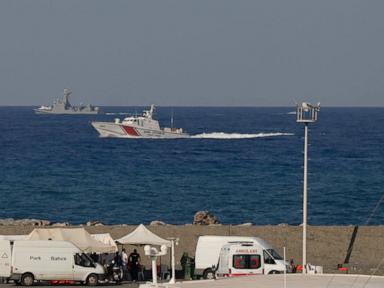
The capsizing of the passenger catamaran Filo Jet off the coast of Kyrenia exposes systemic vulnerabilities in maritime transit corridors, operational decision-making loops, and deep-water salvage constraints. Operating between northern Cyprus and Tasucu, Turkey, the vessel carried 267 passengers and crew before experiencing catastrophic structural compromise. Analyzing this event requires stripping away emotional eyewitness accounts to examine the mechanical failures, evacuation bottlenecks, and hydrodynamic forces that transformed a routine crossing into a mass-casualty incident.
The Failure Sequence and Hydrodynamic Realities
Maritime disasters rarely stem from a single point of failure; they follow a cascading error chain. The sequence onboard the Filo Jet began with mechanical anomalies below decks, manifested as loud noises and progressive flooding.
When a vessel takes on water while underway, free surface effect becomes an immediate threat. Water sloshing across the uncompartmented spaces of a catamaran deck shifts the center of gravity laterally, exponentially increasing the angle of list. The crew's initial assessment—dismissing the sounds as a loose gasket—illustrates a critical failure in operational risk triage. Standard maritime protocol dictates immediate containment and stability assessment upon any unverified hull compromise.
The decision by the captain to reverse course toward Kyrenia rather than beaching the vessel or executing immediate controlled evacuation introduced dynamic bending moments. As the list worsened, asymmetric buoyancy caused the catamaran structure to twist under its own deadweight. The eventual capsize occurred because the rate of downflooding surpassed the vessel's reserve buoyancy threshold, rendering the hull hydrostatically unstable.
Evacuation Friction and Human Performance Under Duress
Human performance degradation under acute panic dictates that evacuation efficiency is a function of clear egress architecture and proactive crew instruction. The Filo Jet incident highlights three distinct friction points that paralyzed the escape sequence:
- Information Asymmetry: The verbal reassurance by crew members that the leak was minor ("a loose gasket") anchored passengers in a state of false security, delaying self-evacuation preparation.
- Spatial Bottlenecks: As the list intensified, lateral G-forces and panic compressed passenger flow toward exits, creating human arching at doorways. Structural doors were temporarily secured or jammed due to hull distortion, halting egress entirely.
- Resource Inaccessibility: Life jacket lockers were either inaccessible due to crowd pressure or locked behind physical barriers during the critical pre-capsize window, forcing unequipped passengers into water survival scenarios without flotation assets.
When evacuation routes fail, survival transitions from a managed protocol to an uncoordinated physical struggle. Passengers forced to break windows or jump directly into open water faced hypothermia, exhaustion, and secondary trauma from structural suction as the vessel settled.
Deep Water Recovery and Salvage Logistics
Rescue operations following the sinking transitioned immediately from surface recovery to deep-water intervention, dictated by the bathymetry of the Mediterranean site. With the hull resting at a depth exceeding 500 meters (1,640 feet), standard saturation diving is rendered physically impossible due to pressure limits and decompression constraints.
This depth threshold forces a reliance on unmanned systems. The deployment of remotely operated submersibles from Turkey represents the primary mechanism for penetrating the submerged hull. Operating a tethered robotic vehicle at 500 meters introduces significant operational variables:
- Umbilical Drag: Currents at intermediate depths exert lateral force on the control tether, reducing maneuverability around complex wreckage geometries.
- Visibility Deficits: Stirred silt and lack of ambient light restrict optical sensors, forcing reliance on sonar mapping and high-intensity lighting arrays.
- Access Restrictions: Internal hull compartments blocked by displaced furniture, bulkheads, and personal effects require specialized manipulator arms capable of delicate structural clearing.
Accountability and Regulatory Liability
The legal fallout, marked by the detention of the ship's crew and a company director on charges of negligence, highlights the legal exposure inherent in commercial maritime operations. In maritime jurisprudence, liability is partitioned into operational negligence and corporate culpability.
Operational negligence focuses on the immediate actions of the master: the delay in issuing a distress signal, the failure to mandate life jacket distribution prior to critical listing, and the tactical choice to maneuver a compromised hull. Corporate culpability examines maintenance records, safety management system compliance, and structural integrity audits prior to departure. The defense must prove that the failure was an unforeseeable act of force majeure, while prosecution must demonstrate that deferred maintenance or overloading created a latent condition of unseaworthiness.
Deploy remotely operated submersibles with integrated acoustic positioning systems to map internal compartments, establish structural stability baselines for the seabed wreck, and complete exhaustive forensic sweeps of trapped spaces to bring closure to the missing personnel investigation.