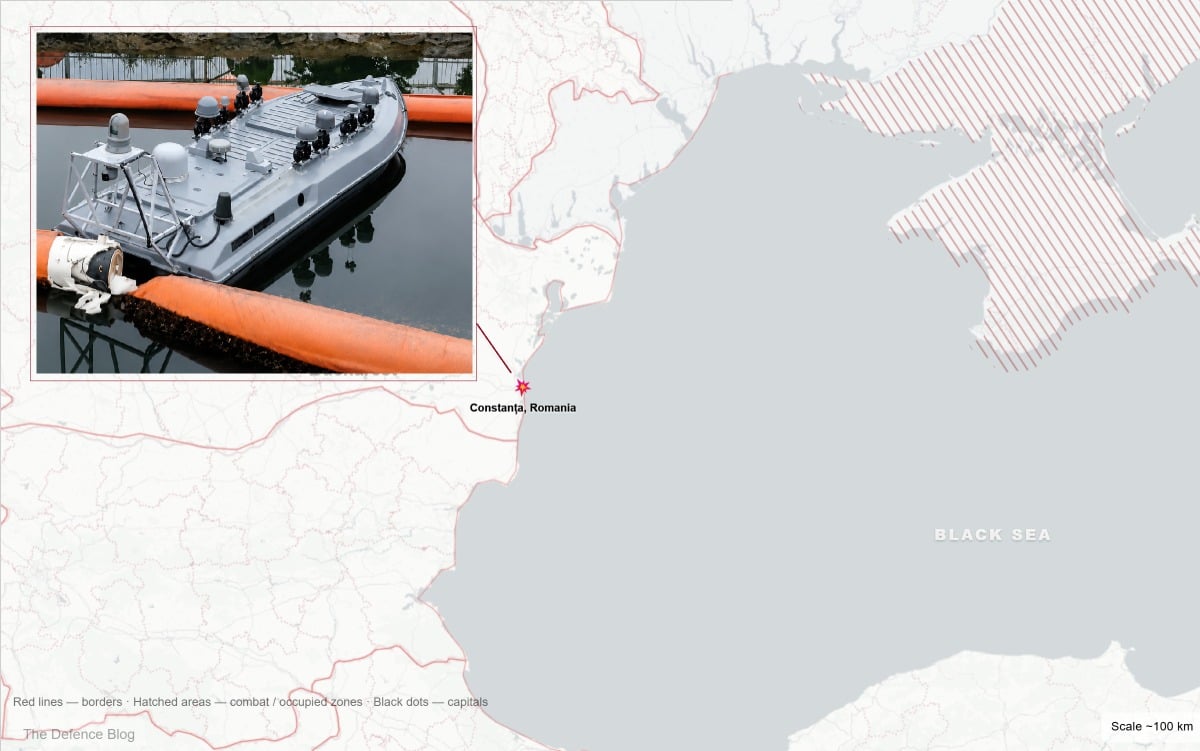
The self-detonation of a 7-to-8-meter unmanned surface vessel (USV) at berths 77 and 78 in the civilian sector of the Port of Constanța underscores a profound operational shift in Black Sea maritime security. This event, occurring in Romania’s premier commercial and logistics hub, is not an isolated tactical anomaly. Instead, it serves as an empirical proof point for the systematic spillover of littoral combat tools into non-belligerent NATO territory. The arrival and subsequent detonation of a green-colored, multi-antenna maritime drone—identified by technical metrics as an explosive-laden system similar to the Ukrainian Magura V5 architecture—reveals critical vulnerabilities in regional defensive postures, maritime interdiction workflows, and critical infrastructure protection.
To assess the strategic impact of this detonation, the incident must be broken down into three analytical pillars: the systemic mechanics of uncrewed drifting hazards, the failure modes of current harbor defense infrastructures, and the economic friction introduced to NATO’s eastern flank.
The Drift Mechanics of Autonomous Maritime Assets
The presence of a live, uncrewed system 100 miles south of the active combat theater demonstrates the persistence of uncrewed hardware in a enclosed maritime basin. When an autonomous vessel loses its primary command-and-control uplink, its trajectory is dictated entirely by a hydrodynamic cost function. This function is governed by three primary variables:
- The Danube-Black Sea Jet Stream: The counter-clockwise surface currents of the western Black Sea naturally channel floating or low-profile objects southward from the Ukrainian coast toward the Romanian littoral shelf.
- Low Radar Cross-Section (RCS) Geometry: Low-profile fiberglass or carbon-composite hulls sit exceptionally low in the water. This design limits wave-reflection returns and allows vessels to bypass standard marine radar configurations optimized for larger commercial traffic.
- Dead-Man Switch and Scuttling Logic: Military-grade USVs utilize onboard automated logic circuits. If an asset suffers continuous jamming or satellite signal degradation, the system is designed either to drift as a blind hazard or to self-detonate via a pre-programmed timer or battery depletion circuit.
The Constanța asset successfully penetrated the civil port perimeter, drifting past external breakwaters until it was physically jammed against anti-pollution barriers near the headquarters of the Romanian Agency for Saving Human Life at Sea (ARSVOM). The subsequent detonation at 10:30 a.m. local time occurred while personnel from the Romanian Intelligence Service (SRI) and the Ministry of National Defense were attempting to stabilize the platform. This indicates that the asset retained its explosive velocity and terminal lethality despite losing its operational context.
Harbor Defense Architecture and Failure Modes
The detection timeline reveals a significant latency bottleneck in coastal early-warning pipelines. ARSVOM personnel first spotted the device at approximately 6:00 a.m., but the physical explosion did not occur until four and a half hours later. This window highlights the operational tension between civilian harbor management and military counter-USV (C-USV) response teams.
A standard harbor defense layout relies on three layers of verification: long-range radar, electro-optical/infrared (EO/IR) tracking, and acoustic monitoring. The breakdown in Constanța exposes specific technical limitations across this matrix. Small, semi-submersible hulls yield minimal thermal signatures when their engines are idling or deactivated, neutralizing standard EO/IR triggers. Furthermore, commercial harbors are high-noise acoustic environments due to large container ships and auxiliary tug operations, effectively masking the cavitation noise of small waterjet propulsion systems.
The second limitation is organizational. The responsibility for monitoring naval traffic falls under the jurisdiction of the Romanian Naval Authority, whereas kinetic neutralization requires specialized military intervention. This division introduces coordination drag. While emergency protocols like the Red Intervention Plan were executed correctly to evacuate civil personnel and deploy reconnaissance aircraft—including SMURD and Black Hawk assets—the system was already inside the port’s high-value infrastructure zone before neutralization assets could intervene.
The Macro-Economic Friction Function
Constanța is not merely a regional port; it functions as a vital logistical choke point for grain exports, bulk commodities, and NATO reinforcement paths feeding the Mihail Kogălniceanu Air Base. Introducing kinetic volatility to this specific node alters the risk premium calculations for commercial maritime operators.
Maritime insurance frameworks evaluate risk based on spatial predictability and historical event frequency. The arrival of drifting explosives introduces a volatile variable into these actuarial formulas.
$$War\ Risk\ Premium = f(P_{strike}, \cdot V_{asset}) + C_{static}$$
Where $P_{strike}$ represents the probability of a kinetic strike within a defined zone, $V_{asset}$ is the total valuation of the commercial hull and cargo, and $C_{static}$ reflects fixed underwriting costs. When $P_{strike}$ increases due to unmanaged drone drift or multi-vehicle swarms—with reports indicating up to four additional explosive-laden platforms active in the coastal search area—insurance syndicates respond by expanding war risk exclusions.
The direct consequence of this economic shift is an inflation of freight rates. Commercial vessels must either absorb higher insurance premiums or invest in private, short-range sub-surface surveillance and acoustic monitoring systems. Both paths increase the overhead costs of shipping through the western Black Sea, directly undercutting the economic competitiveness of Central and Eastern European transit corridors.
Geopolitical Escalation and Treaty Boundaries
The incident cannot be divorced from its broader regional security context. The explosion occurred only one week after a Russian Geran-2 loitering munition struck a residential structure in Galați, and concurrent with the neutralization of a naval mine near Vama Veche. This cluster of events shifts the strategic conversation from theoretical airspace violations to direct, material impacts on Allied sovereign territory.
For NATO, these recurring incursions create a specific gray-zone dilemma. Because the USV self-detonated and has not been conclusively tied to a deliberate offensive launch directed at Romania, it fails to meet the explicit thresholds required for an Article 5 collective defense invocation. Instead, it exposes the operational boundary of Article 4 consultations, forcing frontline states like Romania to manage kinetic events within their borders using purely national or localized defensive structures. The political response—exemplified by Bucharest closing the Russian Consulate General in Constanța following the Galați strike—demonstrates a reliance on diplomatic retaliation to address what is fundamentally an asymmetric, physical security threat.
Strategic Reconfiguration of the Littoral Perimeter
To counter the threat of uncrewed maritime drift, port security paradigms must transition from reactive containment to proactive interception. The current strategy of utilizing passive anti-pollution barriers to catch drifting hardware creates an unacceptably high risk of terminal detonation within high-value berths.
The immediate operational priority requires establishing a continuous, multi-tiered C-USV interception line outside the Constanța breakwaters. This framework demands the integration of active-matrix electronically scanned array (AESA) radars calibrated specifically for low-altitude, ultra-low RCS maritime targets. These sensor arrays must feed automated target-recognition software capable of distinguishing between standard civilian watercraft and low-profile military USVs based on hydrodynamic signature and velocity profiles.
Furthermore, physical mitigation must occur at the outer maritime approaches. Rather than deploying human explosive ordnance disposal teams to stabilize drifting platforms in confined civil waterways, port defense units must employ tethered kinetic interception nets, directed-energy disruption systems, or autonomous surface interceptors equipped with remote neutralization tools. This shifts the physical risk away from critical port infrastructure and prevents the weapon systems from achieving their proximity detonation objectives. Until these active detection and remote interception protocols are integrated into the daily operations of the Romanian Naval Authority and its NATO counterparts, the commercial ports of the Western Black Sea will remain vulnerable to unpredictable kinetic disruptions driven by the ongoing conflict.



:max_bytes(150000):strip_icc()/how-many-types-of-dwarfism-are-there-2860725-v1-8dae2c531b4b47d9ae36ae404d3308a0.png)