Walk through the quiet, stone-paved streets of Solomeo, a medieval village nestled in the hills of Umbria, Italy, and you will hear something rare in the modern world. Silence. Not the empty silence of a ghost town, but the deliberate, heavy quiet of a place built to outlast the frantic noise of our digital age.
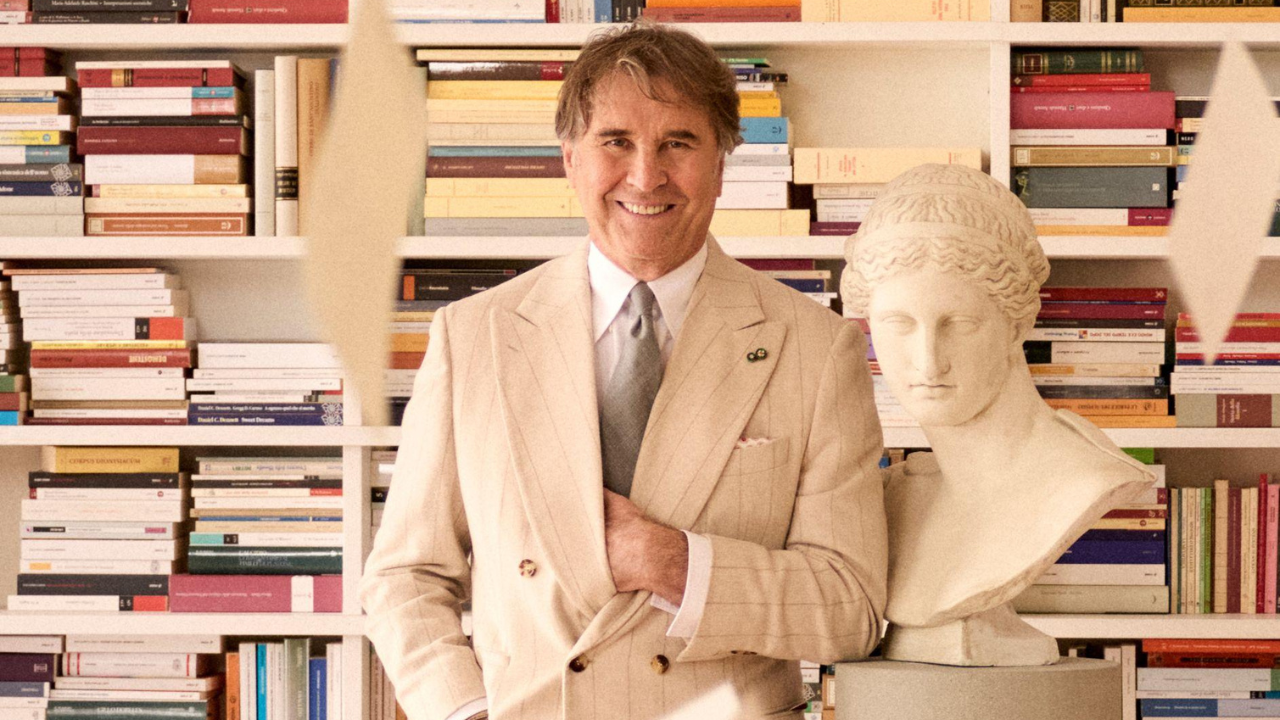
Brunello Cucinelli stands here, looking out over the valley. He is a billionaire, known globally as the "king of cashmere," a man who built a fashion empire on the backs of ultra-luxury sweaters. But he does not talk like a CEO. He does not obsess over quarterly earnings or digital engagement metrics. Instead, he talks about the year 3026.
We live in a culture of the immediate. We build apps that vanish in twenty-four hours. We write thoughts that get buried by algorithms in twenty minutes. We build tech companies designed to flip in twenty months. Cucinelli is doing the exact opposite. He is spending a fortune to build a massive, universal library designed to stand for the next one thousand years.
It is a project modeled directly after the ancient Library of Alexandria. And it is entirely free to humanity.
To understand why a fashion titan would pivot from luxury clothing to ancient history, you have to understand the invisible crisis of our time. We are drowning in data, yet starving for wisdom. We have access to every piece of information ever created, right in our pockets, but we have never felt more disconnected from the foundational truths of human existence. Cucinelli felt this shift deeply. He watched the world speed up, watched the digital fog roll in, and decided to plant a stake in the earth.
Think about a book. A physical, leather-bound volume. If you drop it in the mud, you can dry it off. If the electricity goes out, you can read it by candlelight. If a civilization collapses, the words remain etched on the page, waiting for the next pair of eyes to find them. Now think about a digital file. It requires an internet connection, a subscription service, a specific device, a steady power grid, and a company that chooses not to delete it from a server. Our entire modern memory is resting on a fragile web of glass and wires.
Cucinelli saw this vulnerability. He realized that if we do not intentionally preserve our core philosophies, we risk entering a new dark age where our collective history is simply wiped clean by a glitch or a corporate whim.
The project is called the Universal Library of Solomeo. It is housed in a magnificent eighteenth-century villa, meticulously restored to blend into the Italian countryside. The architecture itself is an argument against modern minimalism. It features heavy wooden beams, thick stone walls, and windows that flood the reading rooms with natural light. This is not a sterile archive; it is a living, breathing sanctuary.
The library will house thousands of volumes across philosophy, history, literature, poetry, and art. The selection process is rigorous, focusing on the works that have shaped human thought across centuries. Think Plato, Aristotle, Marcus Aurelius, Dante, and Shakespeare. These are not decorative books meant to sit on a shelf to look impressive. They are meant to be handled, read, and debated.
The rule of the house is simple: anyone can walk in, sit down, and read. There are no paywalls. There are no algorithmic recommendations trying to sell you something based on the page you just turned. It is a pure, unadulterated space for human thought.
The financial world often looks at Cucinelli with a mix of awe and deep confusion. In the logic of modern capitalism, building a massive library that generates zero revenue is madness. It is a massive capital expenditure with no return on investment.
But Cucinelli operates on a philosophy he calls "humanistic capitalism." He believes that a business must enrich the human soul, not just the bank account. When he took his company public on the Milan Stock Exchange, he explicitly told investors that he would run the business with a focus on long-term human dignity, not short-term profit maximization. The market balked at first. Then, they watched his brand grow into a global powerhouse.
He pays his workers wages that are significantly higher than the industry average. He forbids them from sending work emails after 5:30 PM. He insists that they take a long, unhurried lunch break every day to spend time with their families or walk through the village. The library is the ultimate extension of this philosophy. It is a gift funded by luxury, built to serve the common good.
Consider a hypothetical young student walking into this library five hundred years from now, in the year 2526. The fashion brand of Brunello Cucinelli may well be a footnote in a textile history textbook. The sweaters will have long since faded. But that student will pull a volume of philosophy from a shelf in Solomeo, sit by a stone window, and read the exact same words that guided thinkers in ancient Rome and Renaissance Italy. That student will realize they are not alone in the universe. They will connect with the long, unbroken chain of human experience.
That is the invisible stake of this project. It is an act of defiance against transience.
It is easy to look at a project like this and feel a sense of romantic nostalgia, a desire to retreat from the complexities of modern technology into a idealized past. But that misses the point entirely. Cucinelli is not anti-technology; he is pro-human. He understands that technology is a magnificent tool for calculation, but a terrible master for living.
The Library of Alexandria burned, and with it, a massive portion of humanity's early knowledge was lost forever to the flames. We still feel that loss today, centuries later, wondering what medical breakthroughs, mathematical discoveries, or poetic masterpieces were turned to ash. Cucinelli’s library is an attempt to build a fortress against the modern equivalent of that fire: apathy, digital decay, and the slow erosion of our attention spans.
The stones of Solomeo are cool to the touch. The valley below carries the faint scent of olive trees and damp earth. Inside the villa, the shelves are filling up, book by book, row by row. It is a quiet, slow process in a world that demands speed.
As the sun sets over the Umbrian hills, casting long shadows across the courtyard of the new library, you realize this is not a monument to a billionaire's ego. It is a message in a bottle, cast out into the turbulent ocean of time, waiting for generations we will never live to meet.