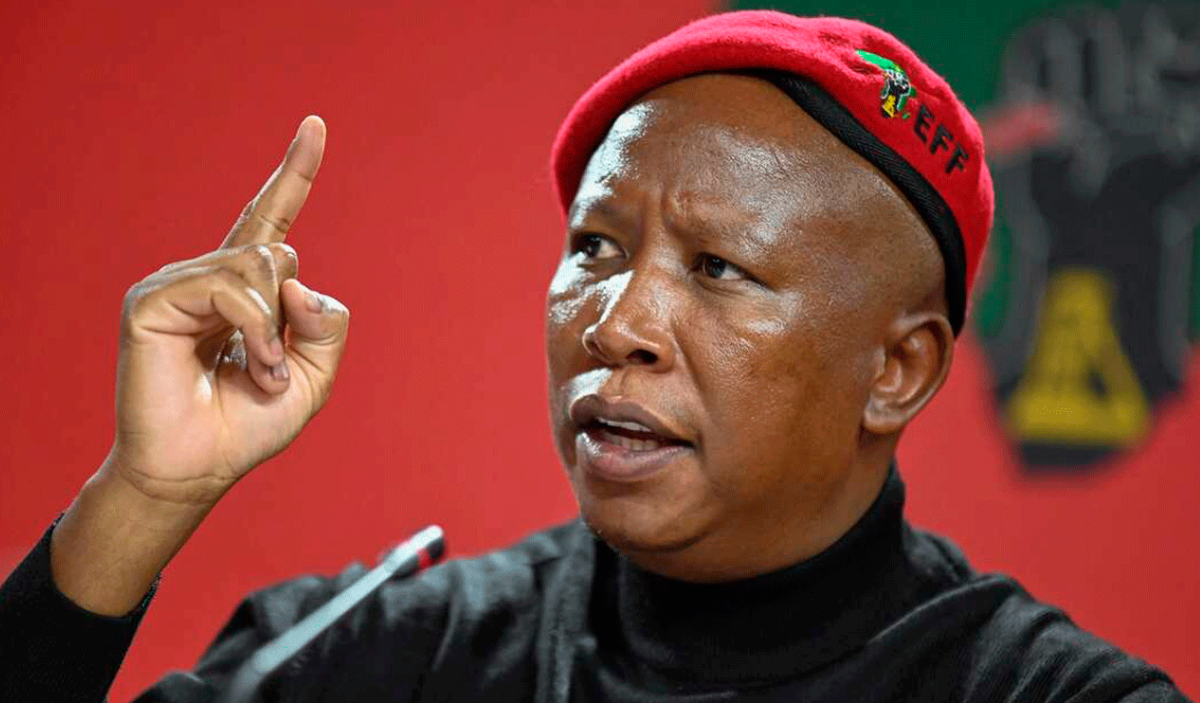
The international press is obsessed with the optics of Julius Malema’s sentencing. They want to frame this as a victory for the "rule of law" or a check on populist power because Donald Trump once tweeted about him. They are wrong. This isn't about a rifle fired at a rally in 2018. It isn't even about gun safety.
This is about the administrative weaponization of paperwork to mask a failing state's inability to control actual violence.
When a court hands down a suspended sentence to a high-profile politician for discharging a firearm in public, the "law and order" crowd cheers. They think the system worked. In reality, the system just admitted it has no teeth. If you or I fired an automatic weapon into the air in a crowded stadium, we wouldn't be looking at a fine and a "don't do it again" warning. We would be under the prison.
The Myth of the Deterrent
The mainstream narrative suggests that holding Malema accountable "sends a message." I’ve spent two decades watching political legal cycles, and I can tell you exactly what that message is: If you are loud enough, the law is a suggestion.
A suspended sentence is the judicial equivalent of a participation trophy. It allows the state to claim a conviction while ensuring the political peace remains undisturbed. The South African Firearms Control Act is one of the most stringent pieces of legislation on paper, yet the country faces staggering rates of violent crime involving illegal, unindexed weapons.
The focus on Malema’s celebratory gunfire is a distraction. While the media analyzes the ballistic report of a single rifle from years ago, the actual flow of illegal arms through the porous borders of the SADC region remains untouched. We are arguing over the etiquette of a man with a megaphone while the house is burning down.
The Trump Variable is a Red Herring
Western outlets love to mention that Donald Trump once criticized Malema’s stance on land expropriation. They do this to bait clicks, creating a "clash of the titans" narrative that doesn't exist. Malema’s legal woes have nothing to do with Mar-a-Lago.
By linking these two, journalists ignore the local reality: the National Prosecuting Authority (NPA) is under immense pressure to prove it isn't "captured." This case was a low-hanging fruit. It was recorded on video. It was undeniable. Yet, it took six years to reach a conclusion that results in zero jail time.
If this were about the gravity of the offense, the timeline would have been months, not over half a decade. This wasn't a trial; it was a slow-motion PR campaign.
Paperwork vs. Power
Let's talk about the mechanics of the Firearms Control Act. The law is designed to track law-abiding citizens. It is an administrative dragnet.
- Licensing: Takes years for the average citizen.
- Compliance: Requires expensive safes and inspections.
- The Reality: None of this stops a politician from grabbing a weapon at a rally.
The "lazy consensus" says we need tougher gun laws. The data says otherwise. South Africa doesn't have a "law" problem; it has an enforcement vacuum. When the state cannot secure its own police armories—where thousands of weapons "disappear" into the hands of gangs every year—prosecuting a politician for a ceremonial discharge is a joke.
I’ve seen this play out in corporate compliance too. Companies write massive handbooks to catch the guy who takes an extra stapler, while the C-suite offshores millions. The Malema case is the "extra stapler" of South African jurisprudence.
The Nuance of Populist Weaponry
Malema understands something his critics don't: The optics of the crime are more valuable than the cost of the sentence.
By firing that weapon, he signaled a readiness for conflict that resonates with a frustrated, disenfranchised base. A suspended sentence doesn't dampen that signal; it amplifies it. It makes him a "victim" of a legal system that he claims is biased against the poor and the black majority, even as that same system gives him a slap on the wrist.
Imagine a scenario where the NPA actually sought the maximum penalty. The resulting civil unrest would have cost the state more than the conviction was worth. This is the "stability tax" that developing democracies pay. They trade justice for peace.
Why You’re Asking the Wrong Questions
People are asking: "Is Malema above the law?"
The real question is: "Does the law even exist if its application is purely performative?"
If you want to understand the health of a nation’s legal system, don’t look at the high-profile show trials. Look at the conviction rates for the 20,000+ murders that happen every year. Look at the rate of recovery for stolen state firearms.
The obsession with Malema’s gun charges is a symptom of a society that prefers theater to surgery. We want the "bad guy" to be scolded on television because it’s easier than fixing a police force that is functionally insolvent.
The Bitter Truth About "Rule of Law"
We are told that no one is above the law. This is a comforting lie we tell ourselves so we can sleep at night. In reality, the law is a tool of resource management. The state has limited resources, and it chooses to spend them on cases that generate the most noise with the least risk.
Malema’s sentencing was a managed outcome. It provided the "win" the state needed without the "consequences" the politician feared. It is a stalemate disguised as a victory.
Stop looking for justice in the headlines. Justice is found in the mundane safety of a street corner at 2:00 AM. As long as that safety is non-existent for the average citizen, the sentencing of a politician for a firearm violation is nothing more than a pyrrhic victory in a war that was lost years ago.
The state didn't win today. It just negotiated the terms of its own irrelevance.