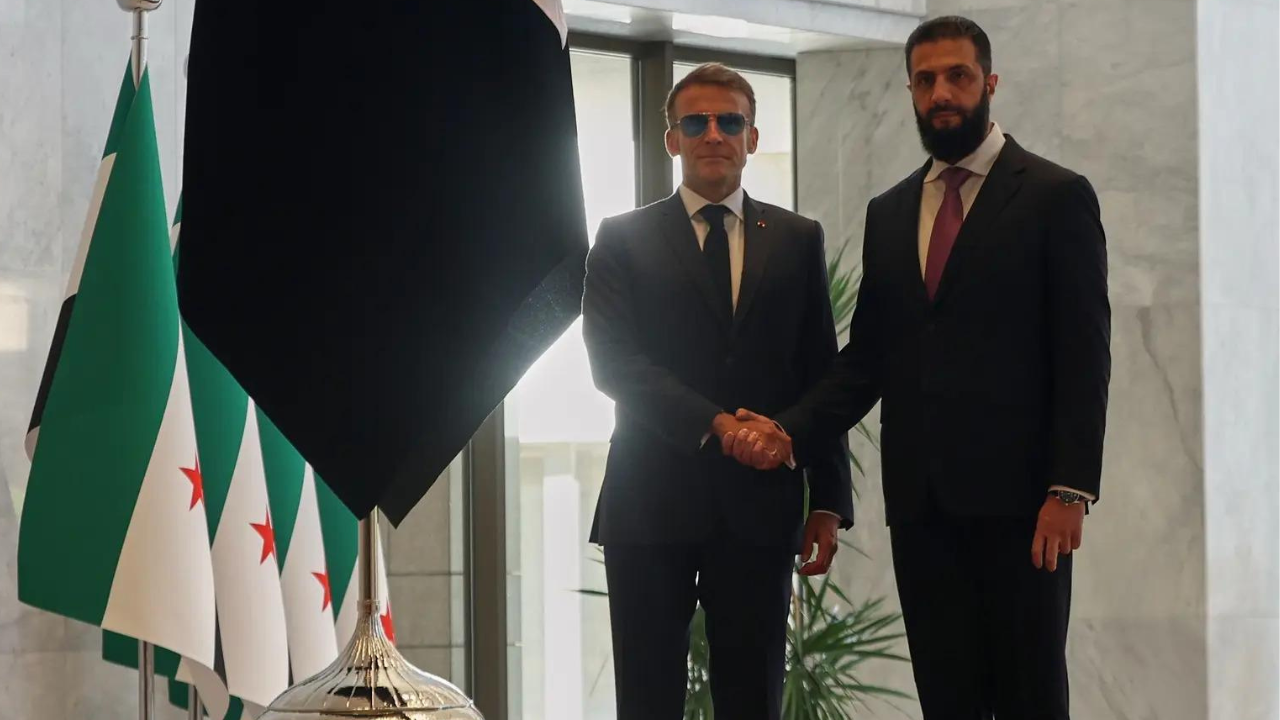
French President Emmanuel Macron narrowly escaped a security catastrophe in Syria when explosions rocked the immediate vicinity of his hotel. While official channels scrambled to downplay the incident as a minor disruption, the close shave exposes a fractured diplomatic strategy and a profound miscalculation of regional stability. Macron announced that his visit would continue regardless of the blasts. However, the reality on the ground indicates that France’s attempt to assert itself as a mediator in the Levant has placed its head of state in unprecedented physical danger.
The incident is not merely a logistical failure. It is a symptom of a deeper, systemic blindness regarding the volatile security architecture of modern Syria.
The Mirage of a Normalized Syria
Western intelligence agencies have spent years warning that Damascus remains a tinderbox, yet diplomatic ambitions frequently override tactical caution. Macron’s presence in the Syrian capital was intended to signal a new chapter of European engagement, an effort to check Russian and Iranian influence while addressing the lingering embers of regional conflict. Instead, the explosions near the presidential delegation's quarters shattered the illusion that any faction truly controls the security environment.
The official narrative from Paris focused heavily on resilience. Aides quickly released statements emphasizing the president's calm demeanor and his refusal to cut the trip short. This is standard political theater designed to project strength. Behind closed doors, the conversation is entirely different. Security details are grappling with a fundamental question. How did hostile actors manage to detonate ordnance close enough to rattle the windows of a heavily fortified diplomatic venue?
Syria is a patchwork of shifting allegiances. To assume a state visit could be insulated from the chaotic reality of local militias and embedded insurgent cells was an act of political hubris. The French administration gambled with the life of its head of state to secure a geopolitical foothold, and the return on that investment is proving to be incredibly perilous.
Deconstructing the Security Failure
A close shave of this magnitude requires a breakdown of multiple intelligence layers. Presidential travel to active conflict zones relies on a combination of host-nation guarantees, pre-advancement security sweeps, and electronic countermeasures. In Damascus, these layers failed to create a sterile environment.
- Host-Nation Complicity or Incapacity: The Syrian security apparatus either lacked the capability to secure the perimeter or intentionally allowed the breach to send a message.
- Intelligence Gaps: French external intelligence, the DGSE, failed to detect the movement of explosives or the positioning of mortars within striking distance of the hotel.
- Asymmetric Threats: The attack utilizes low-cost, high-impact tactics that are notoriously difficult to neutralize in a dense urban environment where every rooftop is a potential launchpad.
The technical reality of modern urban warfare means that absolute security does not exist. Mortars and weaponized commercial drones can be deployed in minutes by small teams blending into the civilian population. By choosing to stay in a centralized, known location rather than a mobile or highly classified secure site, the French delegation presented a static target. The explosions were a direct challenge to Western power, demonstrating that even the most elite protective details cannot rewrite the laws of ballistics and proximity.
The Role of Local Militias
To understand the source of the threat, one must look at the fractured nature of local armed groups. Damascus is ringed by factions that answer to different masters, some aligned with regional power brokers who view European intervention as an existential threat. These groups do not play by the rules of international diplomacy. For them, a French president is not a mediator. He is an opportunity to disrupt normalization efforts and embarrass the central government.
The Failure of the Pre-Advancement Sweep
Before a president sets foot in a hostile nation, advance teams spend weeks mapping every route, vetting every hotel employee, and establishing a secure communications net. When detonations occur within earshot of the executive suite, it means the perimeter was breached long before the motorcade arrived. The intelligence was stale, the local partners were unreliable, or the threat matrix underestimated the desperation of local actors.
The Geopolitical Fallout of Staying Put
Macron’s decision to continue the visit is an attempt to salvage French credibility. Leaving immediately would have been a public relations disaster, signaling that a major Western power could be driven out by a few well-placed shells. Yet, staying creates a terrifying tactical precedent. It tells adversaries that the threshold for altering Western diplomatic behavior is incredibly high, perhaps dangerously so.
This calculation ignores the strategic reality of the region. France wants to position itself as the bridge between a broken Syrian state and the international community, particularly regarding refugee repatriation and reconstruction funds. But Europe lacks the military leverage on the ground to enforce its will. Russia holds the airspace, Iran controls the ground corridors, and local warlords dictate daily survival. France is attempting to play a high-stakes poker game with a weak hand, and the Damascus explosions were a blunt reminder of that vulnerability.
The continuation of the trip will be framed as a triumph of European resolve. In reality, it leaves the French delegation exposed to secondary attacks, ambush risks during transit, and the unpredictable nature of an adversary that now knows exactly how close they can get. It is a high-wire act without a safety net.
The Structural Flaws in Western Diplomacy
The crisis in Damascus exposes a broader flaw in how Western powers approach asymmetric conflict zones. There is an entrenched belief that diplomatic prestige carries an inherent protective shield, that state actors will always protect a visiting dignitary to preserve their own international standing. This belief is obsolete.
In the current international landscape, non-state actors and proxy forces routinely use the targeting of high-profile figures to completely derail state-level negotiations. They do not seek a seat at the table. They seek to destroy the table entirely. By exposing the presidency to these dynamics, France has shown that its strategic planning remains trapped in an era of conventional state-on-state diplomacy, failing to adapt to the messy, fragmented reality of modern proxy warfare.
The coming days will reveal whether this close shave forces a reassessment of French foreign policy or if the administration will continue to chase the ghost of Levantine influence at the risk of executive catastrophe. The smoke over Damascus has cleared, but the structural instability that allowed it to rise remains entirely unchecked.