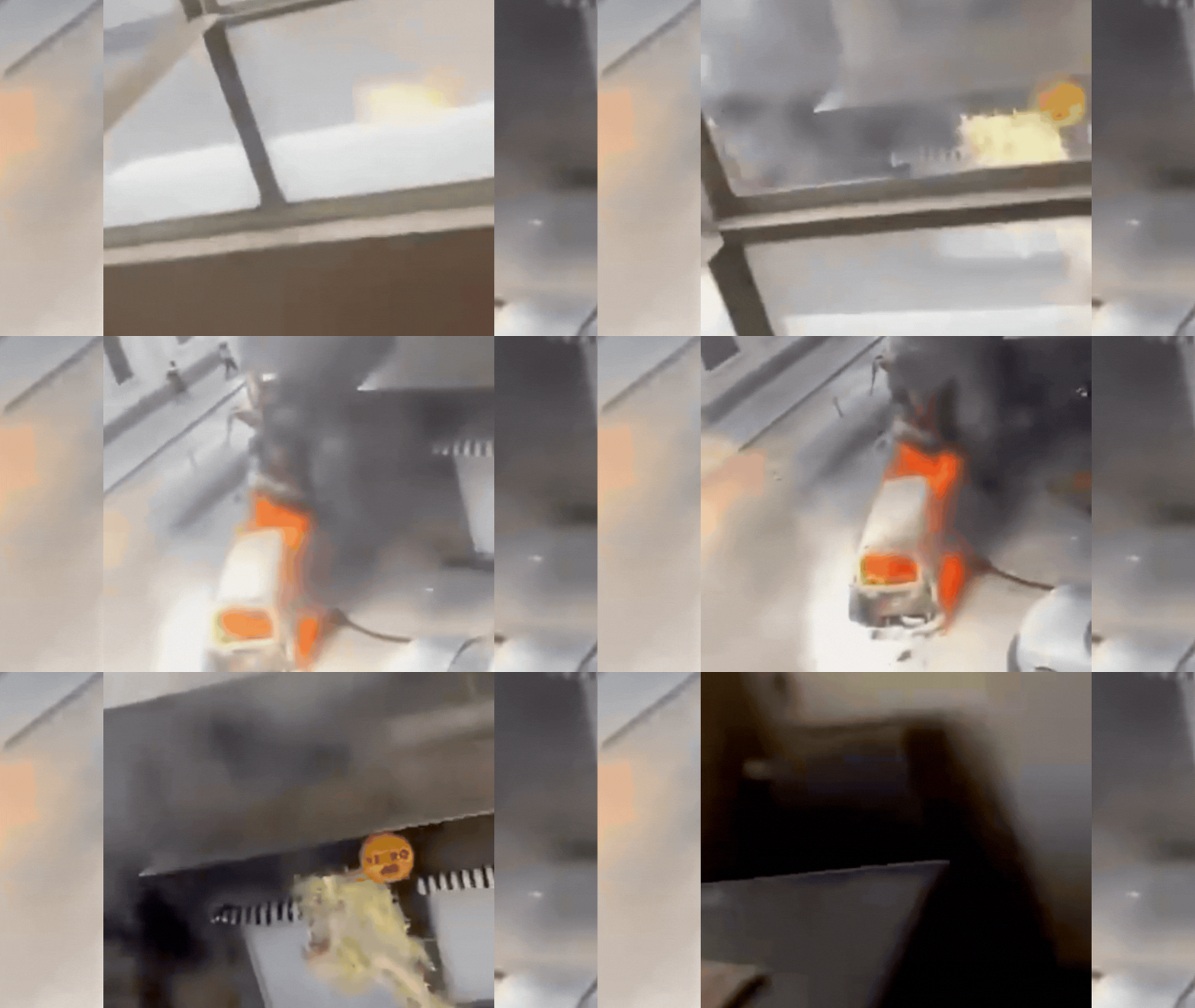
Two synchronized explosions shattered the fragile morning calm of central Damascus on Tuesday, sending plumes of black smoke into the sky just hundreds of meters from where French President Emmanuel Macron was staying. The dual improvised explosive devices—one concealed in a roadside trash bin and another rigged to a parked vehicle—detonated outside the Four Seasons Hotel. At least 18 people were wounded, including four police officers, leaving bloodstains on the asphalt alongside burned-out vehicles. Macron, who had already departed the hotel for a highly sensitive meeting with Syrian President Ahmad al-Sharaa at the presidential palace, was unhurt and unaware of the blasts until after he arrived. The French presidency quickly confirmed that the meetings would proceed as planned.
The attack exposes the profound instability underneath the surface of Syria's post-Assad era. Macron is the first European Union head of state to visit Damascus since an alliance of insurgent factions overthrew Bashar al-Assad in December 2024. By attempting to normalize relations and push for the lifting of Western sanctions, Paris is taking a massive geopolitical risk. The morning's explosions offer a grim reminder that while the leadership in the palace has changed, the underlying security vacuum remains unresolved.
The Failure of the Iron Ring
For months, the new authorities in Damascus have claimed absolute control over the capital city. They built what local security forces described as an impenetrable ring around the diplomatic quarter. Tuesday changed that narrative instantly. The first bomb detonated just after the French presidential motorcade cleared the area, targeting a heavily trafficked avenue nestled between the Syrian Ministry of Tourism and the Damascus National Museum.
Moments later, as emergency personnel and security officers rushed to the site, a second device went off next to an ambulance. This secondary detonation strategy is a classic tactic designed to maximize casualties among first responders and sow maximum panic. Reuters footage captured a motorcycle and a commercial van fully engulfed in flames while civilians fled through the smoke.
No group has claimed immediate responsibility for the twin bombings. The shadow of the Islamic State, disgruntled remnants of the Ba'athist intelligence apparatus, and various local warlords all loom large over the investigation. Just days prior, another bomb tore through a crowded café near the Damascus Justice Palace, killing 10 people and wounding 20 others. The repetition of these attacks proves that insurgent cells can still penetrate the heart of the government's high-security zones at will.
French security details accompanying Macron face an immediate crisis. French intelligence officers had spent weeks vetting the travel routes, checking buildings, and coordinating with the Syrian state apparatus. The fact that two separate devices could be planted and detonated right outside the primary hotel used for the French delegation suggests either a massive failure in intelligence or a worrying level of insider complicity within local security units.
Rebranding the Insurgency
To understand why Macron is risking his political capital in Damascus, one must examine the man sitting across from him at the presidential palace. Ahmad al-Sharaa was not always a conventional statesman. For years, he operated under the nom de guerre Abu Mohammad al-Golani, leading the powerful insurgent group Hayat Tahrir al-Sham, which originally grew out of an al-Qaeda affiliate.
Since seizing power in late 2024, al-Sharaa has executed one of the most aggressive political rebrandings in modern history. He traded military fatigues for tailored Western suits, trimmed his beard, and began preaching a doctrine of pluralism, economic modernization, and religious tolerance. He has moved swiftly to assure wary Christian, Alawite, and Druze minorities that his administration will protect them from sectarian reprisal.
France has chosen to take al-Sharaa at his word, largely because Paris views him as the only viable alternative to total anarchy or a prolonged fractured state. Macron has taken the lead in urging Washington and Brussels to roll back the sweeping sanctions packages that have choked the Syrian economy for over a decade.
This French strategy is deeply controversial among European allies. Several continental capitals remain deeply skeptical of al-Sharaa’s past and argue that legitimizing a former insurgent commander sets a dangerous precedent. The bombings on Tuesday will undoubtedly embolden critics who argue that the new Syrian government cannot even guarantee the safety of its own streets, let alone serve as a stable partner for international diplomacy.
The Commercial Calculus of Paris
Geopolitics rarely operates purely on principles. Macron's trip to Damascus is heavily backed by commercial interests. Traveling alongside the French president is a high-level delegation of corporate executives, including representatives from energy giant TotalEnergies and shipping conglomerate CMA CGM.
Syria requires hundreds of billions of dollars to rebuild its shattered infrastructure after 14 years of civil war. Its ports, power grids, highways, and oil fields are in desperate need of foreign capital and technical expertise. By positioning itself as the first Western power to break the diplomatic isolation of Damascus, France intends to secure the most lucrative reconstruction contracts for its own domestic industries.
- TotalEnergies is eyeing the revitalization of oil and gas fields in the eastern desert regions, which have been running under capacity or managed by local militias for years.
- CMA CGM is interested in expanding logistical control over the Mediterranean ports of Lattakia and Tartous, turning them into modern hubs for regional trade.
- French construction and engineering firms are eager to bid on massive urban redevelopment projects in ruined suburbs around Damascus and Aleppo.
Before the explosions occurred, the two leaders were scheduled to sign several bilateral agreements and memorandums of understanding aimed at opening up investment channels. Syria wants the money. France wants the market share. However, foreign investment requires stability, and international corporations will not deploy personnel or equipment to a country where car bombs can detonate outside five-star hotels with impunity.
The Minority Question and Domestic Friction
While al-Sharaa projects an aura of absolute control to visiting Western dignitaries, the internal dynamics within Syria tell a far more complicated story. The country remains deeply traumatized by more than a decade of sectarian warfare. Many members of the country's minority communities view the Sunni-dominated government with intense anxiety.
During his brief stay before the bombings, Macron met with various representatives of Syrian civil society to discuss the protection of these vulnerable groups. Reports have trickled out of northern and western Syria detailing sporadic clashes between government forces and localized minority militias who refuse to surrender their weapons to the new authorities in Damascus.
The current administration's hold on power is highly dependent on its ability to kickstart the economy and distribute resources equitably. If sanctions are not lifted and reconstruction money does not flow quickly, inflation will continue to sour, and public anger will boil over. The perpetrators of Tuesday’s bombings understand this timeline perfectly. By targeting the exact location of the French diplomatic mission, they sent a message to global investors that Syria is still a war zone, effectively choking off the economic lifeline al-Sharaa desperately needs.
Cross Border Complications and the Road Ahead
The security challenges facing Damascus are not contained within its borders. French diplomats have reportedly spent the last several weeks warning the al-Sharaa government to remain completely neutral regarding the ongoing regional military conflicts involving Israel and Lebanon. The previous regime had deep institutional links to regional militant networks, and parts of the Syrian security apparatus are still sympathetic to those factions.
Macron's next stop after Damascus is a high-profile NATO summit in Ankara, Turkey. Turkey shares a massive border with Syria and has long maintained its own military presence and proxy forces inside Syrian territory. Macron will have to explain his unilateral diplomatic push to Turkish President Recep Tayyip Erdogan and other NATO allies who view France's rapid embrace of al-Sharaa with varying degrees of alarm and annoyance.
The smoke cleared quickly from the street outside the Four Seasons Hotel on Tuesday morning, and the physical debris was swept away by municipal workers within hours. The political fallout will take much longer to resolve. Macron's determination to continue his meetings despite the security breach shows that Paris has committed fully to this path and cannot afford to back down.
Yet, as the French president sat in the gilded halls of the presidential palace discussing economic cooperation and diplomatic normalization, the smell of burnt rubber and explosives lingered just down the road. Syria's transition is not a clean break from the past. It is a violent, unpredictable process where the line between statecraft and survival remains razor-thin.