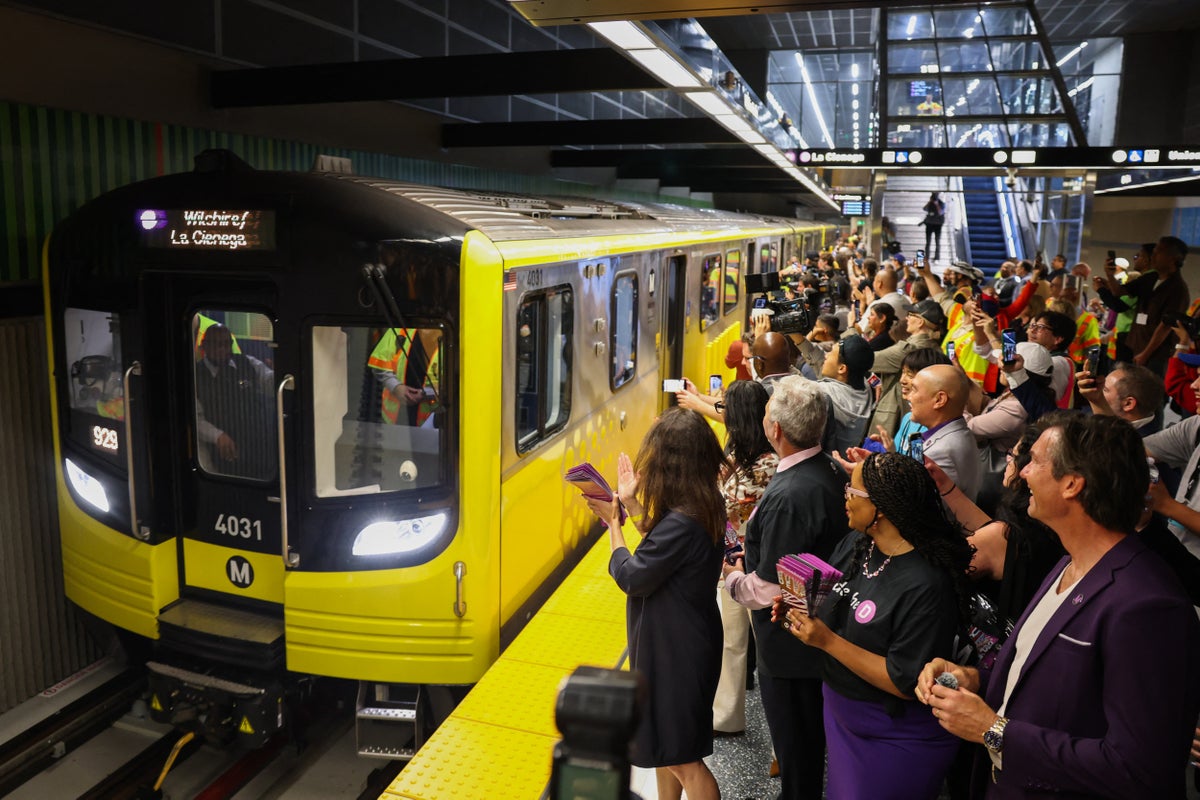
The headlines practically write themselves. Los Angeles Metro ridership surges by two million, fueled by a glittery lineup of Taylor Swift concerts, Beyoncé's Renaissance tour, and a packed summer of high-profile sporting events. The transit board is taking a victory lap. City officials are patting themselves on the back. The media is eating it up, spinning a cozy narrative about a car-centric city finally embracing the rails.
It is a beautiful fantasy. It is also completely wrong.
Celebrating a temporary transit spike driven by stadium tours is like a failing retail store celebrating Black Friday sales while its weekday foot traffic plummets to zero. It ignores the structural decay underneath. It mistakes a fleeting tourism bump for a sustainable, systemic shift in commuter behavior.
If we want to save public transit in Los Angeles, we have to stop treating stadium-bound pop stars as a viable ridership strategy.
The Illusion of the Event-Driven Surge
Let’s look at the cold, hard numbers.
LA Metro’s widely publicized "two million rider surge" sounds massive on a press release. But break down the math. LA Metro’s system spans light rail, heavy rail, and a massive bus network. When you spread two million trips across an entire month of operations, the daily bump is modest. More importantly, these rides are highly concentrated. They happen on specific lines, during specific hours, on specific days of the week.
This is what transit planners call peaking.
[System Baseline] ---------> [Massive Event Spike] ---------> [System Baseline]
(Steady Underuse)            (Overwhelmed Infrastructure)     (Steady Underuse)
An event-driven spike does not represent a change in daily habits. It represents a temporary logistical necessity. People took the train because parking at SoFi Stadium costs $100 and the traffic on Prairie Avenue is a legendary nightmare. Once the concert ends, those riders go right back to their SUVs for their daily commutes to Santa Monica, Glendale, or Downtown LA.
I have watched cities dump millions of dollars into tailoring their transit systems for major events, only to watch their daily, bread-and-butter commuter numbers stagnate or decline. When you design a system to serve the suburban concertgoer instead of the daily working-class commuter, you build a theme park ride, not a public utility.
The Invisible Middle Class of Transit
While Metro celebrates the influx of suburbanites riding the rails once a year to see a concert, the core rider is being ignored.
The true backbone of LA transit is not the tourist or the wealthy event-goer. It is the service worker, the student, the hospital staff, and the daily commuter who relies on the bus system. Historically, bus riders make up roughly 70% to 75% of Metro’s total ridership. Yet, the vast majority of public relations triumph—and capital investment—goes toward glamorous rail expansions and event-day logistics.
This is a classic case of survivorship bias in transit planning.
By focusing on the visible, photogenic crowd filling up trains to Exposition Park or Inglewood, Metro ignores the invisible crisis on its bus lines:
- Gridlock on Arterials: Buses are stuck in the same horrific traffic as single-occupancy vehicles because the city refuses to dedicate lane space to transit.
- The Safety Deficit: Daily riders, particularly women and shift workers traveling late at night, consistently report feeling unsafe. A temporary police presence during a Taylor Swift concert does nothing to solve the chronic security issues on a Tuesday night at 11:00 PM.
- Frequency and Reliability: A service worker trying to get to a shift at 6:00 AM does not care about a special express train running at midnight for concertgoers. They care that their bus runs every 8 minutes instead of every 30 minutes.
If Metro spent half as much energy optimizing its bus corridors and ensuring basic passenger safety as it did coordinating concert shuttle graphics, daily ridership would see a permanent, sustainable lift.
The True Cost of Public Transit Security Theater
Let's address the elephant in the station: safety.
Whenever critics point out that Metro is struggling to retain its core ridership, the agency points to its increased security deployment during high-profile events. This is security theater at its finest.
During massive events, stations are flooded with ambassadors, law enforcement officers, and Metro staff. The platforms feel secure, clean, and orderly. The casual rider goes home thinking, “Wow, Metro has really cleaned up its act.”
This is a temporary mirage.
Maintaining that level of staffing across a sprawling county-wide network 24 hours a day, 7 days a week, is financially impossible under current budgets. The moment the crowds disperse, the stations revert to their baseline state.
+------------------------------------+------------------------------------+
| Event-Day Security Theater         | Everyday Reality (Tuesday, 10 PM) |
+------------------------------------+------------------------------------+
| Flooded with transit ambassadors   | Empty platforms, unstaffed booths  |
| Visible law enforcement presence   | Delayed emergency response times   |
| Cleaned platforms and cars         | Neglected maintenance              |
| High-income, crowd-safety effect   | Isolated, vulnerable riders       |
+------------------------------------+------------------------------------+
Riders are not stupid. They see through this. You cannot build long-term trust with a consumer base by putting on a show only when the wealthy suburbanites come to town.
Dismantling the "Induced Demand" Myth for Transit
For decades, urban planners have relied on the concept of induced demand to argue against highway expansion: if you build more lanes, more cars will show up to fill them.
The inverse, however, does not automatically apply to transit. Just because you build a rail line to a stadium does not mean people will use it for their daily lives. Transit adoption is not a field of dreams; "if you build it, they will ride" is a lie.
People choose transit based on a brutal, rational calculation of three variables:
- Time: Does it get me there faster than driving?
- Cost: Is it significantly cheaper than driving and parking?
- Dignity: Is the experience clean, safe, and reliable?
In Los Angeles, transit almost always loses the time equation because the city is highly decentralized. Unlike New York or Chicago, where a single dominant downtown hub draws the vast majority of workers, LA’s jobs are scattered across dozens of nodes—Century City, Burbank, El Segundo, Pasadena, Westwood.
A rail network designed on a hub-and-spoke model cannot efficiently serve a decentralized metropolis. The event-driven surge only proves that transit works when thousands of people are headed to the exact same destination at the exact same time. It does nothing to solve the geometric problem of getting one person from Glendale to Torrance on a random Wednesday afternoon.
Stop Trying to Build Rail (Do This Instead)
The path forward is not glamorous. It will not get city council members invited to ribbon-cutting ceremonies, and it will not make for exciting press releases. But it is the only way to build a functional transit system in a sprawling megacity.
1. Seize the Lanes
Rail is incredibly expensive and takes decades to build. We do not have decades. The fastest way to transform LA transit is to take lanes away from cars and give them exclusively to buses.
We need physical, camera-enforced concrete barriers separating bus lanes on major arterials like Wilshire, Santa Monica, and Sunset Boulevards. If a bus can bypass traffic and move twice as fast as a Tesla, people will ride it. If the bus is stuck in the same bumper-to-bumper hell, it will remain the transportation of last resort.
2. Shift Funding from Tourism to Frequency
Stop prioritizing projects based on their proximity to future sporting events like the Olympics or the World Cup. Design the system for the people who live and work here every day.
Redirect capital budgets away from gold-plated rail extensions and into operating budgets. Use that money to run buses and trains every five to seven minutes, all day, every day. Frequency is freedom. When riders know they can show up at a stop without checking a schedule because a vehicle is always coming, ridership skyrockets.
3. Implement Proof-of-Payment with Real Barriers
The open-station design of many LA Metro rail stops is a failure. It invites fare evasion, which in turn leads to a lack of accountability and a decline in perceived safety.
Install floor-to-ceiling fare gates at every single station. Enforce fare collection. This isn't about punishing the poor; transit agencies can and should offer deep subsidies or free passes to low-income residents. It is about creating a controlled, cared-for environment where everyone who enters has verified their presence.
The two million rider "surge" is a distraction. It is a vanity metric designed to shield transit leadership from the uncomfortable reality of their daily performance.
If we continue to measure the health of our public transit system by how many concertgoers we can move on a Saturday night, we will continue to watch our daily ridership erode. It is time to stop chasing the high of the occasional stadium crowd and start doing the hard, unglamorous work of serving the daily commuter.
The party is over. It is time to fix the system.