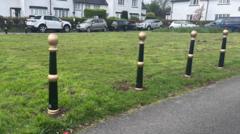
The outrage machine is at it again. In Gwaelod-y-Garth, a small village near Cardiff, the locals are clutching their pearls over some wooden posts. These aren't just any posts; they are "horrendous" bollards installed on a village green famous for appearing in Doctor Who. The narrative is predictable: big, bad councils ruining a picturesque filming location with "ugly" infrastructure.
It is a classic case of aesthetic entitlement winning over civic reality.
Everyone loves to complain about local government until a car tire tracks mud across the grass or an illegally parked SUV blocks an ambulance. These bollards aren't an eyesore. They are a defensive line against the entitlement of the modern driver and the romanticized delusions of the "not in my backyard" (NIMBY) crowd.
The Myth of the Untouched Green
The residents argue that these bollards ruin the "character" of a green used for filming. Let’s break that down. A film set is, by definition, an artificial construction. When Doctor Who rolls into town, they bring trucks, lighting rigs, cables, and a small army of technicians. They don't leave the green "natural." They leave it managed.
The idea that a village green must remain a frozen snapshot of the 1950s is a fantasy. Public spaces are living, breathing assets. They require protection. If you don’t install physical barriers, you are effectively granting a license for every delivery driver and tourist to treat the grass like a driveway.
I have seen dozens of councils attempt the "soft touch" approach. They use signs. They use "pretty" flower beds. They use gentle reminders in the local parish magazine. It never works. People ignore signs. They drive over flowers. The only thing a distracted driver respects is something that will actually dent their bumper.
Why Aesthetic Outrage is a Luxury Belief
"They look like something from a construction site," says one resident.
Good. They should.
The primary function of a bollard is visibility and protection. If you make them blend in too well with the "rustic charm" of the village, they become a trip hazard or a hidden obstacle that causes insurance nightmares. There is a specific, boring logic to the height and placement of these posts. It’s governed by safety standards, not interior design trends.
Complaining about the look of safety infrastructure is a peak luxury belief. It suggests that your visual comfort is more important than the structural integrity of the soil or the safety of pedestrians. We see this in urban planning constantly. People fight bike lanes because they "clutter" the street, then complain about traffic. They fight cell towers because they’re "ugly," then scream when their 5G drops.
The Doctor Who Fallacy
Using a TV show as leverage for your architectural complaints is a weak move. The BBC chose that location because it looked right for a specific scene at a specific time. They didn’t buy the village. They didn't grant it a permanent exemption from the 21st century.
In fact, the "Doctor Who" fame is exactly why the bollards are necessary. Fame brings fans. Fans bring cars. Cars bring erosion. If the village green is a "monument," then treat it like one. You don't let people drive their Citroens onto the lawn at Versailles. Why should Gwaelod-y-Garth be any different?
The Physics of Soil Compaction
Let’s talk about the science that the "outraged" ignore. When a vehicle drives onto a grass verge or a village green, it does more than just flatten the blades. It causes soil compaction.
- Pore Space Reduction: Soil needs air and water to reach the roots. Weight from tires crushes those tiny pockets.
- Drainage Failure: Compacted soil becomes impermeable. Instead of soaking up rain, the green becomes a muddy pond.
- Root Death: Without oxygen, the grass dies from the bottom up.
By the time the residents noticed the green was "ruining," it would be too late. The council is acting preemptively to prevent the green from becoming a dust bowl or a swamp. The bollards are a one-time cost that prevents a lifetime of expensive landscaping repairs.
The "Ugly" Argument is a Trap
When people call something "horrendous," they are usually avoiding a harder conversation about change. They don't want the bollards because the bollards represent an end to the "wild" era where rules were optional.
A bollard is a boundary. It says: "This space is for people, not machines."
If you truly cared about the village green, you would welcome the posts. You would see them as a commitment from the local authority to keep the space car-free. Instead, the focus is on the color of the wood or the shape of the top. This is bikeshedding—the act of giving disproportionate weight to trivial issues while ignoring the complex ones.
The Cost of "Pretty" Solutions
Could the council have used something more "integrated"? Sure. They could have spent £50,000 on hand-carved stone monoliths or Victorian-style cast iron posts.
But then the headline would be: "Council Wastes Thousands on Fancy Posts While Potholes Go Unfilled."
Local government is a game of trade-offs. Standardized wooden bollards are cost-effective, durable, and easy to replace when someone inevitably hits one. They are the honest choice. Using high-end materials to appease the aesthetic sensibilities of a few vocal residents is a misuse of public funds.
Stop Asking for "Consultation" on Common Sense
One of the loudest complaints in these stories is always: "We weren't consulted!"
We have over-consulted ourselves into paralysis. Does a council need a town hall meeting to decide to stop people from driving on the grass? No. That is basic maintenance. It is the execution of a standing duty to protect public assets.
If we consulted on every bollard, every sign, and every trash can, nothing would ever get built. The "outrage" here isn't about a lack of democracy; it’s about a lack of control. Residents feel they own the visual field of the village. They don't. The public space belongs to the public, and that includes the future public who won't have a green to enjoy if the current one is driven into the dirt.
The Real Enemy Isn't the Council
The real enemy is the car.
If people didn't feel entitled to park wherever they pleased, we wouldn't need bollards. The "horrendous" posts are a physical manifestation of our collective failure to behave. They are a mirror reflecting the fact that we cannot be trusted to respect a simple patch of grass without a physical barrier stopping us.
If the residents want the bollards gone, the solution isn't a petition. It's a total cultural shift in how we treat common land. Until that happens, the bollards stay.
A Lesson in Functional Beauty
There is a certain honesty in a bollard. It doesn't pretend to be a tree. It doesn't pretend to be art. It is a functional object doing a necessary job.
We need to stop demanding that every piece of infrastructure look like a prop from a period drama. True beauty in a village isn't found in the absence of posts; it’s found in a green that is actually green, healthy, and safe for children to run on without dodging a delivery van.
The residents of Gwaelod-y-Garth should stop looking at the posts and start looking at what the posts are protecting. They are protecting the very thing the residents claim to love.
The bollards aren't the problem. The whining is.
Get over the aesthetics. Protect the land. Move on.