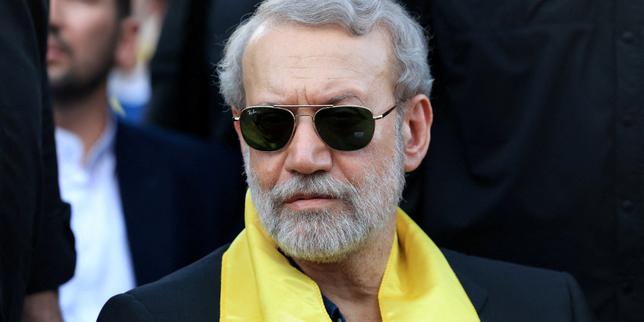
The targeted elimination of Ali Larijani by Israeli forces represents a fundamental shift in the regional conflict from tactical attrition to the systematic dismantling of Iran’s ideological and diplomatic architecture. While previous strikes focused on operational commanders—the "muscle" of the Axis of Resistance—this action strikes the "connective tissue" between the Iranian theocracy and its external proxies. Larijani was not merely a high-ranking official; he functioned as the primary architect of Iran’s long-term regional integration strategy and a critical backchannel for nuclear negotiations. The removal of such a figure creates an immediate institutional vacuum in Tehran’s ability to synchronize its "Forward Defense" policy.
The Triad of Strategic Impact
To evaluate the significance of this event, one must categorize the impact across three distinct operational layers: diplomatic continuity, proxy synchronization, and internal regime stability.
1. The Diplomatic Deficit
Larijani occupied a unique position as a "bridge" figure. Unlike the hardline ideological purists of the Islamic Revolutionary Guard Corps (IRGC), Larijani possessed the sophisticated political vocabulary required to engage with Western and regional powers. His removal creates a negotiation bottleneck. Without his mediation, the Iranian leadership loses its most effective tool for calibrated escalation—the ability to signal intent through unofficial channels to prevent a localized conflict from becoming a total war.
2. The Command and Control Fracture
The relationship between Tehran and its proxies (Hezbollah, Hamas, and the Houthis) relies on personal trust and historical prestige. Larijani’s authority was derived from decades of proximity to Supreme Leader Ali Khamenei. His death introduces friction in the transmission of orders.
- Latency: Proxy leaders must now recalibrate their loyalty to a new, likely less experienced, intermediary.
- Divergence: Without a singular authoritative voice like Larijani’s, individual proxy groups are more likely to pursue autonomous agendas that may not align with Tehran’s overarching strategic interests.
3. Intelligence Penetration and the Paranoia Loop
The successful execution of an operation against a figure of Larijani’s stature confirms the catastrophic failure of the Iranian counterintelligence apparatus. This creates a psychological tax on the remaining leadership.
- Decentralization: Fearing further strikes, the regime may decentralize its command structure, which reduces its efficiency and increases the risk of miscalculation.
- Paranoia: The inevitable internal purge that follows such a high-level breach will likely sideline competent but "suspicious" officials, further degrading the state's administrative capacity.
The Operational Mechanics of the Strike
The technical precision required to track and neutralize an individual of Larijani’s rank suggests a multi-layered intelligence operation that integrates signals intelligence (SIGINT), human intelligence (HUMINT), and real-time geospatial surveillance (GEOINT).
The Israeli strategy appears to be a shift from territorial attrition (targeting missiles and bunkers) to cognitive decapitation. By removing the intellectual and diplomatic "nodes" within the Iranian power structure, the IDF (Israel Defense Forces) and Mossad are not just destroying hardware; they are dismantling the software that runs the Axis of Resistance.
The Cost-Benefit Ratio of High-Value Target (HVT) Elimination
High-value target operations follow a specific mathematical logic. The cost of the operation is fixed (intelligence gathering, munitions, diplomatic fallout), while the benefit is variable based on the target’s replacement cost.
- Low Replacement Cost: Field commanders in Gaza or Southern Lebanon are often replaced within hours.
- High Replacement Cost: Strategists like Larijani, who possess 40 years of institutional memory and unique diplomatic relationships, are effectively irreplaceable in the short to medium term.
The removal of Larijani represents a massive net loss for the Iranian state’s "strategic depth." It is a move that increases the entropy of the Iranian decision-making process.
The Strategic Bottleneck: Tehran’s Response Matrix
Tehran’s response options are currently constrained by a series of structural vulnerabilities. The regime faces a classic Trilemma in its retaliatory strategy:
- Symmetric Escalation: Directly striking Israeli high-value targets would provide domestic satisfaction but carries an unacceptably high risk of inviting a full-scale Israeli-American strike on Iran’s nuclear infrastructure.
- Asymmetric Proxy Surge: Utilizing Hezbollah or the Houthis to increase the volume of fire is the traditional Iranian playbook, but Hezbollah’s command structure is already severely degraded, and the Houthis have limited reach against Israel’s hardened missile defense systems (Arrow 2, Arrow 3, and David’s Sling).
- Diplomatic Retrenchment: Accelerating the nuclear program toward weaponization is the "ultimate deterrent," but it risks preemptive destruction before a viable warhead can be fielded.
This creates a state of strategic paralysis. The death of Larijani—the very man who would have been tasked with navigating this trilemma—makes a coherent response even less likely.
Technical Implications for Regional Stability
The elimination of Larijani must be viewed through the lens of Integrated Deterrence. By demonstrating the ability to reach into the most protected circles of the Iranian state, Israel is signaling that no degree of geographic distance or political rank provides immunity.
The Shift in Kinetic Rules of Engagement
Previously, there was an unspoken "Red Line" regarding the targeting of top-tier political figures. This strike indicates that the threshold for acceptable targets has been permanently lowered. This has two immediate consequences:
- Hardened Infrastructure: Iran will likely accelerate the transition of its remaining leadership into deep underground facilities, further isolating them from the realities on the ground.
- Technological Escalation: The use of increasingly sophisticated AI-driven surveillance and autonomous strike platforms will become the norm in this conflict, as both sides seek to minimize the human risk involved in high-stakes operations.
Assessing the Displacement of Iranian Influence
The most profound long-term effect of Larijani’s death is the erosion of Iranian soft power within the Middle East. Larijani was the face of a "pragmatic" Iran that could talk to Riyadh, Moscow, and Beijing. Without him, the regime appears increasingly one-dimensional—a military-industrial complex with a thinning ideological veneer.
The Power Vacuum in the Shia Crescent
In Iraq and Syria, where Larijani was a key power broker, his absence will be felt immediately. The local factions that relied on his personal guarantees will now face a period of uncertainty. This creates an opportunity for regional rivals (Turkey, Saudi Arabia) to re-assert influence in areas that were previously considered Iranian strongholds.
The Institutional Fatigue of the IRGC
The IRGC is now forced to take over the diplomatic functions previously handled by Larijani’s office. This mission creep will inevitably lead to institutional fatigue. Military officers are rarely successful diplomats, and their involvement in high-stakes negotiations typically leads to more rigid, less creative outcomes.
Strategic Play: The Path Forward
The liquidation of Ali Larijani is a decisive move in a larger campaign of systemic dismantling. For Israel and its allies, the objective is no longer to "manage" the conflict with Iran but to render the Iranian regional strategy functionally inoperable.
The immediate strategic play for regional actors is to exploit the period of transition in Tehran. As the regime scrambles to replace Larijani’s unique skill set, intelligence agencies will have a window of opportunity to identify and engage with disillusioned elements of the Iranian bureaucracy who see the current path as suicidal.
For the international community, the focus must shift to the nuclear breakout window. With the most effective "diplomatic valve" removed, the risk of Iran making a desperate dash for a nuclear weapon has increased. Surveillance of the Fordow and Natanz facilities must be intensified.
The era of "strategic patience" is over. We have entered an era of strategic liquidation. The removal of Larijani is not the end of the war; it is the beginning of the end of the Iranian regime’s ability to project power beyond its borders.