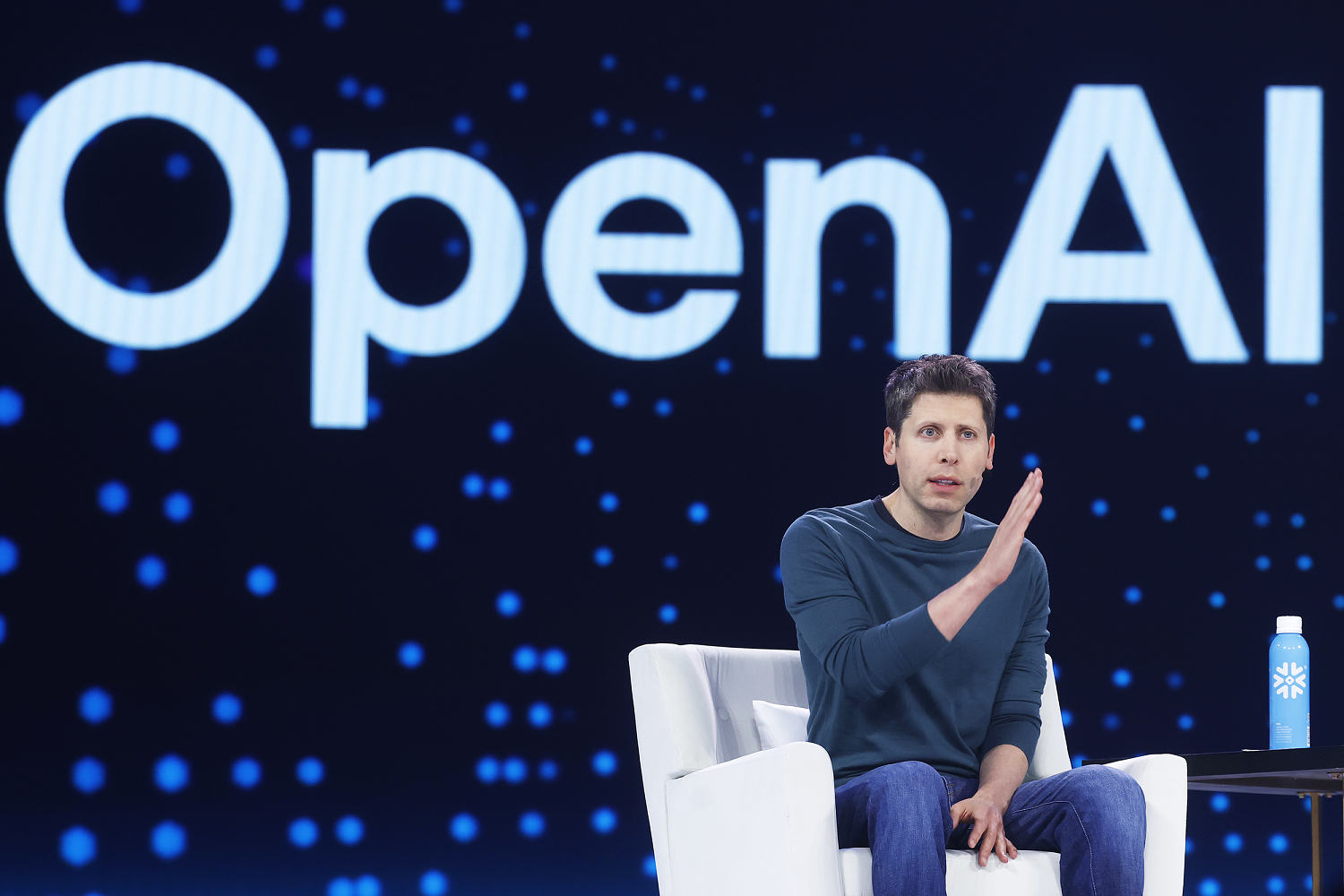
The State of Florida’s lawsuit against OpenAI and its Chief Executive Officer, Sam Altman, represents a fundamental clash between non-profit foundational charters and the economic realities of scaling frontier artificial intelligence. At its core, the litigation transcends standard corporate governance disputes; it interrogates whether an organization can legally transition its core asset base from a public-good mandate to a highly commercialized capitalization structure without triggering catastrophic liability under state consumer protection and deceptive trade practices laws.
The state’s complaint centers on an alleged bait-and-switch: capturing public trust, academic collaboration, and early-stage philanthropic capital under the guise of an open-source, safety-first research lab, only to restrict access and maximize equity value for private investors once structural breakthroughs were achieved. Analyzing this dispute requires deconstructing the underlying structural incentives, the mechanics of the capped-profit transition, and the specific legal levers state prosecutors are deploying to challenge OpenAI’s operational architecture. Read more on a connected topic: this related article.
The Structural Inversion of the OpenAI Governance Model
To understand the legal vulnerability targeted by the Florida Attorney General, one must examine the friction points within OpenAI’s corporate architecture. The organization was founded as a 501(c)(3) public charity with an explicit mandate to build safe, universally beneficial artificial general intelligence (AGI) while freely sharing its research.
The structural inversion occurred when the capital requirements for training large language models outpaced traditional philanthropic funding vectors. Compute scaling laws dictated that moving from GPT-2 to GPT-3 and beyond required billions of dollars in cloud infrastructure capital, necessitating the creation of a commercial vehicle. More reporting by Ars Technica highlights similar perspectives on this issue.
This structural evolution established a highly irregular hierarchy:
- The Non-Profit Alpha: The 501(c)(3) entity (OpenAI Inc.) remains the ultimate controlling node. It possesses a fiduciary duty to humanity, not to investors.
- The Holding Entity: A commercial transition layer designed to manage equity distribution.
- The Capped-Profit LLC: OpenAI Global LLC, the operating entity that houses the intellectual property, commercial contracts, and computing partnerships (notably with Microsoft). Investors in this tier are legally restricted to a capped return on their principal, after which all residual value reverts to the non-profit.
The legal vulnerability emerges from the operational execution of this structure. The state’s argument rests on the premise that the commercial tail has effectively wagged the non-profit dog. When the board exercised its fiduciary duty in November 2023 by terminating Sam Altman over a perceived failure to remain "candid in his communications," the subsequent investor and employee revolt forced a near-instantaneous reversal.
From an analytical standpoint, this event demonstrated that while the non-profit board held de jure control on paper, the commercial entity and its primary capital providers held de facto control over the organization's operational reality. The state alleges that this delta between stated governance and actual operational mechanics constitutes a deceptive practice toward the public.
The Deceptive Trade Practices Framework: Quantifying Misrepresentation
Florida’s legal strategy bypasses traditional shareholder derivative logic—since the public are not shareholders—and instead relies heavily on consumer protection statutes, specifically the Florida Deceptive and Unfair Trade Practices Act (FDUTPA). The prosecution’s case relies on proving a systemic divergence between OpenAI's public declarations and its operational deployment.
To establish liability, the prosecution must map three distinct vectors of misrepresentation:
1. The Open-Source Asymmetry
OpenAI established its initial brand equity and attracted top-tier research talent on the explicit premise of open collaboration. The transition to a closed, proprietary model system (beginning with the commercialization of GPT-3 and hardening with GPT-4) is framed not as a pivot driven by safety considerations, but as an exclusionary mechanism designed to secure market dominance for commercial partners. The state quantifies this by contrasting early manifestos celebrating the democratization of AI with the highly restrictive API structures and non-disclosure terms governing current enterprise deployments.
2. The Commercialization of Safety Benchmarks
The complaint alleges that safety evaluations have been functionally subsumed by product launch cycles. In a standard corporate framework, safety testing is a cost center, whereas deployment is a revenue driver.
By tying executive compensation and investor returns to the speed of commercial deployment, OpenAI created an internal cost function where delaying a model launch to conduct rigorous red-teaming carries a severe financial penalty. The state seeks to prove that OpenAI systematically discounted safety margins to beat competitors to market, directly contradicting its public safety charter.
3. Asymmetric Information Transfer to Commercial Incumbents
The partnership with Microsoft introduces a profound conflict of interest regarding the "benefit of humanity" mandate. The exclusive licensing of core IP to a mega-cap technology company creates a closed loop where the economic rents generated by foundational model discoveries are captured by private enterprise before any broader societal distribution occurs. Florida argues that consumers and regional businesses are forced to pay market-rate premiums for technologies that were advertised as public infrastructure.
The Defense Vector: Safety as a Justification for Opacity
OpenAI’s legal defense will inevitably anchor itself to the concept of "existential risk mitigation." The core argument posits that the shift from open-source transparency to proprietary opacity was not driven by profit maximization, but by an evolving understanding of catastrophic risk vectors associated with highly capable autonomous agents.
Under this framework, open-sourcing the weights of a human-level or near-human-level cognitive model constitutes an irreversible proliferation risk. Malicious actors could strip safety filters, fine-tune the model for biochemical synthesis, or deploy autonomous cyber-weapons at zero marginal cost.
Therefore, OpenAI will argue that restricting access behind a controlled API layer is the only operationally responsible method to fulfill its original non-profit mandate of ensuring AGI benefits humanity.
However, this defense faces a severe logical bottleneck. If the decision to withhold model access was purely safety-driven, the commercial monetization of those exact models through enterprise subscriptions and hardware partnerships must be strictly decoupled from corporate profitability.
The state will counter by looking at the allocation of compute resources: if internal infrastructure is overwhelmingly allocated to optimizing commercial workloads rather than accelerating alignment research, the safety argument loses its empirical foundation.
Economic and Operational Implications for the Frontier AI Ecosystem
The structural scrutiny brought by the Florida lawsuit signals the end of the hybrid non-profit/commercial corporate archetype in Silicon Valley. The legal pressures exposed by this case establish clear operational constraints for all market participants.
Capital Allocation Bottlenecks
Foundational AI development requires capital expenditures that are fundamentally incompatible with non-profit structures or traditional philanthropic horizons. A modern cluster running tens of thousands of next-generation accelerators costs billions to acquire and power.
Organizations can no longer straddle the line; they must either accept the lower velocity of purely public or academic funding or adopt explicit, transparent C-corporate forms that explicitly state profit maximization as a primary objective, tempered only by standard regulatory compliance.
Regulatory Weaponization of Corporate Charters
State attorneys general are increasingly utilizing consumer protection laws as a proxy for federal AI regulation. In the absence of comprehensive federal legislation governing model deployment, state-level litigation regarding corporate governance and consumer deception will dictate operational standards.
Companies that made expansive, marketing-heavy statements about safety, ethics, and openness during their developmental phases will find those statements converted into binding legal benchmarks by state prosecutors.
The Auditing of Alignment Claims
This litigation will likely force a standardization of what constitutes safety and alignment research. Currently, "safety" is a loosely defined corporate catchphrase. A protracted legal discovery process will force OpenAI to disclose internal emails, board minutes, and resource allocation metrics.
This will establish a clear public ledger detailing exactly how much capital was spent on commercial product optimization versus empirical safety engineering.
Strategic Realignment Mandate
For executive leadership across the artificial intelligence sector, the corporate architecture of OpenAI can no longer be viewed as a viable template for scaling operations. The optimal strategic play requiring immediate execution involves three distinct operational course corrections.
First, corporations must execute a clean decoupling of safety research and commercial deployment. If a business unit is tasked with risk mitigation, its funding, reporting lines, and performance metrics must be structurally insulated from the commercial success of model rollouts.
Concurrently, corporate charters must be audited to eliminate aspirational language that can be legally construed as a binding warranty to the public. Marketing and communication teams must align corporate statements with the realities of fiduciary duties owed to equity holders.
Finally, firms must prepare for an era of fragmented domestic regulation. When state-level consumer protection acts are successfully deployed against technology developers, compliance architectures must be rebuilt to monitor and adjust to regional legal standards rather than treating the domestic market as a regulatory monolith. The survival of frontier research labs depends entirely on their ability to match the legal clarity of their corporate structures with the empirical reality of their capital requirements.