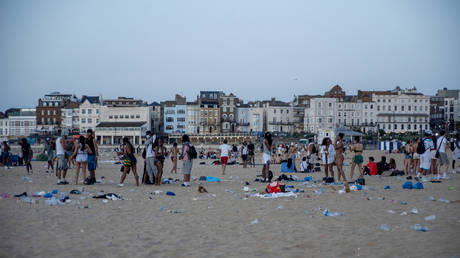
The rain in any given English market town doesn't just fall; it bleeds into the tarmac, turning the historic red-brick facades into a slick, monochromatic reflection of the sky. By 11:00 PM on a Friday, that reflection is usually shattered by the heels of weekend revellers, the bass vibrating through the heavy oak doors of the local pub, and the familiar, chaotic symphony of a British high street in full swing.
But tonight, a new kind of quiet is settling over these coastal and rural hubs.
It starts with a laminated A4 sign taped to a lamppost. It looks innocuous, printed in the dry, bureaucratic font of a local council decree. Yet, its message is sharp enough to rewrite the social fabric of the neighborhood. The Public Spaces Protection Order—or PSPO, to those who track the shifting tides of local governance—has officially banned the consumption of alcohol across vast swathes of public town centers.
To the casual observer, it is a straightforward cleanup operation. A war on anti-social behavior. An effort to erase the unsightly image of broken glass and rowdy arguments from the doorsteps of independent boutiques. But look closer, past the sterile language of municipal policy, and you find a deeply human friction between the desire for public safety and the survival of the traditional British community.
The Ghost of the Public Square
Consider a man we will call David. He is sixty-four, a retired dockworker, and he has lived within a two-mile radius of the same North Yorkshire high street for his entire life. Two years ago, David lost his wife. His kids live in Manchester and London. His week is a vast, echoing expanse of silence, punctuated by two distinct events: a Tuesday morning trip to the butcher, and a Friday evening where he sits on the memorial bench near the town fountain, catches the last rays of watery sunlight, and opens a single, cold can of bitter.
He doesn't shout. He doesn't smash bottles. He talks to the people walking their dogs. He asks after the baker’s children. For David, that bench and that beverage are a tether to the living world.
Under the new regulations sweeping across dozens of UK towns, from the windswept corners of Devon to the post-industrial valleys of Wales, David is now a lawbreaker.
If a community enforcement officer spots him crack the tab on that can, he faces an immediate £100 fine. If he can’t or won't pay, that figure can skyrocket to £1,000 in a magistrates' court. The law, by its very nature, is a blunt instrument. It cannot distinguish between a lonely man seeking a moment of connection and an aggressive group causing a public nuisance. It simply clears the square.
This is the invisible stake of the booze ban. When we sanitize our public spaces to eliminate friction, we often eliminate the people who rely on those spaces the most.
The Math Behind the Modern Prohibition
The impulse from local councils is entirely understandable. They are trapped in a vice. A decade of severe funding cuts has left local authorities with skeletal budgets, while the police forces tasked with monitoring British night-time economies are stretched to a breaking point.
Statistically, the link between cheap, off-license alcohol and town-center disorder is undeniable. Data from the Office for National Statistics has consistently shown that alcohol is a factor in a staggering proportion of violent incidents in public spaces. On paper, removing the catalyst removes the crime.
But the math of human behavior is rarely that linear.
When a town imposes a blanket ban on drinking in its streets, the activity does not vanish into the ether. It displaces. It moves down the road, past the boundary markers of the council’s map, into the unlit parks, the residential alleyways, and the hidden canal paths. The problem isn't solved; it is merely pushed into the shadows where there are no CCTV cameras, no streetlights, and no passing foot traffic to keep the peace.
There is a stark irony here. The high street is already dying a slow, agonising death at the hands of online retail and skyrocketing commercial rents. For decades, the one thing the internet could not replicate was the physical, chaotic, beautiful reality of human gathering. By turning town centers into sterile corridors where lingering is viewed with suspicion, we risk stripping away the final reason people have to visit them at all.
The Broken Window Fallacy of the Soul
We are told that these measures are about pride. It is a modern iteration of the old "broken windows" theory of policing: if you fix the small signs of disorder, you prevent the larger crimes from taking root. The logic dictates that if a family stepping out of a pizza restaurant doesn't have to walk past a group of boisterous drinkers, they will feel safer, spend more money, and return more often.
But we have to ask what we are sacrificing on the altar of this pristine, commercialized vision of community.
A town is not a shopping mall. It is an ecosystem. It requires the old, the young, the eccentric, and the marginalized to coexist in the same space. When you introduce laws that allow the state to fine someone simply for holding a container, you alter the psychology of the street. The default setting shifts from trust to surveillance. The police and council wardens are no longer guardians of the peace; they are cosmic bouncers regulating an open-air venue.
It is a confusing time to navigate the geography of British life. We are urged to combat loneliness, to step outside our front doors, and to support local businesses. Yet, the moment we sit down in a public square without a commercial receipt in our hands, the clock begins to tick.
The Empty Bench
The sun goes down fast in July when the cloud cover is thick. On the high street, the shopfronts are shuttered with gray steel grates. A cold wind sweeps up from the coast, carrying the scent of salt and vinegar from the local chippy, along with the distinct absence of voices.
The fountain in the center of the square murmurs quietly to itself. The memorial bench is empty.
David stayed home tonight. He watched a repeat of a quiz show he had already seen three times, sitting in an armchair that smells faintly of old upholstery and dust. Outside, his town center is clean. The streets are spotless. The pavement is clear of glass, clear of noise, and entirely clear of life.
We have successfully policed the rowdiness out of the neighborhood, and in doing so, we have policed away the neighbors.