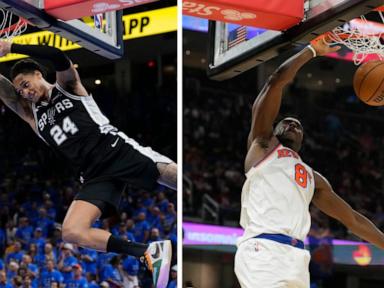
The media machine loves a time machine. As Game 1 of the 2026 NBA Finals tips off at the Frost Bank Center, every mainstream outlet is running the exact same lazy, nostalgia-soaked script. They are selling you a "rematch of the 1999 Finals". They are hyping up celebrity-packed front rows, superfan hysterics, and a romanticized clash between New York grit and San Antonio system basketball.
It is total fiction.
If you are buying into the "playoff buzz and superfan excitement" angle, you are being spoon-fed a narrative designed to generate casual clicks rather than break down actual basketball mechanics. This series is not a historical throwback, nor is it a validation of traditional team-building.
The Illusion of the Nine Day Rest Advantage
The lazy consensus dominating sports talk radio this week is that the New York Knicks have the definitive upper hand because they swept the Cleveland Cavaliers and rested for nine days. Meanwhile, the San Antonio Spurs just crawled out of a brutal seven-game war against the Oklahoma City Thunder.
I have watched teams spend decades mismanaging player recovery cycles in June. The idea that a nine-day layoff in the high-intensity environment of the modern NBA is an advantage is fundamentally flawed.
- Muscle Rust vs. Game Rhythm: In professional basketball, aerobic conditioning drops off quickly without live-game stress. The Knicks haven't faced actual defensive resistance since late May.
- The Shock of Speed: The Spurs are arriving hot, battle-tested, and already operating at the precise, hyper-accelerated physical pace required to win a title in 2026.
To assume New York will stroll into Game 1 completely fluid while San Antonio is too exhausted to move ignores how modern sports science handles active recovery. The Spurs are sharp; the Knicks are cold.
The Wembanyama Deception
Every analyst is framing this series as Jalen Brunson’s offensive brilliance going head-to-head with Victor Wembanyama's generational defensive length. This binary completely misinterprets how San Antonio actually operates on the floor.
Traditional View: Wembanyama = Rim Protector
Actual Blueprint: Wembanyama = Offensive Floor-Spacer & Transition Catalyst
Wembanyama is not merely a modern-day David Robinson anchoring a traditional drop-coverage scheme. He is a perimeter-oriented offensive engine pulling Karl-Anthony Towns completely out of the paint. If New York tries to match up traditionally, their interior defense will be utterly dismantled.
The Real Tactical Battlegrounds
People Also Ask: How can the Knicks stop Victor Wembanyama?
They can't. The premise of the question is wrong. You do not stop a guy with an 8-foot wingspan who shoots off the dribble. You force him to cover ground laterally until his legs give out.
Instead of focusing on Wembanyama alone, the series actually hinges on two entirely different factors:
- The Stephon Castle Variable: The rookie guard is the structural glue allowing San Antonio to play positionless basketball. His ability to hound Brunson for 94 feet will dictate the tempo of Game 1.
- The True Cost of Towns: Bringing Karl-Anthony Towns to New York was heralded as the final piece of a championship puzzle. But in a series against a hyper-athletic, spacing big man like Wembanyama, Towns' defensive lateral mobility becomes a catastrophic liability.
Stop Romanticizing Superfan Culture
The media is obsessed with the idea that the return of Finals basketball to Madison Square Garden is somehow a victory for the soul of the sport. They focus on the cameras tracking famous faces courtside.
Let's be brutally honest: crowd noise does not fix a broken half-court offense.
The Knicks’ 11-game playoff win streak was built on bullying a severely depleted Eastern Conference. Relying on the emotional energy of a fan base that has been starving since 1999 is a desperate strategy. When the whistle blows, Spike Lee isn't rotating to block a shot on the weak side. The tactical reality of the Spurs' half-court execution will silence the noise remarkably fast.
The downside to this contrarian view? If New York’s perimeter shooters catch absolute fire due to the adrenaline of the home crowd later in the series, tactical schemes can occasionally get overridden by sheer variance. But betting an entire championship series on shooting variance and fan hype is a losing proposition.
Forget the 1999 history lessons. Disregard the narrative about rest. This series is a cold, calculated evaluation of modern basketball geometry. The team that manipulates space better wins, and right now, San Antonio has the mathematical advantage.
Watch the spacing on the first three possessions of Game 1. You will see immediately that the mainstream coverage has been looking at the wrong sport all week.
.jpg?width=1200&auto=webp&crop=3%3A2)