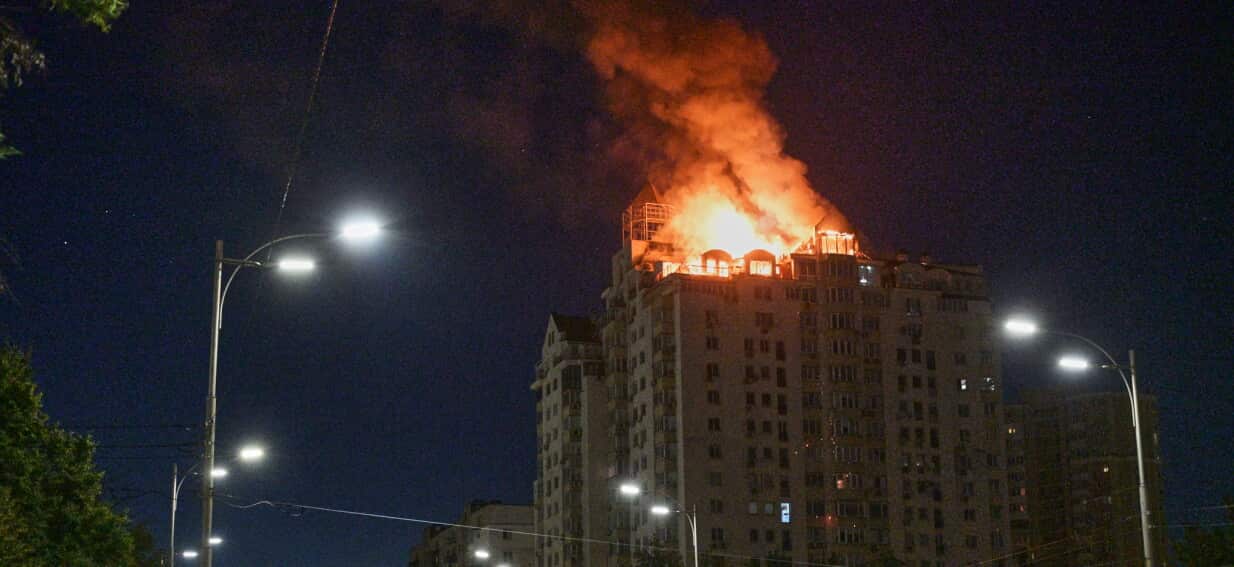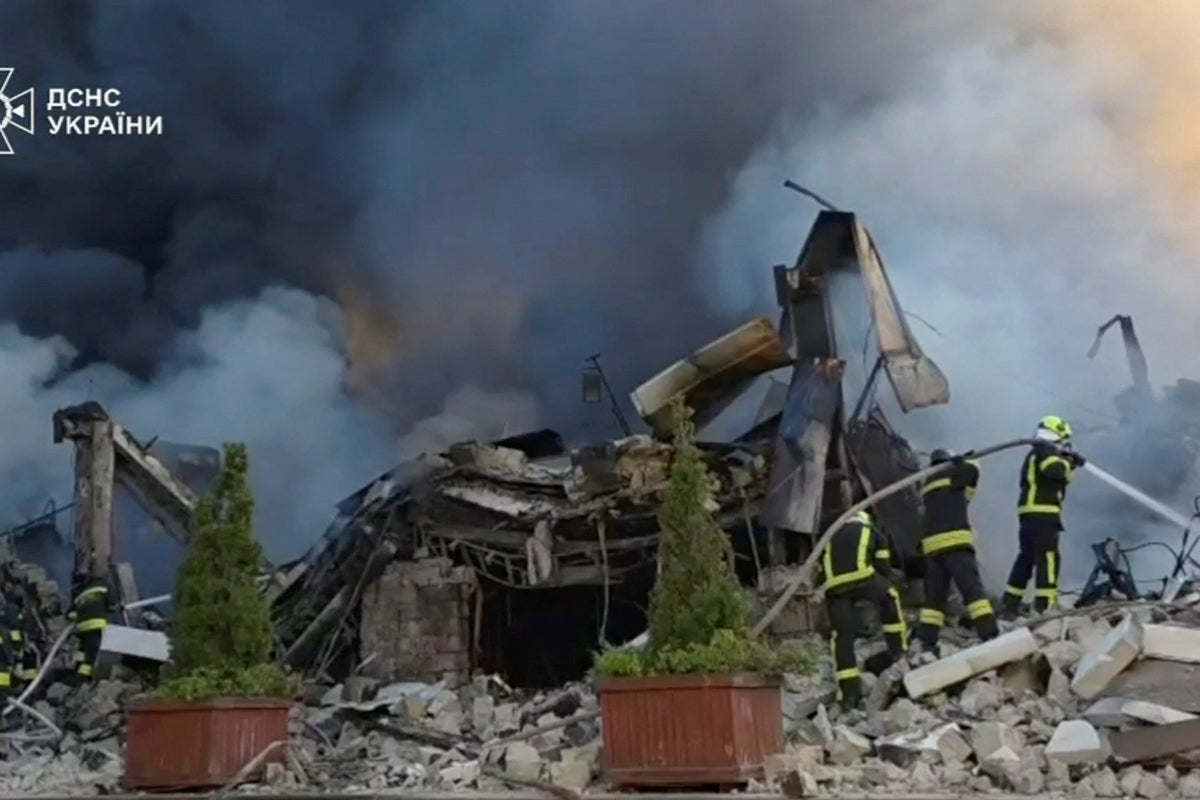
The persistent bombardment of Kyiv by the Russian Federation, occurring simultaneously with the operational stagnation of its ground forces along the Donbas and southern axes, presents a paradox only to those evaluating the conflict through a purely territorial lens. Traditional military doctrine dictates that deep-strike assets should support the main effort at the decisive point of battle. However, the Kremlin’s deployment of long-range precision munitions against the Ukrainian capital operates on a distinct calculus. It is an optimization problem balancing asymmetric attrition, political coercion, and systemic air defense depletion.
To understand why a military machine facing severe logistical and tactical bottlenecks on the frontline continues to commit high-value cruise and ballistic missiles to a distant capital, one must dissect the operational mechanics of modern protracted warfare. This asymmetry is governed by three structural pillars: the consumption-to-replenishment ratio of air defense interceptors, the centralization of Ukrainian decision-making infrastructure, and the domestic political imperatives of the Russian state.
The Air Defense Depletion Function
The primary operational objective of targeting Kyiv is not immediate territorial capitulation, but the forced maldeployment of Ukraine's air defense network. Air defense is inherently a resource-allocation problem under conditions of extreme scarcity. Ukraine’s Western-supplied systems, such as the Patriot PAC-3, NASAMS, and IRIS-T, are finite assets with long manufacturing lead times.
The strategy operates via a cost-exchange ratio unfavorable to the defender. Russia utilizes a layered strike package designed to maximize the economic and kinetic strain on Kyiv’s defensive umbrella. This package typically features:
- Low-cost loitering munitions (Shahed-136/Geran-2): These units cost between $20,000 and $50,000. Their primary function is to oversaturate radar arrays, force the expenditure of expensive interceptors, and expose the geo-locations of hidden firing units.
- Decoy cruise missiles (Kh-55 variants without nuclear payloads): These assets present the same radar cross-section as live munitions, compelling defenders to treat them as high-priority threats.
- High-velocity ballistic and hypersonic munitions (Iskander-M, Kinzhal, Zircon): These are committed once the defense grid is saturated or distracted, targeting high-value infrastructure or the air defense systems themselves.
When Ukraine launches a Patriot interceptor (estimated at $3 million to $4 million per missile) to destroy a $40,000 loitering munition or a $1 million cruise missile, the economic asymmetric ratio ranges from 3:1 to nearly 100:1.
By consistently threatening Kyiv—the political, economic, and administrative heart of the country—the Russian military command forces Ukraine into a permanent defensive posture around the capital. This creates a critical bottleneck for frontline ground forces. Every air defense battery tethered to Kyiv to protect civilian infrastructure and government buildings is a battery unavailable to shield advancing infantry, counter-battery radars, or logistical hubs in Zaporizhzhia or the Donbas from Russian tactical aviation and glide bombs. The frontline stagnation is, therefore, a structural byproduct of Russia choosing to prioritize the systemic degradation of Ukraine's strategic rear over local tactical gains.
Infrastructure Centralization and the Coercion Model
Kyiv contains the highest density of dual-use infrastructure in Ukraine. This includes the centralized command-and-control (C2) nodes of the political and military leadership, the primary data centers managing state logistics, and the electrical substations driving the national rail network, which serves as the logistical backbone for Western military aid.
The targeting matrix adheres to a specific framework of infrastructural warfare:
[Strike Package Input] -> [Saturate Air Defense Grid] -> [Kinetic Impact on Grid Substations] -> [Systemic Power Loss] -> [Logistical Deceleration at the Front]
When long-range strikes disrupt the Kyiv energy knot, the downstream effects are felt directly on the frontline. The repair of high-voltage transformers requires specialized manufacturing capabilities that cannot be easily decentralized. By systematically striking these nodes, Russia forces Ukraine to divert engineering resources, financial capital, and military personnel away from offensive operations toward domestic stabilization.
This methodology also relies on the theory of societal friction. The strategic hypothesis posits that continuous exposure to kinetic threat, rolling blackouts, and economic paralysis in the capital will eventually degrade civilian morale to the point where the political leadership faces internal pressure to negotiate on unfavorable terms. While empirical historical data suggests that strategic bombing often hardens civilian resolve rather than breaking it, the Kremlin evaluates this variable through a different risk-reward metric: even if civilian resolve remains intact, the diversion of state resources to maintain basic societal functions reduces the net energy available for frontline military execution.
The Political Economy of Domestically Consumed Power
A war of attrition requires continuous validation within the domestic political sphere of the attacking state. As the Russian ground campaign encounters diminishing marginal returns—characterized by high casualty rates for incremental gains of destroyed settlements—the state apparatus requires highly visible indicators of military efficacy.
Deep strikes on Kyiv serve a crucial communicative function for the Russian state media apparatus. Kinetic impacts on a capital city are easily weaponized as propaganda victories to offset the lack of breakthrough maneuvers on the ground. It allows the leadership to project strategic initiative and technological parity with Western military systems, specifically when claims are made regarding the penetration of advanced air defense grids.
Furthermore, this strategy interfaces with the production cycles of the Russian defense industrial base. While Western sanctions have complicated the procurement of microelectronics, Russia has successfully transitioned to a wartime economy, scaling up the domestic assembly of cruise missiles and loitering munitions via facilities in places like the Alabuga Special Economic Zone. Because ground maneuvers are constrained by acute shortages of modern armored fighting vehicles and trained infantry squads, the Russian military command substitutes capital-intensive, automated warfare (long-range strikes) for labor-intensive warfare (territorial breakthroughs) wherever possible. It is highly efficient for the Kremlin to expend manufactured munitions to maintain strategic pressure rather than ordering costly frontal assaults that risk destabilizing domestic political compliance through further mobilization waves.
Structural Limitations of the Russian Strike Strategy
The strategic utility of the Kyiv bombardment is bounded by clear operational constraints. The strategy fails to achieve decisive results due to three structural limitations.
First, the intercept efficiency of Western-supplied systems remains high when consolidated in a single dense urban environment. Kyiv is currently one of the most heavily defended airspace sectors globally. This high interception rate means that Russia must expend a massive volume of its monthly missile production just to achieve a handful of kinetic impacts. The opportunity cost of this expenditure is the relative safety of Ukrainian logistical nodes closer to the border and the frontline, which are left unattacked due to the concentration of Russian munitions on the capital.
Second, the assumption that infrastructural damage leads to political capitulation ignores the adaptability of modern distributed networks. Ukraine has decentralized aspects of its digital infrastructure, utilized mobile power generation, and engineered rapid-repair protocols for its rail and energy grids. The systemic collapse envisioned by Russian planners has been mitigated by international engineering support and the rapid integration of non-traditional technologies.
Third, the strategy is vulnerable to shifts in Western political will. Intense, highly visible attacks on a European capital frequently act as political catalysts in Washington, London, and Brussels, triggering accelerated packages of air defense ammunition and longer-range counter-strike capabilities. The strikes intended to coerce the adversary often end up reinforcing the defender’s supply chains.
Strategic Forecast and Hard Realities
The operational reality of the conflict indicates that Russia will not cease its targeting of Kyiv, irrespective of how static the frontline becomes. The investment in production lines for long-range munitions is locked in; the political necessity of projecting offensive capability remains absolute.
For Ukraine, the strategic imperative is twofold: it must acquire a sufficient volume of low-cost counter-drone systems (such as Gepard anti-aircraft guns or laser-guided electronic warfare modules) to decouple the economic asymmetry of the Shahed strikes, thereby reserving its multi-million dollar Patriot and NASAMS interceptors exclusively for ballistic and hypersonic threats.
The side that optimizes its cost-exchange ratio in this deep-strike theater will ultimately dictate the sustainability of operations on the frontline. If Ukraine can achieve cost parity in its air defense matrix, Russia’s strategy of targeting Kyiv will yield diminishing strategic returns, eventually forcing a reallocation of their munitions toward the tactical frontline—or exposing the limits of their industrial capacity. Until that economic and kinetic equilibrium is reached, the capital will remain the center of gravity for Russia's long-range campaign.