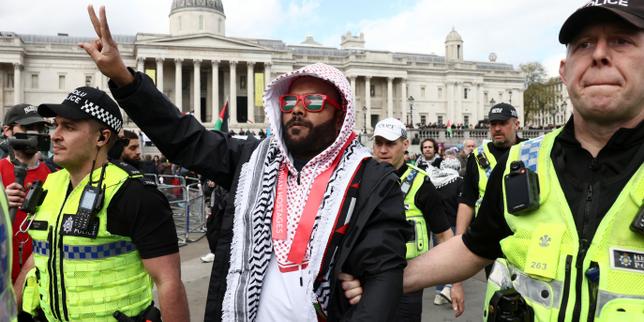
The British government is moving toward a fundamental shift in how it polices the streets of London. Following a series of incidents that have heightened tensions across the capital, Prime Minister Keir Starmer has signaled a willingness to grant police expanded powers to preemptively ban specific pro-Palestinian marches. This is not merely a reaction to a single afternoon of unrest; it is an attempt to rewrite the unwritten rules of British civil liberty in the face of rising communal friction. The move aims to bridge the gap between protecting the right to demonstrate and ensuring the safety of the Jewish community, particularly after recent targeted harassment in the city’s heart.
The Breaking Point in London
For months, the Metropolitan Police have operated under a policy of "policing by consent," attempting to manage massive weekly demonstrations with a mix of surveillance and light-touch intervention. That approach effectively ended last week. A spike in antisemitic rhetoric and a series of physical confrontations have convinced Downing Street that the current legal framework—specifically the Public Order Act—may no longer be fit for purpose in its present form.
Starmer, a former Director of Public Prosecutions, understands the legal machinery better than most of his predecessors. He is not approaching this as a populist firebrand but as a clinical strategist. By weighing an outright ban on certain routes or specific groups, he is signaling that the era of "wait and see" policing is over. The government’s logic is simple: when a protest ceases to be an expression of opinion and becomes a tool for intimidation, the state has a moral and legal obligation to intervene.
Behind the Legal Curtain
Current laws already allow the Home Secretary to ban a march, but only under extreme circumstances where a "serious threat to public order" cannot be managed by local police. Historically, the threshold for this has been incredibly high. Police chiefs have often been reluctant to request such bans, fearing that pushing protests underground makes them harder to monitor and more likely to turn violent.
The shift now being discussed involves lowering that threshold. Government insiders suggest the new criteria would focus on the "cumulative impact" of repeated demonstrations on specific neighborhoods. It is a subtle but massive change. Instead of looking at a single march in isolation, the Home Office would look at the months of disruption, the recurring cost to the taxpayer, and the sustained psychological toll on residents who feel targeted by the rhetoric on display.
The Problem of Definition
One of the biggest hurdles Starmer faces is the definition of "hateful" or "intimidatory" behavior. What one person sees as a legitimate cry for justice, another perceives as a direct threat to their safety. This ambiguity has long been the shield behind which radical elements operate.
The Metropolitan Police have struggled with this grey area. Officers on the ground often find themselves in the impossible position of deciding, in a split second, whether a chant or a banner crosses the line into criminality. By the time a legal review happens days later, the damage to community relations is already done. A preemptive ban removes that ambiguity for the officer on the street, but it replaces it with a heavy-handed central authority that many civil rights advocates find chilling.
The Intelligence Gap
A major factor driving this policy shift is a series of classified briefings regarding the organization of these marches. It is an open secret in Westminster that certain elements within the protest movement are not interested in peaceful advocacy. Intelligence reports have identified specific "agitator cells" that use the cover of larger, peaceful crowds to coordinate harassment campaigns.
The attack in London that served as the catalyst for this policy change was not an isolated outburst. It was the result of a radicalized fringe feeling emboldened by what they perceive as a vacuum of authority. Starmer’s team believes that by banning certain marches, they can strip away the "human shield" of peaceful protesters, forcing these radical elements into the open where they are easier to arrest and prosecute.
The Opposition from Within
Starmer is not just fighting the protesters; he is fighting a significant portion of his own party and a skeptical legal establishment. The UK has no written constitution, but the right to protest is woven into the country's identity. Critics argue that once you grant the state the power to ban a march based on the "possibility" of offense or intimidation, you have effectively ended the right to dissent.
Human rights lawyers are already preparing challenges. They point out that the European Convention on Human Rights, which the UK still adheres to, protects the right to assembly even when the message is unpopular or deeply offensive to some. If Starmer moves forward with a ban, he is virtually guaranteed a bruising battle in the High Court. For a Prime Minister who built his reputation on the rule of law, losing a case on civil liberties would be a devastating blow to his authority.
The Operational Reality of a Ban
There is also the question of whether a ban actually works. If the government bans a march from a specific route, the organizers will likely simply move to another area or shift to "flash mob" tactics that are even harder to police. We saw this during the lockdowns and during previous eras of political unrest. A ban creates a vacuum, and in the world of modern activism, vacuums are filled quickly by more chaotic, decentralized actions.
The police themselves are divided. While senior commanders want more clarity, rank-and-file officers worry that a ban will turn them into the "enemy" in the eyes of a large segment of the population. Policing a legal march is difficult; policing an illegal one that thousands of people show up for anyway is a nightmare that often ends in broken bones and burning vehicles.
The Cost of Inaction
Despite the risks, the government feels it cannot stay the course. The financial cost of policing these protests is now measured in the tens of millions of pounds. Resources are being diverted from frontline neighborhood policing—solving burglaries and responding to violent crime—to manage a repetitive cycle of weekend demonstrations.
More importantly, the social cost is becoming untenable. When a segment of the British population feels they can no longer walk through their own capital without fear, the social contract is effectively broken. This is the "Brutal Truth" that Starmer is grappling with. He is choosing to risk his reputation as a liberal internationalist to fulfill the more basic duty of a Prime Minister: maintaining the King’s Peace.
The International Ripple Effect
What happens in London rarely stays in London. Governments across Europe are watching this development with intense interest. From Paris to Berlin, the same tensions are boiling over. If the UK successfully creates a new legal standard for banning protests based on community impact and antisemitic intimidation, it will provide a blueprint for other Western democracies struggling with the same issues.
This isn't just about one march or one city. It is a test case for how a modern, pluralistic society manages the collision of two fundamental rights: the right to speak and the right to live without fear.
Moving Toward a Hard Line
The signals coming out of the Home Office suggest that the first test of this new policy could come within weeks. The government is expected to issue revised guidance to the Metropolitan Police Commissioner, essentially "inviting" a request for a ban on specific upcoming dates. This choreographed move allows the police to claim they are acting on operational necessity while giving the government the political cover of supporting the "thin blue line."
The success or failure of this gambit will depend on the government’s ability to prove that these marches are no longer about foreign policy, but have become a domestic public safety crisis. They will need to produce evidence of coordinated intimidation that goes beyond offensive placards.
This is a high-wire act with no safety net. If Starmer succeeds, he will be credited with restoring order to a fractured capital. If he fails, he will be remembered as the leader who tried to sacrifice ancient British freedoms for a temporary political peace, only to find he ended up with neither. The streets of London are about to become a laboratory for a very dangerous experiment in state power.
The decision to move forward with these bans is a gamble that the British public's desire for order now outweighs its traditional commitment to absolute freedom of assembly. It is a bet that the "silent majority" is more tired of the disruption than they are worried about the erosion of the right to march. As the legal teams and police commanders finalize their plans, the only certainty is that the next few months will redefine the limits of dissent in the United Kingdom for a generation. Governments do not easily give back the powers they take during a crisis. Once the threshold for banning a protest is lowered, it stays lowered, ready to be used by whichever administration follows. This is the reality of the precedent Starmer is setting. It is a choice made in the heat of a volatile moment that will have consequences long after the current protests have faded from the headlines.