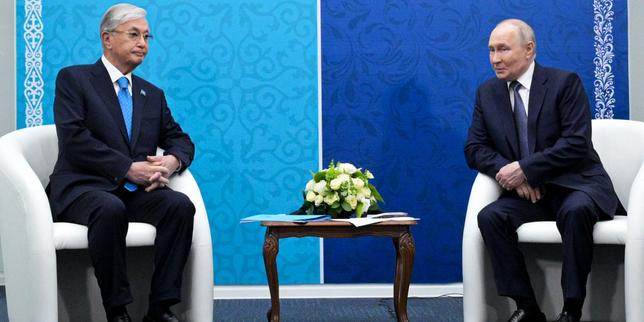
Geopolitics rarely shifts in a single afternoon. Leaders usually stick to scripts written decades ago, trading empty diplomatic pleasantries while avoiding actual friction. But public friction happened when Kazakh President Kassym-Jomart Tokayev looked straight at Vladimir Putin and stated that the fighting in Ukraine had to stop.
That moment matters. Kazakhstan shares the longest continuous land border in the world with Russia, outside of Russia's border with Mongolia. For decades, Astana relied heavily on Moscow for security guarantees, economic ties, and political stability. When Tokayev says things must change, you need to pay attention.
The Weight of Geography and History
Geography is destiny. Kazakhstan sits right in Russia's immediate backyard. Moscow views Central Asia through a hyper-protective lens, treating the region as a buffer zone against Western influence, radical Islam, and economic instability.
Tokayev isn't Western-leaning in the way Washington or Brussels might wish. He came to power with backing from the old guard, weathered massive domestic unrest with the help of Russian-led security troops, and steers a tightly controlled political apparatus. Yet, when the war in Ukraine dragged on, Astana realized the cost of staying completely quiet outweighed the risks of pushing back.
Sanctions hurt. Secondary sanctions from Western nations threaten banks and logistics networks across Central Asia. If Kazakhstan becomes a backdoor for Moscow to bypass international trade restrictions, secondary penalties will crush local financial institutions. Tokayev has to balance the heavy boot of Russian pressure against the sharp economic reality of Western trade markets.
Reading Between the Diplomatic Lines
Diplomatic language sounds boring on purpose. Words get weighed, measured, and sanitized until they lose all flavor. So when a leader breaks protocol in front of TV cameras, the disruption is deliberate.
Tokayev didn't just mention peace. He publicly affirmed territorial integrity. That phrase hits differently when you look at a map. Kazakhstan has a massive ethnic Russian minority concentrated in its northern provinces. Nationalist voices in Moscow have occasionally floated historical claims over those lands, similar to the pretexts used against Ukraine.
By standing firm on borders, Tokayev sends a quiet message to the Kremlin. Astana wants economic partnership, not annexation. They want trade corridors that bypass Russian ports through the Caspian Sea, reaching Europe via Azerbaijan and Turkey. They are diversifying their options.
What Central Asia Tells Us About the Rest of the World
Smaller nations are rewriting their playbooks. The old bipolar world where you picked a side and stayed there is dead. Countries like Kazakhstan, India, Brazil, and Turkey practice transactional sovereignty. They work with Russia when it suits them, buy Western tech when they need it, and trade with China aggressively.
Moscow hates this shift. Putin expected total solidarity, or at least compliant silence, from former Soviet republics. Instead, he gets cautious distancing. Central Asian leaders smile for the cameras while quietly signing deals with European energy commissioners looking for alternative oil and gas routes.
You cannot understand modern energy markets or eastern European security without watching Astana. Kazakhstan holds massive uranium reserves, critical rare earth minerals, and vast oil fields. When Tokayev tells Moscow that the war needs an end, energy markets flinch. Europe wants those resources. China wants secure transit routes for its Belt and Road initiative. Everyone is watching how far Central Asia can pull away from Russia's gravitational pull without getting burned.
The Economic Tightrope Walk
Let's look at the numbers. Bilateral trade between Russia and Kazakhstan actually surged after 2022 because of parallel imports—goods flowing through Kazakhstan to feed Russian demand. On paper, Astana profits from Moscow's isolation.
Reality is messier. Local businesses face constant compliance headaches. International shipping companies refuse to touch cargo if there is a whiff of Russian sanctions evasion. Tokayev established rules that block sanctions-busting, infuriating Russian nationalists who expected an open-door policy from their neighbors.
It is a daily exercise in tightrope walking. Lean too far toward the West, and Moscow cuts off the pipelines running through Russian territory to the Black Sea. Lean too far toward Moscow, and Western banks lock Kazakh lenders out of the global dollar system. Tokayev keeps finding the narrow middle path, using sharp rhetoric to carve out room to breathe.
Where This Leaves the Conflict
Diplomacy moves at a glacial pace until it accelerates violently. No single speech stops an artillery barrage. Tokayev won't broker a comprehensive peace treaty on his own.
What he does is chip away at the narrative of Russian invincibility and diplomatic isolation. When a closest ally tells you to stop fighting while the television cameras roll, the illusion of unity shatters a little more. Moscow can spin the narrative however they want for domestic television, but regional leaders know the truth.
The war in Ukraine broke the old security architecture of Eurasia. Every capital from Tashkent to Ulaanbaatar is recalculating risks. They see a weakened Russia bogged down in a grinding war of attrition, an aggressive China expanding its economic footprint, and a West that still controls global finance.
Keep an eye on transit corridors, pipeline deals, and trade summits in the region. That is where the real future of the post-Soviet space is being negotiated, far away from the front lines in the Donbas. Astana has chosen its direction, step by cautious step, proving that even in Moscow's shadow, nobody wants to go down with a sinking ship.