The corporate world is panicking about artificial intelligence stealing everyone’s jobs. Turn on the news, and you're bombarded with terrifying headlines about mass corporate displacement. Just last month, American employers announced 97,006 job cuts, and outplacement firm Challenger, Gray & Christmas linked roughly 40% of those corporate layoffs directly to AI efficiencies. Half of the American public admits they're worried about losing their livelihood to software.
But Jeff Bezos thinks the entire panic misses the mark.
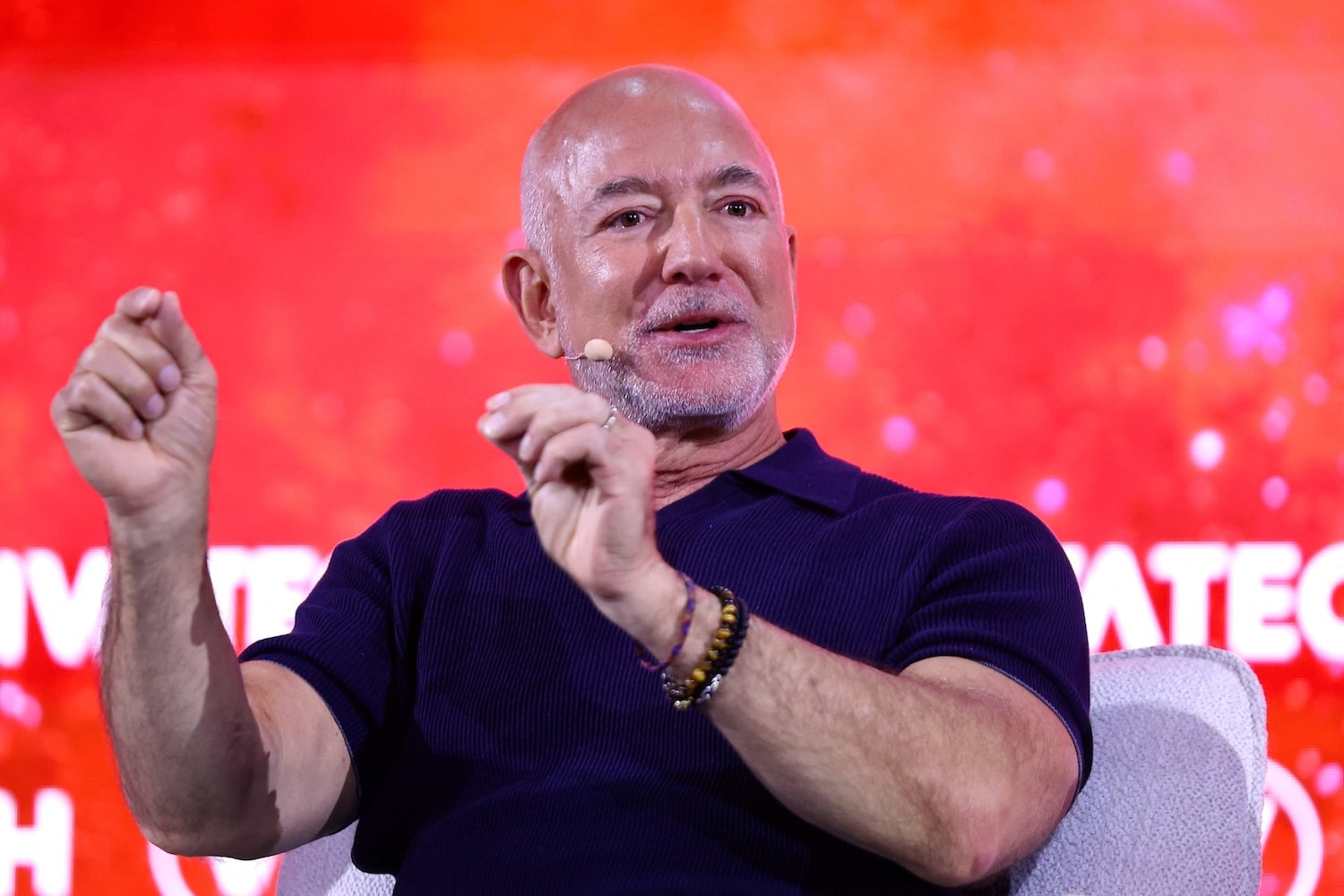
Speaking on stage at the VivaTech conference in Paris, the Amazon founder flatly rejected the idea of an AI-driven unemployment crisis. He looks at the exact same data and reaches the exact opposite conclusion. He isn't just saying AI won't replace human workers; he’s actively betting billions that it will cause a massive labor shortage.
It sounds wild on the surface. How can a technology that handles tasks in seconds create a shortage of workers? To understand his logic, you have to look past the immediate corporate layoffs and look at how technology actually scales economies.
The Bulldozer Fallacy and Endless Human Aspiration
The core mistake people make when thinking about automation is treating the total amount of work in the economy like a fixed pie. If a machine does half the work, humans must only get the remaining half, right? Bezos calls this out as fundamentally wrong. He relies on a simple historical truth: all civilisational wealth is driven by invention.
When someone invented the plough six thousand years ago, it didn't eliminate the need for human labor forever. It made the entire society wealthier, dropped the cost of food, and freed up human hands to build cities, write laws, and invent other things.
Think of AI as an intellectual bulldozer. If you give a worker a shovel, they can dig a small hole. If you give them a bulldozer, they can move a mountain. The bulldozer doesn't eliminate the need for the operator; it drastically raises the scale of what that operator can achieve.
Human aspirations are effectively endless. When a piece of technology makes a process ten times cheaper and faster, we don't just sit back and do less. We scale our ambitions up by a factor of ten. Companies don't stop building things when they get efficient; they identify more problems to solve and start projects that were previously too expensive or complicated to even consider.
The $41 Billion Bet on Physical Engineering
Bezos isn't just pontificating from a yacht. He’s backing this thesis with an immense amount of capital. His new AI venture, Prometheus, which launched with former Google executive Vikram Bajaj, just raised $12 billion in a Series B round from massive institutional players like JPMorgan Chase, Goldman Sachs, and BlackRock. That brings the company's total funding to more than $18 billion, valuing the lab at a staggering $41 billion.
Prometheus isn't building another chatbot to write basic marketing copy or generate weird digital art. The company is building what it calls an "artificial general engineer."
Most popular AI systems today are built on large language models trained on human text. Prometheus is training its systems on massive pools of real-world physical and engineering data. The goal is to build an AI that understands the actual laws of physics, allowing it to transform heavy manufacturing, aerospace, and pharmaceutical development.
Right now, designing a new rocket engine or an advanced automotive part requires a brutal cycle of physical prototyping. You design it, build a physical model, test it until it breaks, and start over. Prometheus wants to handle that entire loop inside an advanced simulation environment, drastically shortening physical design pipelines.
If you can design and validate an aerospace component in days instead of years, you don't fire your engineers. You suddenly need way more engineers because you can run fifty projects simultaneously. The constraint isn't the work itself; it’s the friction of the process. Remove the friction, and demand for builders explodes.
The Reality of Current Corporate Layoffs
It’s easy to look at Amazon's current workforce management and call Bezos a hypocrite. Under current CEO Andy Jassy, Amazon has trimmed roughly 30,000 corporate roles over the past year. Jassy explicitly stated that he expects AI implementations to reduce the company's total corporate headcount as efficiency gains scale.
But there’s a vital distinction between a company-level corporate restructuring and an economy-wide employment collapse.
A tech company cutting 10% of its white-collar staff because software can handle basic code optimization or document review is a painful short-term displacement. But in a healthy economy, those workers don't just disappear. The capital saved by those efficiencies gets redeployed into new high-growth areas.
Look at Cisco, which recently cut 4,000 jobs. They didn't do it to pocket the cash and shrink; they did it to immediately shift resources into building out AI infrastructure.
Bezos also points out that the labor market might adjust at the margins in ways we don't expect. Instead of mass unemployment, higher productivity could mean fewer required work hours across the board. We might see an increase in single-income households because one salary buys more purchasing power, or a sharp decline in forced overtime, all while maintaining the same total economic output.
The Silicon Valley Ideological Divide
Bezos's aggressive optimism puts him at total odds with other major tech founders. The AI community is deeply divided on this issue, and the stakes are massive for how policy gets shaped over the next few years.
On the other side of the fence, you have leaders like Anthropic CEO Dario Amodei. Anthropic, which ironically receives heavy financial backing from Amazon, takes a far more bearish view. Amodei has warned that advanced systems could rapidly eliminate vast swaths of the global workforce, presenting challenges that go way beyond simple corporate layoffs. He has even publicly floated the idea of raising capital gains taxes to fund a universal basic income to prevent an absolute employment apocalypse.
Politicians are already capitalizing on this fear. Senator Bernie Sanders has pushed for legislation to create an AI sovereign wealth fund via a 50% one-time tax on leading AI companies, arguing that because the technology is built on the collective knowledge of humanity, its wealth must benefit everyone, not just a handful of tech moguls.
If the public and policymakers buy into the doomsday narrative, we’re going to see a wave of restrictive labor regulations and heavy taxation designed to protect existing jobs. If the Bezos expansion thesis wins out, the focus will shift entirely toward aggressive retraining programs to get workers ready for the massive influx of complex engineering roles.
How to Prepare for the AI Labor Shift
If you're trying to navigate your career or your business through this transition, waiting around for economists to settle this debate is a losing strategy. A CFO survey projects that AI-driven corporate layoffs could spike significantly over the next year. The short-term pain is real, even if the long-term expansion happens exactly like Bezos predicts.
You need to position yourself where the data intersects with reality.
First, stop focusing on pure text generation or basic administrative tasks. The software can do that, and companies will cut headcount there to save money. The value is moving rapidly toward physical implementation, system integration, and advanced simulation.
Second, look at the industries receiving the heaviest capital flows. With Prometheus raising $18 billion to target aerospace, automotive, and heavy manufacturing, there is going to be a massive premium on data operations teams who know how to integrate machine learning models into actual physical production workflows. Knowing how to bridge the gap between digital simulation and real-world physics validation is going to be one of the rarest skills on the market.
The human workers who thrive in the next decade won't be the ones competing with the software. They'll be the ones steering the bulldozer.