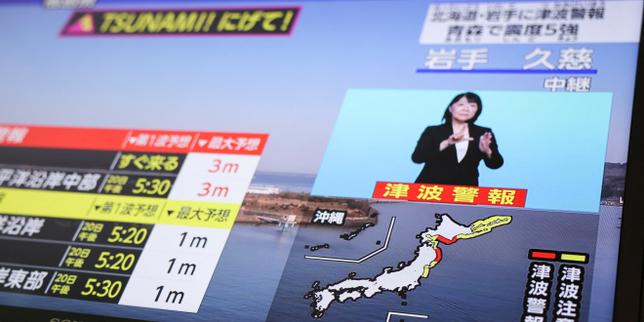
The issuance of an inaugural "megaquake advisory" by the Japan Meteorological Agency (JMA) following a 7.1 magnitude event off Kyushu marks a fundamental shift in seismic risk management from reactive recovery to probabilistic mitigation. The Japanese archipelago sits at the intersection of four tectonic plates—the Pacific, Philippine Sea, Eurasian, and North American—creating a high-frequency seismic environment where the marginal risk of a catastrophic event is a constant baseline rather than an anomaly. The recent 7.7 magnitude tremors do not merely represent isolated geological shifts; they function as stress-transfer mechanisms within the Nankai Trough, a subduction zone capable of generating M8 to M9 events.
The Mechanics of Nankai Trough Stress Accumulation
The Nankai Trough is a subduction boundary where the Philippine Sea Plate slides beneath the Eurasian Plate at a rate of approximately 4.0 to 6.5 centimeters per year. This movement is not fluid. Interplate coupling creates friction, locking the plates in place and accumulating elastic strain energy. When the shear stress exceeds the frictional strength of the fault, a rupture occurs.
A 7.7 magnitude event acts as a significant "slow slip" or "foreshock" candidate because it alters the static stress on adjacent segments of the fault line. This phenomenon, known as Coulomb Stress Transfer, dictates that a rupture in one section of a fault increases the mechanical load on the neighboring sections. The probability of a follow-on "megaquake" increases significantly in the 72-hour window following an initial large tremor because the system is in a state of precarious equilibrium.
The Triad of Seismic Impact Variables
Quantifying the danger of the Nankai Trough requires analyzing three distinct physical vectors:
- Rupture Length and Duration: Unlike standard earthquakes that last 30 to 60 seconds, a megaquake involving the full extent of the Nankai Trough could involve a rupture zone exceeding 700 kilometers, with ground shaking lasting several minutes. This duration causes structural fatigue in high-rise buildings that might otherwise survive shorter pulses.
- Tsunami Hydrodynamics: The bathymetry of the Japanese coastline exacerbates wave height through "funneling" effects. In the event of a full-scale Nankai rupture, initial tsunami waves are projected to reach the coast in less than five minutes in certain prefectures, rendering traditional evacuation windows obsolete.
- Liquefaction and Soil Stability: Reclaimed land in urban centers like Osaka and Tokyo loses shear strength during prolonged shaking. The transition of solid soil into a liquid state undermines the foundation of critical infrastructure, regardless of the building’s upper-frame seismic reinforcement.
Infrastructure Resilience and the Japanese Building Code
Japan’s building codes are the most stringent globally, evolving through iterative learning from the 1923 Great Kanto, 1995 Hanshin, and 2011 Tohoku disasters. The current regulatory framework operates on two distinct levels of protection:
- Shin-Taishin (New Anti-Seismic Design Code): Standardized in 1981, this code mandates that buildings should not collapse during a Level 7 (JMA scale) earthquake and should sustain only minor, repairable damage during mid-range events.
- Seismic Isolation vs. Vibration Control: High-value assets and critical infrastructure utilize Menshin (seismic isolation), where the structure sits on lead-rubber bearings to decouple it from ground motion. Secondary structures often use Seishin (vibration control), employing internal dampers to absorb kinetic energy.
The limitation of these systems lies in their design limits. Most systems are calibrated for specific peak ground acceleration (PGA) values. A megaquake exceeding M9.0 risks hitting the "resonance frequency" of tall structures, where the building's natural sway matches the earthquake's wave frequency, leading to exponential amplification of movement and eventual structural failure.
The Economic Cost Function of a Megaquake
The Cabinet Office of Japan estimates that a maximum-scale Nankai Trough earthquake could result in economic damages exceeding 220 trillion yen ($1.5 trillion USD). This is not a static loss of property but a multi-stage disruption of global supply chains.
Supply Chain Bottlenecks
The "Tokaido Corridor," which connects Tokyo, Nagoya, and Osaka, is the industrial heart of Japan. It houses the majority of the nation’s semiconductor fabrication, automotive assembly, and precision machinery manufacturing. A major seismic event in this region creates a global "single point of failure." Even if factories remain standing, the loss of "Just-in-Time" logistics due to damaged Shinkansen lines and coastal expressways halts production across the Pacific.
Energy Grid Fragility
Following the 2011 Fukushima Daiichi disaster, Japan’s energy mix shifted, but the vulnerability of coastal LNG (Liquefied Natural Gas) terminals remains a critical risk. Tsunami-induced damage to these terminals would result in an immediate national power deficit, complicating recovery efforts and disabling the automated cooling systems required for other industrial processes.
Tsunami Warning Systems and the Technological Barrier
The shift from a "Tsunami Warning" to a "Megaquake Advisory" reflects a sophisticated use of the S-net and N-net seafloor observation networks. These consist of thousands of kilometers of fiber-optic cables equipped with pressure gauges and seismometers on the ocean floor.
These systems provide real-time data on vertical seafloor displacement. However, the data processing latency—though only seconds—remains a bottleneck when the epicenter is close to the shore. The "blind zone" of an earthquake early warning system is the area nearest the epicenter where the S-waves (destructive waves) arrive before the digital alert can be processed and broadcast. For a Nankai event, this blind zone encompasses several high-density population centers.
Strategic Institutional Response Requirements
The transition from "alert lifted" to "ongoing vigilance" requires a structural recalibration of civilian and corporate behavior. The current advisory suggests that while the immediate risk of a 7.7 event has stabilized, the probability of a secondary, larger rupture remains statistically elevated compared to baseline levels for at least seven days.
Operational Protocols for Global Entities
Organizations operating within the Nankai impact zone must move beyond basic "earthquake drills" and implement the following logic-driven contingencies:
- Data Redundancy and Off-site Mirroring: Real-time synchronization of data to servers located outside the Eurasian/North American plate boundary (e.g., Singapore or the US West Coast, though the latter carries its own Cascadia Subduction Zone risks).
- Autonomous Energy Sourcing: Dependence on the national grid is a failure point. Facilities must maintain minimum 14-day "island mode" capabilities via hydrogen fuel cells or hardened microgrids.
- Human Capital Dispersal: Reducing the concentration of key decision-makers in a single geographic "hazard zone."
The geological reality is that the Nankai Trough enters a window of high rupture probability every 100 to 150 years. The last major events occurred in 1944 and 1946. We are currently 80 years into the cycle, within the standard deviation for a major recurrence. The 7.7 magnitude event is not a conclusion; it is a data point indicating that the subduction interface is active, pressurized, and approaching its limit of elastic deformation.
Immediate priority must be placed on the hardening of "Last Mile" communication infrastructure and the relocation of emergency stockpiles to elevations exceeding 30 meters. The objective is no longer the prevention of damage, but the radical acceleration of the recovery curve to prevent a localized seismic event from becoming a permanent national economic contraction. Efforts should focus on liquidating "fragility" within the supply chain by diversifying manufacturing nodes away from the Shizuoka-to-Hyogo coastal axis immediately.