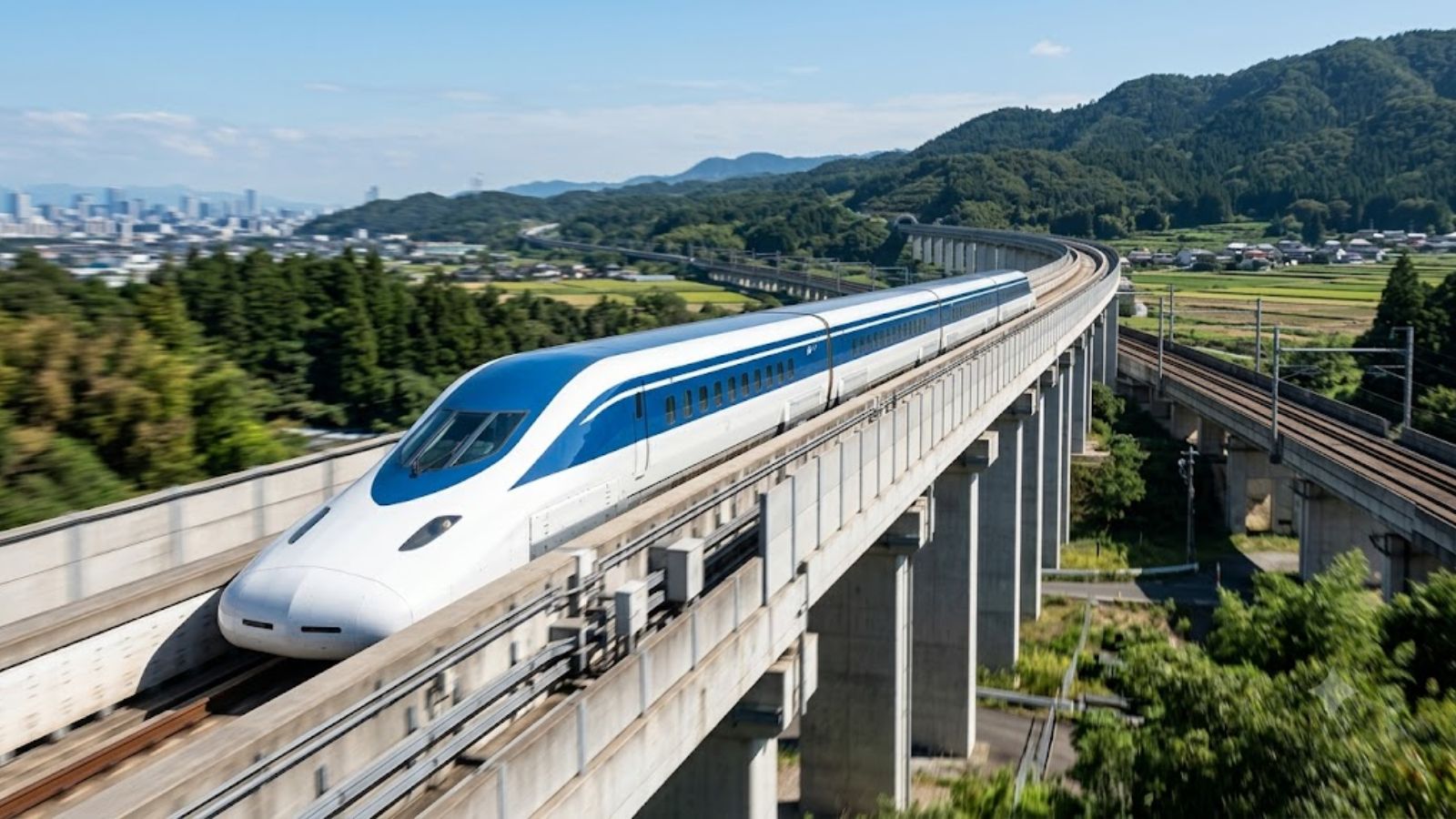
The modern conversation surrounding the Chuo Shinkansen superconducting magnetic levitation (maglev) project frequently collapses into a single headline metric: a 40-minute transit time between Tokyo and Nagoya at speeds of 505 kilometers per hour. This speed-centric focus misinterprets the true structural utility of the infrastructure. The project, developed by the Central Japan Railway Company (JR Central), operates primarily as a critical economic hedge against catastrophic corridor failure and a massive optimization of domestic passenger capacity.
The existing Tokaido Shinkansen line, which has formed the backbone of the Japanese economy since 1964, carries more than 450,000 passengers daily. Running at absolute peak capacity during peak intervals—scheduling up to 17 trains per hour—the existing line faces severe systemic risks. These risks include aging concrete infrastructure, escalating maintenance requirements that demand nightly line closures, and acute vulnerability to seismic activity along the Pacific coast. The Chuo Shinkansen provides a redundant, inland corridor that fundamentally restructures the economic geography of Japan, merging Tokyo, Nagoya, and eventually Osaka into a single integrated megaregion of 65 million people. If you found value in this post, you might want to look at: this related article.
The Technical Vector Superconducting Levitation Mechanics
Traditional high-speed rail systems rely on wheel-on-rail friction, which introduces strict mechanical limits. Beyond 300 to 320 kilometers per hour, adhesion decreases significantly, and wear on overhead pantographs and tracks scales exponentially. The Chuo Shinkansen completely bypasses these mechanical constraints by using niobium-titanium superconducting magnets cooled with liquid helium to $-269^\circ\text{C}$.
The system operates within a concrete guideway embedded with two sets of electromagnetic coils. Levitation and guidance are governed by the electrodynamic suspension system. For another angle on this development, check out the recent coverage from Ars Technica.
[Guideway Wall: Levitation/Guidance Coil] <---> [Train: Superconducting Magnet] <---> [Guideway Wall: Propulsion Coil]
As the train moves, the superconducting magnets aboard the vehicle induce an electrical current within the levitation coils on the guideway walls. This interaction generates an electromagnetic force that pushes the train up from below and pulls it up from above, maintaining a stable levitation gap of approximately 100 millimeters.
This levitation distance is a critical differentiator from European electromagnetic systems, such as Germany's Transrapid, which maintain a gap of only 15 millimeters using attractive magnetic forces. The 100-millimeter clearance provides an indispensable safety margin against seismic displacement, allowing the train to remain entirely suspended and stable even during severe ground shaking.
Propulsion relies on a linear synchronous motor system. Alternating current supplied to the propulsion coils along the guideway creates a shifting magnetic field. This field continuously pulls the onboard superconducting magnets forward, locking the train's speed directly to the frequency of the electrical current. Deceleration uses regenerative braking, converting kinetic energy back into electrical grid power as the train slows down. Mechanical wheels are only deployed at speeds below 150 kilometers per hour, retracting entirely once electrodynamic levitation forces become self-sustaining.
The Aerodynamic Cost Function
Bypassing track friction does not eliminate physical resistance. At 505 kilometers per hour, aerodynamic drag becomes the dominant consumer of energy. Aerodynamic resistance scales quadratically with velocity ($F_d \propto v^2$), while the power required to overcome that drag scales cubically ($P \propto v^3$). Moving a train at 500 kilometers per hour requires roughly 3.5 to 4 times the energy per passenger-kilometer compared to a conventional Shinkansen operating at 285 kilometers per hour.
To mitigate this extreme energy penalty, JR Central designed the L0 Series rolling stock with a highly elongated, 22-meter aerodynamic nose. This geometry minimizes the piston effect—the sudden compression of air when a high-speed vehicle enters a confined space—which would otherwise cause severe sonic booms at tunnel exits and structural fatigue on the rolling stock.
The Geological Bottleneck The Southern Alps and Shizuoka Impasse
The path of least resistance between Tokyo and Nagoya is already occupied by the coastal Tokaido Shinkansen. The Chuo Shinkansen takes an inland, direct route that cuts through the Akaishi Mountains, commonly known as the Southern Alps. This geographical choice dictates that approximately 86% of the 286-kilometer route between Shinagawa Station in Tokyo and Nagoya Station must be constructed deep underground.
The most complex engineering challenge centers on the Southern Alps Tunnel, a 25-kilometer section that reaches a maximum depth of 1,400 meters below the surface. This extreme depth subjects the excavation process to high rock pressures and the constant risk of high-pressure groundwater inflows.
The project encountered a severe political and hydrological bottleneck within an 8.9-kilometer stretch of this tunnel located inside Shizuoka Prefecture. The excavation intersects fractured rock zones that feed the Oi River basin, a critical water supply supporting agriculture, manufacturing, and drinking water for roughly 620,000 residents. The regional government previously blocked construction due to projections that tunneling could divert up to 2,000 liters of water per second away from the river basin, threatening local ecosystems and tea cultivation.
The resolution of this nine-year impasse required a complex regulatory framework and an unprecedented risk-mitigation agreement. JR Central committed to a legally binding mechanism to pump all water collected during tunnel excavation back into the Oi River basin using specialized bypass tunnels and high-capacity pumping stations. The company agreed to compensate the prefecture for any quantifiable reduction in river flow, regardless of whether a direct causal link to construction can be definitively proven. With the regional government issuing formal construction approval, excavation of this final section can proceed, though the complexity of the geology means this 8.9-kilometer bottleneck will require at least ten years of continuous drilling to complete.
Financial Architecture and Capital Cost Functions
The capital expenditure for the Tokyo-to-Nagoya segment stands at approximately ¥11 trillion ($67.7 billion). This figure represents a near-doubling of initial projections, driven by escalating tunnel stabilization costs, complex urban land acquisition, and extensive environmental mitigation infrastructure.
Unlike infrastructure projects globally that depend heavily on direct state subsidies, JR Central is financing the initial Tokyo-Nagoya segment primarily through corporate bonds and cash reserves generated by its highly profitable Tokaido Shinkansen operations. The Japanese government intervened only to provide low-interest loans totaling ¥3 trillion through the Fiscal Investment and Loan Program to accelerate the subsequent extension toward Osaka.
The financial viability of this capital allocation relies entirely on shifting high-yield business travel from the Tokaido Shinkansen to the maglev line. JR Central plans to price maglev tickets only marginally higher than current Nozomi express fares. The primary revenue driver is a drastic restructuring of the service matrix:
- The Express Layer: The Chuo Shinkansen absorbs the high-paying, time-sensitive business traffic between major metropolitan hubs.
- The Intermediate Layer: The existing Tokaido Shinkansen is repurposed to increase the frequency of stops at intermediate industrial hubs like Shizuoka, Hamamatsu, and Toyohashi.
- The Commuter Layer: Expanded regional capacity captures a broader demographic of long-distance daily commuters.
This structural separation optimizes the asset utilization of both lines. By shifting long-distance travelers to the maglev, the conventional Shinkansen frees up significant capacity to capture underserved mid-tier regional markets, balancing the network's overall passenger load factor.
Macroeconomic Redundancy and Risk Allocation
The strategic imperative of the Chuo Shinkansen extends far beyond corporate profitability. The project is a fundamental component of Japan's national disaster resilience framework. The existing Tokaido corridor passes directly through areas highly vulnerable to the predicted Nankai Trough earthquake, with specific coastal sections at risk of tsunami inundation and soft-soil liquefaction.
An extended disruption of the Tokaido Shinkansen would sever the primary logistical link between Japan's three major economic engines: Tokyo, Chubu (Nagoya), and Kansai (Osaka). The Chuo Shinkansen mitigates this systemic vulnerability through its specific alignment and construction choices:
- Seismic Isolation via Subterranean Alignment: Tunnels drilled through stable bedrock are structurally resilient during seismic events. Underground structures move in unison with the surrounding rock mass, experiencing significantly lower acceleration forces than elevated viaducts or surface tracks exposed to surface wave amplification.
- Geographical Dissimilarity: By tracking far inland through mountain bedrock, the maglev line sits completely outside the zone of coastal tsunami risk and liquefaction hazards.
- Autonomous Fail-Safe Braking: The linear synchronous motor system allows the central control room to cut power to specific guideway sectors instantly. Without power, the electrodynamic suspension naturally drops the vehicle onto its mechanical braking wheels, bringing the train to a controlled stop without relying on onboard power systems or driver intervention.
Operational Constraints and Long-Term Network Integration
The superconducting maglev system delivers unparalleled velocity, but it introduces distinct operational constraints that prevent it from completely replacing conventional rail. The design of the guideways makes switching tracks a highly deliberate, mechanical process. Unlike traditional rail switches that can change position in seconds, a maglev guideway switch requires heavy structural segments to articulate mechanically, creating a scheduling bottleneck that limits maximum service frequency compared to the conventional Shinkansen.
The extreme depth of the underground stations introduces a significant passenger logistics bottleneck. Shinagawa's maglev platforms are located dozens of meters below the active Tokaido Shinkansen tracks. The time required for passengers to transition from street level or connecting local lines down to the deep maglev platforms threatens to erode a portion of the time savings achieved during transit.
The realistic timeline for commercial operations points to 2036 at the earliest for the Tokyo-Nagoya segment, determined entirely by the ten-year engineering window required for the Shizuoka mountain excavation. The secondary phase, extending the line to Shin-Osaka to achieve a 67-minute cross-country transit time, depends on the stabilization of JR Central's balance sheet following the heavy capital expenditure of the first phase.
The project does not represent a simple upgrade to domestic transit. It serves as a structural overhaul of a nation's core economic corridor, substituting massive upfront capital and energy expenditure for long-term demographic integration and absolute systemic redundancy.
_(cropped).jpg/440px-Rob_O'Neill_(40543587961)_(cropped).jpg)