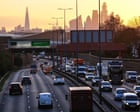
You can smell London before you see it. It is a thick, metallic tang that sits at the back of the throat, a cocktail of diesel exhaust, pulverized brake pads, and the heavy, stagnant air trapped between brick terraces. For decades, millions of people accepted this scent as the tax for living in a global capital. It was just the smell of progress.
But progress has a body count.
Imagine a fictional six-year-old named Leo. He lives in a brick flat near the North Circular road. Leo does not know what peer-reviewed medical journals say about particulate matter. He only knows that sometimes, his chest feels like it is being squeezed by a giant, invisible fist. He knows the panic of reaching for an inhaler that cannot work fast enough. His mother, frantic in the middle of the night, knows the exact duration of the blue-light ambulance ride to the nearest emergency room.
For years, stories like Leo’s were treated as tragic, isolated realities of urban life. Asthma happened. Poor lung health happened. Then, London decided to alter its chemistry.
The Cost of Entry
In 2017, the city introduced the Toxicity Charge, or T-Charge. It was a blunt instrument. If you drove an older, heavily polluting vehicle into the heart of London, you paid a fee. Two years later, this evolved into the Ultra Low Emission Zone (ULEZ). The premise remained simple yet controversial: pay to pollute, or change your car.
The political warfare that followed was fierce. Critics labeled the policies as a war on drivers, a cash grab, and a regressive tax on the working class. The debate raged in council chambers and across talk radio, framed entirely around the economy, personal freedom, and the cost of transport.
Lost in the noise of the political theater was the quiet, undeniable reality of human biology.
The human respiratory system is an incredibly delicate interface. Every day, we pump thousands of liters of air into our bodies. When that air is laden with nitrogen dioxide ($NO_2$) and fine particulate matter known as $PM_{2.5}$, the lungs inflame. The blood vessels constrict. For a healthy adult, it might mean a nagging cough or a scratchy throat. For a child with asthma or an elderly man with chronic obstructive pulmonary disease (COPD), it is a trigger for a medical emergency.
Medical researchers watched the policy rollout with a different set of questions. They were not looking at balance sheets or voting intentions. They were looking at hospital beds.
What the Wards Revealed
A major study tracking the impact of these environmental policies brought forward data that shifted the entire conversation. Researchers analyzed thousands of insurance claims and public health records to see what happened to emergency hospital admissions before and after the introduction of the T-Charge and the ULEZ.
The findings were stark.
In the areas covered by the restrictions, emergency admissions for respiratory issues dropped significantly. The drop was not a vague, long-term projection. It was immediate. When you choke off the supply of poison in the air, people stop suffocating.
Consider the mathematics of a hospital ward. A single emergency admission for an acute asthma attack represents a failure of prevention. It costs the health service thousands of pounds, drains resources from overstretched medical staff, and inflicts profound trauma on the family involved. Multiply that single admission by thousands across a sprawling metropolis, and the scale of the crisis becomes clear.
The data proved that the reduction in air pollution directly correlated with a reduction in the number of people arriving at hospital doors gasping for air. The policy was working, but not in the way the politicians were arguing. It was working at the cellular level.
The Geography of Air
Air is rarely stationary, and it does not respect borough boundaries. This reality brings forward one of the most complex aspects of the entire initiative. The initial T-Charge and ULEZ covered relatively small, central areas of London. The data revealed that while the heart of the city saw a dramatic improvement in air quality and a corresponding drop in hospital admissions, the outer boroughs remained choked.
This created a health divide. A child living in Westminster breathed fundamentally cleaner air than a child living in Enfield or Croydon.
To understand why this matters, one must understand how pollution behaves in an urban landscape. Think of a city as a canyon. Tall buildings trap emissions at street level, creating pockets of highly toxic air. When a heavy diesel vehicle accelerates away from a traffic light, it leaves behind a plume of microscopic particles that hang in the air at exactly the height of a child's stroller.
The expansion of the ULEZ to encompass the entirety of Greater London was met with even greater resistance than the initial launch. Yet, the medical data provided a fierce justification. If the pilot program saved lives in the center, it was a moral imperative to extend that protection to the periphery.
Public health policy is often an exercise in abstraction. We talk about percentages, targets, and compliance rates. We lose sight of the fact that a 10% reduction in a statistic means a real person is spending their evening at home on the sofa instead of hooked to a ventilator in a sterile room.
The Skeptic's Question
It is reasonable to question the definitive nature of these studies. Critics frequently point out that public health is influenced by a myriad of shifting variables. Smoking rates change. Housing conditions fluctuate. Economic pressures rise and fall. How can anyone isolate the impact of a driving fee against the backdrop of a chaotic world?
The researchers anticipated this skepticism. They utilized a method called difference-in-differences analysis. By comparing the trends in London to other major UK cities that did not introduce similar pollution charges during the same window, they isolated the variables.
The results held firm. The sharp decline in respiratory emergencies was unique to the zones where the financial penalties changed driver behavior. It was not a nationwide trend driven by better medicine or a mild winter. It was London. It was the policy.
Change is rarely comfortable. Forcing a tradesman to replace a diesel van that still runs perfectly fine is a tangible, frustrating financial burden. That frustration is real, and it deserves empathy. But the counterweight to that financial pain is invisible. You cannot easily see the illness that did not happen. You cannot photograph the ambulance ride that was never booked.
The New Baseline
We are currently rewriting the baseline of what is acceptable in modern cities. Future generations will likely look back at the early 21st century with the same disbelief we reserve for Victorian London, when open sewers ran down the middle of the street. They will wonder why we tolerated a system where simply walking down a sidewalk meant inhaling carcinogens as a matter of course.
The London experiment has provided a blueprint that cities worldwide are studying. Paris, New York, Madrid, and Tokyo are all grappling with the same fundamental equation: how to balance the freedom of movement with the right to breathe.
The answer is becoming increasingly clear. The economic arguments against clean air zones tend to dissolve when weighed against the staggering cost of chronic illness and emergency healthcare. The invisible savings of a healthier population outweigh the visible costs of compliance.
The metallic tang still lingers in certain corners of London, especially on hot, windless summer days. The work is far from finished. But the data shows that the trajectory has altered.
Somewhere in London tonight, a child who would have been rushed to the emergency room three years ago is sleeping soundly through the night. Their mother is not watching their chest rise and fall with a stopwatch in her hand. They do not know the name of the policy that protected them, nor do they care about the political careers made or broken in its wake. They are simply breathing.