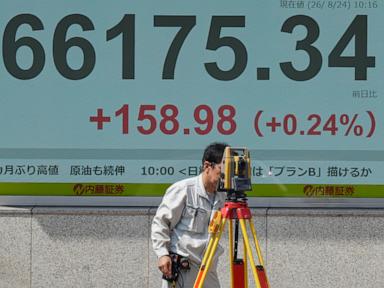
Dawn breaks over Tokyo not with a roar, but with the quiet, rhythmic clicking of computer terminals on the trading floors of Nihonbashi. Coffee cups are refilled. Screens glow in shades of clinical green and sharp red. To an outsider walking past the sleek glass facades, everything looks ordinary. Business as usual. The trains are running on time, and the salarymen are rushing toward their offices with practiced urgency.
Yet, beneath the surface calm, something heavy is shifting.
Far across the ocean, in the cavernous rooms where central bankers and bond traders dictate the weather of the global economy, a quiet panic has taken root. Yields on government debt are climbing. That dry, technical phrase—bond market pressure—sounds harmless enough, the sort of jargon meant to glaze the eyes of anyone who does not work in finance. But translate it into the language of real life, and the picture changes entirely. It means the cost of borrowing is rising. It means the invisible scaffolding holding up corporate expansion, government budgets, and everyday mortgages is suddenly under immense strain.
And Asian shares are feeling the weight.
Across the region, from the bustling electronics hubs of Seoul to the manufacturing powerhouses of Hong Kong, indices are slipping. Investors are pulling back, squinting at their portfolios with furrowed brows. They are asking a very old, very anxious question: How long can the floor hold?
To understand why a few percentage points in a distant bond market can send tremors through the streets of Taipei or Singapore, we have to look past the ticker symbols. We have to look at how modern money actually works.
Imagine a massive, interconnected plumbing system hidden beneath a sprawling metropolis. Every city block represents a different nation, a different stock market, a different family trying to pay their bills. The bond market is the main water reservoir. When the cost of filling that reservoir goes up—when interest rates tick higher because investors demand more return for taking on risk—the pressure cascades through every pipe in the city. Suddenly, the water pressure drops in the neighborhood taps.
That is what is happening right now. As US Treasury yields climb, drawing international capital back toward American shores like a powerful magnet, money flees the emerging and mature markets of Asia. Currencies soften. Import costs rise. A factory owner in Osaka importing raw materials suddenly finds their profit margins squeezed not by a drop in demand, but by the cruel math of foreign exchange rates and tighter credit.
Markets hate uncertainty more than they hate bad news. Bad news can be measured, quantified, and priced in. Uncertainty is a ghost in the room. Right now, that ghost wears the face of persistent inflation and central banks trapped between the Scylla of slowing economic growth and the Charybdis of runaway prices.
Consider the plight of the average retail investor sitting in a cramped apartment in Taipei, staring at a brokerage app on a smartphone. Let us call him Kenji. Kenji is thirty-four, works in logistics, and poured his modest savings into regional tech stocks hoping to secure a down payment for a home. Two years ago, his portfolio was a source of quiet optimism. Today, red arrows dominate his screen. He watches the Nikkei and the Hang Seng slide day after day, not because the companies he invested in are failing to build products, but because the macro weather has turned hostile.
Kenji does not care about yield curves. He cares about the price of a three-bedroom apartment, which slips further out of reach with every basis point hike across the Pacific.
This is the human cost of abstract financial data. Behind every downward tick in Asian shares is a delayed expansion plan, a shelved hiring initiative, or a family tightening their belt just a little bit more.
The pressure is not uniform. Different economies are reacting with varying degrees of resilience. Japan navigates its own delicate exit from decades of ultra-loose monetary policy, walking a tightrope where higher domestic yields collide with a historically weak yen. China grapples with domestic property sector headwinds while trying to reassure foreign capital that its doors remain open and stable. Southeast Asian tigers like Indonesia and Malaysia watch their currencies dance to the tune of Federal Reserve whispers, forced to defend their economic perimeters with higher local rates that inevitably bite into domestic consumer spending.
It is a delicate dance of dominoes. One nation wobbles, and the vibration travels instantly down the line, amplified by high-speed trading algorithms that react in microseconds to whispers from Washington and Frankfurt.
We have seen this movie before. The actors change, the stage directions are updated for the digital age, but the plot remains stubbornly identical. Greed gives way to caution. Leverage unravels. The tide goes out, and suddenly everyone discovers who has been swimming without a suit.
Yet, to paint the current market retreat purely as a tragedy misses the other side of the coin. Markets are cyclical creatures. They are giant, nervous collective brains trying to price the future in real-time. When prices drop, valuations reset. Companies with strong balance sheets, genuine innovation, and real earnings power suddenly become bargains for those with the stomach to look past the immediate storm.
The billionaire value investors of the world do not panic when Asian shares decline. They sharpen their pencils. They look for the baby thrown out with the bathwater. They know that the underlying engine of growth in Asia—driven by a massive, ambitious middle class, technological prowess, and deep integration into global supply chains—does not evaporate simply because bond yields spike for a few quarters.
The tension, however, remains palpable.
Walk through the financial district of Singapore as evening falls. The air is warm and humid, carrying the scent of street food and exhaust fumes. Inside the towering glass monoliths, the lights stay on long past midnight. Analysts pore over spreadsheets, trying to model the unmodelable. Traders argue in subdued tones over final positions. They are hunting for clues in a fog of conflicting data. Is this a routine correction, a healthy clearing of the speculative pipes, or the prelude to a deeper structural shift in global capital flows?
Nobody knows for certain. The answers will not arrive in a press release. They will reveal themselves slowly, painfully, trade by trade, day by day, as the rest of the world wakes up to the quiet drumbeat of rising interest costs.
The bond market has spoken, and Asia is listening. The rest is just noise.