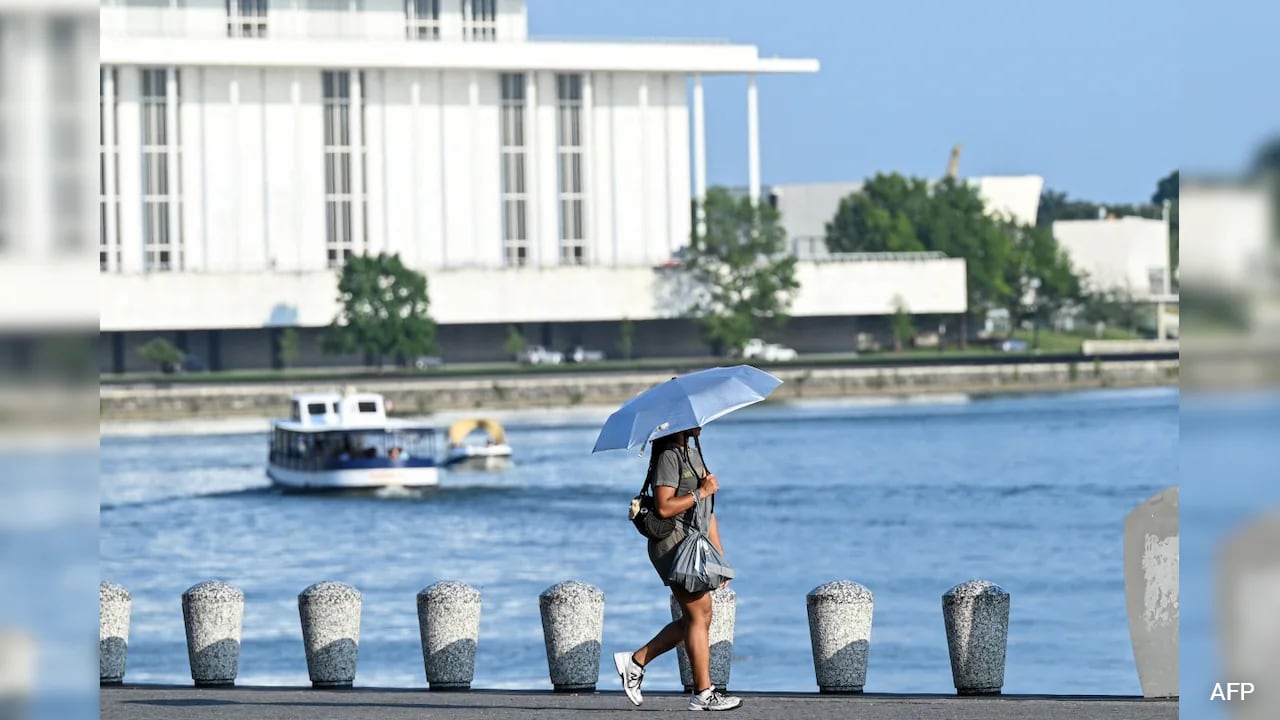
A relentless, multi-system heat dome has locked down over the eastern and central United States, threatening to rewrite temperature records for over 180 million Americans ahead of the Fourth of July weekend. Major urban centers from Chicago to Washington, D.C., are facing daytime temperatures pushing past 100 degrees Fahrenheit, with humidity driving the real-feel heat index to a suffocating 115 degrees. While municipalities scramble to open cooling centers and adjust holiday parade routes, the true systemic threat lies hidden within the nation's electric infrastructure. A volatile combination of an accelerating "Super El Niño," concrete-driven urban heat islands, and unprecedented baseload demand from artificial intelligence data centers has pushed the American power grid closer to its structural breaking point than at any time in the past decade.
This is not a standard summer hot spell. It is a compounding infrastructural crisis that standard emergency playbooks are fundamentally unequipped to handle.
The Collision of Two High Pressure Systems
The meteorological architecture of this heat wave involves a rare and punishing phenomenon. Instead of a single localized ridge of high pressure, two separate systems—one originating over the desert Southwest and another over the subtropical Atlantic—have drifted across the continent and merged directly over the American heartland.
This combined atmospheric ceiling acts as a massive thermal lid. As high pressure forces the air downward, that air compresses and warms exponentially. The cloud cover disappears completely, allowing intense midsummer sunlight to bake the ground hour after hour, accumulating heat that has nowhere to escape.
Exacerbating this setup is the rapid development of a Super El Niño event in the Pacific. This shifts the global jet stream, steering cool northern air masses far away from the U.S. border while locking thermal systems into place for weeks. Rather than moving steadily from west to east, the merged high-pressure center has stalled completely along the Interstate 95 corridor, turning the entire eastern seaboard into a structural pressure cooker.
Why the Night Is More Dangerous Than the Day
Public safety announcements routinely focus on the peak afternoon hours, but meteorologists and emergency physicians look at a different metric entirely: the overnight minimums.
Forecast Peak Conditions (July 2–5)
+-------------------+-----------------+-----------------------+
| Metro Area        | Projected High  | Nighttime Minimum     |
+-------------------+-----------------+-----------------------+
| Washington, D.C.  | 104°F – 105°F   | 81°F (Urban Core)     |
| Philadelphia      | 105°F           | 79°F                  |
| New York City     | 101°F           | 80°F                  |
| Chicago           | 99°F            | 78°F                  |
+-------------------+-----------------+-----------------------+
Human biology relies on evening cooling to shed the core thermal load accumulated during daytime exposure. When the ambient temperature fails to drop below 80 degrees, the human cardiovascular system remains under continuous, elevated stress. High humidity levels make this dynamic significantly worse. When the dew point climbs past 70 degrees, the air becomes so thoroughly saturated with moisture that human sweat cannot evaporate effectively.
Because evaporative cooling is the body's primary defense against heat stroke, this atmospheric saturation renders natural thermal regulation nearly impossible, even for healthy individuals resting in the shade.
The problem multiplies exponentially inside major metropolitan areas due to the urban heat island effect. Thousands of square miles of dark asphalt, concrete buildings, and steel structures absorb enormous amounts of solar radiation during the day. After sunset, these materials slowly radiate that trapped thermal energy back into the local environment.
In cities like New York and Washington, downtown neighborhoods are registering nighttime temperatures up to 10 degrees hotter than the surrounding rural suburbs. This lack of nocturnal recovery transforms a manageable daytime hazard into a cumulative medical emergency, driving up clinical cases of heat exhaustion and heat stroke before the next day's sun even rises.
The Grid Under Siege
While individuals struggle to cool their bodies, regional grid operators are facing an unprecedented operational nightmare. The timing of this heat dome directly coincides with a massive structural shift in how America consumes electricity. Over the past twenty-four months, the rapid buildout of hyperscale data centers dedicated to training generative artificial intelligence has permanently altered the nation's baseload power requirements.
Historically, grid operators could count on clear, predictable valleys in power consumption during late-night hours, allowing transmission equipment and power plants to cool down and undergo routine maintenance. AI data centers have eliminated those operational windows. These massive server farms run at near-maximum capacity twenty-four hours a day, seven days a week, drawing massive, unyielding quantities of electricity regardless of the weather.
When you overlay a multi-day extreme heat event onto this high baseload demand, the entire transmission system begins to degrade. High ambient air temperatures physically reduce the carrying capacity of high-voltage transmission lines because the copper and aluminum wires expand and sag under the combined stress of external heat and high internal electrical current.
Transformers require ambient cooling to dissipate the heat generated by converting voltage levels. Without overnight relief, these critical sub-stations bake in their own thermal energy, causing insulation to fail and triggering sudden, cascading localized blackouts even if the primary power plants have excess generation capacity.
The federal government and regional entities like PJM Interconnection have issued urgent alerts warning that power demand could reach absolute historic peaks over the holiday weekend. If a major transformer cluster fails in a major urban market under these conditions, hundreds of thousands of homes could lose air conditioning simultaneously. In an environment where indoor temperatures can shoot past 90 degrees within hours, a widespread blackout ceases to be a mere economic inconvenience—it becomes an immediate mass-casualty threat.
The Inadequacy of Municipal Defense Playbooks
Faced with these realities, the standard municipal responses are showing severe structural limitations. Cities like Chicago and New York have deployed hydration vans, extended public pool hours, and opened designated cooling centers inside schools and library basements. However, these solutions assume a highly mobile, informed population that can easily commute to these facilities during peak heat hours.
The most vulnerable demographics—the homebound elderly, the economically disadvantaged who cannot afford the surging electric bills required to run aging window AC units, and outdoor labor forces—frequently fall through these bureaucratic cracks.
In Nashville, emergency teams have resorted to direct physical distribution of bottled water to unhoused populations, a necessary but ultimately stopgap measure that highlights the absence of permanent, climate-resilient urban infrastructure.
Furthermore, major public events are colliding directly with this weather crisis. The Fourth of July weekend represents one of the highest-density travel and outdoor gathering periods on the domestic calendar.
In Washington, D.C., hundreds of thousands of spectators are projected to gather on the exposed, unshaded grass of the National Mall for the largest fireworks display in the city's history, despite official forecasts showing afternoon temperatures shattering a century-old record. Simultaneously, international crowds are filling outdoor venues across East Coast cities for high-stakes FIFA World Cup matches.
Organizers in Philadelphia have adjusted promotional Fan Festival hours to avoid the worst afternoon peaks, but the core reality remains unchanged: millions of people will be voluntarily exposing themselves to extreme thermal stress at a time when emergency services are already stretched thin by regional infrastructure strains.
The Real Cost of Delayed Adaptation
For decades, domestic climate policy has treated extreme heat waves as isolated, anomalous weather events to be managed via temporary emergency declarations. This current multi-system heat dome demonstrates that extreme thermal stress is now a structural feature of the North American summer, supercharged by global atmospheric shifts and aggravated by an outdated power grid that was built for a completely different century.
The primary vulnerability is no longer a lack of awareness; it is an infrastructural deficit. The continuous expansion of data centers, the lack of mandatory thermal protections for outdoor labor forces, and the heavy reliance on a centralized, fragile energy grid mean that every subsequent heat wave will carry a higher premium in both infrastructure damage and human life.
Until municipal planning mandates green roofing, widespread urban canopy restoration, and decentralized micro-grids capable of isolating power failures, the country will remain entirely dependent on the thin hope that its aging transmission lines do not snap under the strain.