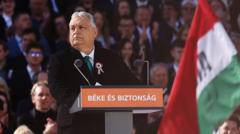
Western media is obsessed with the ghost of "voter intimidation" in Hungary. They treat Viktor Orban like a crude cartoon villain who scares people into the voting booth at gunpoint. It is a lazy, comfortable narrative. It allows Brussels and DC to ignore a much more uncomfortable reality: Orban isn’t winning because he’s a bully; he’s winning because he’s a better architect of social reality than his opponents.
If you believe the headlines, the Hungarian electorate is a trembling mass of rural voters terrified of losing their pensions if they don’t tick the Fidesz box. I have spent years analyzing central European power dynamics, and this "intimidation" trope is the go-to excuse for political losers who cannot fathom why their brand of liberal technocracy is being rejected.
The Efficiency of the Echo Chamber
The claim of mass intimidation falls apart under the slightest logical pressure. Intimidation is expensive. It requires a massive, boots-on-the-ground infrastructure to monitor millions of secret ballots. It is inefficient. What Orban has built is something far more sophisticated: Hegemonic Narrative Control.
Fidesz doesn't need to threaten you at the door. They have already won the war for your eyeballs, your radio, and your local newspaper long before election day. In the West, we call this "marketing" or "spin." In Hungary, the opposition calls it "intimidation" because they lack the resources to compete. Let’s stop pretending that a lopsided media environment is the same thing as physical or economic coercion. It is an intellectual failure to conflate the two.
The Myth of the Vulnerable Rural Voter
Mainstream reporting loves to highlight the "public works" schemes as a tool for blackmail. The argument goes: if you don’t vote for the local Fidesz mayor, you lose your manual labor job.
This ignores the fundamental psychology of the Hungarian countryside. These programs didn't create a culture of fear; they created a culture of dependency-as-loyalty. To a villager in Szabolcs-Szatmár-Bereg, the state isn't an abstract oppressor. The state is the only entity that showed up when the factories closed in the 90s. While the urban elite in Budapest were busy talking about "democratic norms" and "transparency," Orban was talking about wood for the winter.
You don't need to intimidate someone into voting for the person who kept their lights on. That’s just basic political transactionalism. To call it "intimidation" is a patronizing insult to the intelligence of the working class.
Gerrymandering is Not a Crime—It’s a Strategy
Critics scream about the 2012 electoral reforms. Yes, Fidesz redrew the maps. Yes, they shifted to a single-round system that favors the largest party.
But here is the truth the opposition hates: the rules are public. They are transparent. The UK uses First-Past-The-Post. The US uses the Electoral College and constant redistricting. We don't call the GOP or the Tories "dictators" for maximizing their structural advantage.
Orban understood the math of the game better than the fragmented opposition. While the left was arguing over which academic should lead their coalition, Orban was consolidating a bloc that could win under any set of rules. The "intimidation" narrative is a smokescreen for the opposition's inability to form a coherent, unified front that appeals to anyone living outside the capital city.
The Civil Society Trap
We see endless reports about the "crackdown" on NGOs and "foreign agents." The narrative suggests that by restricting these groups, Orban is silencing the voice of the people.
This is a fundamental misunderstanding of Hungarian sovereignty. From the perspective of the average Fidesz voter, these NGOs aren't "civil society." They are the vanguard of a foreign cultural elite trying to bypass the democratic process. When Orban targets these groups, his base sees it as an act of defense, not offense.
By framing every legal restriction as "intimidation," the West actually hands Orban a win. He can point to the screeching headlines and say, "See? The foreigners are trying to tell you how to live again." The outrage is the fuel in his tank.
The Cost of the Contrarian Truth
Is Hungary a perfect democracy? No. The centralization of power is extreme. The overlap between the state and the party is nearly total.
The downside of this model is stagnation. When you eliminate friction, you also eliminate the competition that drives innovation. Hungary risks becoming a museum of 20th-century nationalistic thought while the rest of the world moves into the quantum age. But that is a far cry from the "reign of terror" depicted by the BBC or CNN.
Stop Asking if the Election is Fair
The question "Is the Hungarian election fair?" is the wrong question. In a world of algorithmic persuasion and massive wealth inequality, "fairness" is a fairy tale we tell ourselves to feel better about our own systems.
The real question is: Why does the Fidesz message resonate despite the lack of "fairness"?
If the opposition actually wants to win, they need to stop crying about being bullied and start offering a product that people actually want to buy. They are trying to sell a "return to normalcy" to people who remember "normalcy" as a time of poverty and national humiliation.
Orban provides a sense of agency, however manufactured it may be. He gives people a story where they are the heroes, not the victims of global economic shifts.
The Institutionalized Reality
Orban has successfully turned the state into a patronage machine. This isn't "intimidation"—it's State Capture 101. - Judiciary: Packed with loyalists.
- Media: Owned by friendly oligarchs.
- Economy: Key sectors handed to "national champions."
This is a legalistic takeover. Everything is done by the book. The laws are passed in parliament. The judges rule based on those laws. It is a "Rule of Law" nightmare where the law itself has been weaponized.
Calling this "intimidation" is like calling a hostile corporate takeover "theft." It might feel like it, but the paperwork is all in order. If you want to fight it, you have to fight the law, not the "vibe."
The Feedback Loop of Failure
Every time an international observer group releases a report about "voter pressure," they strengthen Orban’s hand. He uses the criticism to prove his point: that "Brussels" is out to get Hungary.
The "voter intimidation" angle is a gift to the Fidesz propaganda machine. It allows them to paint the opposition as losers who can't handle a defeat. It validates the "us vs. them" mentality that keeps the base energized.
The data doesn't show a nation living in fear. It shows a nation that has traded a degree of pluralism for a perceived sense of stability and national pride. You might hate that trade. I might hate that trade. But calling it "intimidation" is a lie that prevents us from understanding the actual mechanics of modern illiberalism.
Stop looking for secret police in the bushes. Look at the balance sheet. Look at the school curriculum. Look at the property deeds of the local elite. That is where the power is held, and it doesn't require a single threat to stay there.
Quit waiting for a revolution that isn't coming. The system isn't broken; it's working exactly as intended. If you can't beat a man at his own game, stop complaining about the rules and learn how to play. Or better yet, go find a different game entirely.