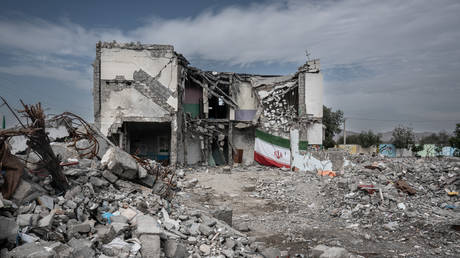
The world's most advanced military shouldn't be dropping smart bombs based on ten-year-old intelligence. Yet, that's exactly what happened on February 28, 2026, when a U.S. missile tore through the Shajareh Tayyebeh elementary school for girls in Minab, southern Iran. The strike killed at least 175 people, including 120 young girls between the ages of 7 and 12, along with 26 teachers. It stands as the deadliest American civilian casualty incident in decades.
While the White House initially deflected and downplayed responsibility, a series of military probe findings and open-source investigations have exposed a devastating reality. The tragedy wasn't a mechanical glitch or a stray missile. It was a failure of data verification. U.S. forces targeted a functioning school because they relied on obsolete defense data, ignoring visible physical changes on the ground that had been there for a decade. For another view, see: this related article.
The Lethal Cost of Outdated Military Data
When U.S. and Israeli forces launched their joint air campaign against Iranian targets, the operational tempo was blistering. The Pentagon reported striking over 1,000 targets within a single 24-hour window. In that high-pressure environment, speed replaced rigorous verification.
Preliminary findings from the military investigation reveal that U.S. Central Command (CENTCOM) planners pulled target coordinates directly from outdated Defense Intelligence Agency databases. According to those old records, the building in Minab was listed as an active military asset—specifically, a barracks and command base belonging to a naval brigade of the Islamic Revolutionary Guard Corps (IRGC). Similar coverage regarding this has been shared by Reuters.
The intelligence was technically true once, but it was ancient history. The IRGC naval brigade had moved out years ago. The local community repurposed the site into a primary school to serve young girls in the southern region. Because analysts failed to cross-check old database files against current imagery before clearing the target for execution, the strike package was loaded with coordinates for a ghost target.
What High Resolution Imagery Proved
The absolute breakdown in tactical reconnaissance becomes undeniable when you look at public satellite data. Independent investigators from groups like Human Rights Watch quickly pulled commercial satellite records to piece together the history of the site. The findings were damning.
- 2016 Concrete Separation: High-resolution imagery from 2016 shows a massive, permanent security wall being constructed to divide the school property entirely from the adjacent, old IRGC compound.
- Distinct Structural Changes: For ten years, the walled-off school operated out in the open, featuring distinct playground areas, courtyard modifications, and daily civilian foot traffic completely inconsistent with an active military base.
- Classroom Destruction: Satellite passes from early March 2026 confirmed that ordnance didn't just miss a nearby military target and hit the school as collateral damage. Multiple precision bombs struck the school buildings directly while classes were actively in session.
Any recent visual scan by an analyst should have flagged the wall and the heavy presence of children. Instead, the mission moved forward using digital target folders that hadn't been properly refreshed or ground-vetted in years.
The Legal and Tactical Fallback
In Washington, the immediate reaction was damage control. President Trump initially tried to point the finger away from U.S. forces, suggesting Iran was behind the blast. Top administration officials, including Secretary of Defense Pete Hegseth and Secretary of State Marco Rubio, quickly pivoted to a standard defense, emphasizing that the U.S. military does not deliberately target educational facilities or civilian populations.
Legally, that distinction matters, but it doesn't absolve the command structure. Under international humanitarian law and the precautionary principle, military forces must take all feasible measures to verify that targets are actual military objectives. Proving a war crime requires establishing intent or deliberate recklessness. If a command structure moves so fast that it ignores basic verification steps, the line between an honest mistake and criminal negligence blurs completely.
The Pentagon launched an Army Regulation 15-6 investigation to determine exactly how the targeting data pipeline failed so catastrophically. Four months later, human rights groups and international observers are still waiting for the full report to be made public.
Rebuilding the Target Verification Pipeline
Fixing a systemic failure of this scale requires more than just apologizing. It demands an immediate overhaul of how data flows from intelligence agencies to frontline strike platforms. Relying heavily on automated databases without manual imagery confirmation in populated areas is a recipe for disaster.
Military commands must enforce mandatory, dual-source verification for any target located within city or municipal boundaries. If a target folder has not been updated with fresh aerial or satellite reconnaissance within the last 30 days, it cannot be cleared for a strike. Furthermore, the Department of Defense needs to fully restore funding to its specialized civilian protection units. Recent budget cuts stripped away the very oversight personnel whose entire job is to double-check target lists for nearby schools, hospitals, and homes. Without those structural safeguards, advanced precision weapons are only as accurate as the old data guiding them.