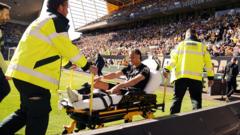
Tottenham Hotspur just escaped the most catastrophic humiliation in modern Premier League history. By a microscopic margin of two points, the north London club avoided relegation to the Championship on a nerve-shredding final day of the 2025/26 season. While tactical chaos and a carousel of four different head coaches in twelve months grabbed the headlines, the real culprit behind this historic collapse was an unprecedented, compounding medical emergency.
Spurs players missed more than 200 combined Premier League matches this season. Key creators James Maddison and Dejan Kulusevski were sidelined for the entirety of the campaign with devastating knee injuries. Big-money signing Xavi Simons tore his ACL in April, and star defender Cristian Romero left the pitch in tears with a severe knee injury during the run-in. Following their final-day survival, Maddison broke the dressing room's silence, calling the casualty list "astronomical" and demanding an internal investigation.
The club has now launched a sweeping, top-to-bottom review led by new performance director Dan Lewindon, who arrived from the City Football Group in February. While a standard post-mortem would blame simple bad luck or a congested fixture list, this investigation is digging far deeper. It is exposing structural failures in squad recruitment, a toxic cycle of rushing players back from serious injuries, and an astonishing engineering failure regarding the stadium's multi-million-pound retractable pitch.
The Relentless Sledgehammer of Managerial Whiplash
To understand why the muscle fibers and ligaments of Tottenham's elite athletes buckled, you have to look at the tactical whiplash the squad endured over the last two years.
Football teams build specific physical conditioning profiles over months of repetitive training. When a club changes tactical philosophies abruptly, the physical load placed on the players mutates instantly. Under Ange Postecoglou during the 2023/24 and 2024/25 seasons, the squad was trained to execute a hyper-intense, high-sprinting system. Defenders like Micky van de ven and Cristian Romero were asked to repeatedly engage in explosive, high-stakes recovery sprints. The result was an immediate spike in severe hamstring tears.
When Thomas Frank took over last summer, he identified player availability as his primary objective. Yet, the transition to a new training methodology required entirely different metabolic and physical demands. When Frank was sacked in February 2026, the squad was thrown into another physical loop before Roberto De Zerbi finally arrived to steady the ship.
Every time a new manager walks through the door at Hotspur Way, the players face a double-edged sword. First, the training sessions change drastically overnight, shocking their musculoskeletal systems. Second, players desperate to impress a new boss will push their bodies far past the red line, ignoring minor pain until something snaps.
"Our situation with the injuries has been worse than any other club," James Maddison admitted. "People try and say 'Oh, but we've got this and that', but ours is astronomical and we need to look at why that is."
The Failure of Accelerated Rehabilitation
The internal review is pointing a finger at a destructive pattern of rushing compromised players back into the starting lineup. This is not a new issue at Tottenham, but this season it turned terminal.
When a squad lacks depth, the pressure on medical staff to clear star players for match duty is immense. In previous months, key assets like Pape Matar Sarr and Micky van de Ven were repeatedly thrown back into high-stakes matches despite later admissions that they were not fully fit. The result was a predictable, devastating snowball effect.
- The Sparing of Rotation: Because the starting eleven was constantly missing three or four key components, the healthy players could never be rotated.
- The Fatigue Compound: Full-backs and central midfielders were run completely into the ground, playing 90 minutes twice a week across domestic and European competitions.
- The Inevitable Snap: Fatigue compromises running mechanics. When mechanics break down, healthy players suffer acute soft-tissue tears or catastrophic joint failures.
This cycle destroyed the middle of Tottenham's season, leading to a horrific run of form where they failed to win a match for four months. The squad was operating on a fine line of survival, relying on teenagers like Archie Gray and Alfie Dorrington to anchor a Premier League defense.
Blaming the Turf
The most unexpected aspect of Lewindon’s ongoing investigation is a forensic audit of the Tottenham Hotspur Stadium's state-of-the-art retractable pitch.
The stadium features a split-berth, retractable grass surface that slides out to reveal an artificial NFL field underneath. Privately, questions have circulated within the medical department for two seasons about whether the micro-vibrations, joining seams, or hardness of this complex engineering marvel are contributing to the club's horrific knee injury record.
Initial independent testing conducted on match days has shown no glaring discrepancy in bounce or traction between the stadium turf and the pristine training pitches at Hotspur Way. However, the club is commissioning a deeper, long-term mechanical analysis. They are investigating whether the structural underlay of a moving pitch absorbs impact differently than a traditional, deep-soil stadium bed. When players change direction at 20 miles per hour, even a fractional increase in rotational friction or surface rigidity can be the difference between a normal stride and a torn ACL.
Dismantling the Fragmented Medical Culture
Perhaps the most damning revelation of the review is a severe lack of trust between the first-team squad and the club’s internal medical department.
Over the course of this relegation-threatened campaign, several high-profile players chose to bypass Tottenham’s medical staff entirely. Instead, they placed their rehabilitation in the hands of private physiotherapists, trainers from their former clubs, or medical personnel attached to their respective national teams.
This fragmentation created a chaotic recovery environment. The club's internal sports science staff were frequently left in the dark about the exact training volumes and therapeutic interventions their own players were receiving off-site.
To fix this broken culture, Lewindon is dismantling the traditional medical hierarchy and replacing it with an integrated, pod-based model. Moving forward, players will be grouped into small units of four to six. Each pod will be permanently assigned a dedicated physiotherapist and an integrated sports scientist. This structure is designed to foster accountability, hyper-personalize training loads, and rebuild the shattered trust between the players and the staff responsible for their health.
A Total Overhaul of Recruitment Strategy
The review is also forcing a drastic rethink within the scouting department, placing sporting director Johan Lange's future under intense scrutiny.
For too long, Tottenham’s recruitment strategy has prioritized raw talent and market opportunity while ignoring historical availability metrics. In the modern, hyper-congested football calendar, durability is a distinct talent. A player who scores 20 goals a season but misses 15 matches with recurring soft-tissue issues is a structural liability to a club trying to compete on multiple fronts.
The data gathered over the last 12 months proves that Tottenham can no longer afford to sign luxury players with spotty medical histories. The club’s recruitment profiles are being rewritten to place a premium on robust physical metrics, bone density histories, and career minutes-played ratios.
Furthermore, the club is bringing in a specialist psychologist to address the mental scars left by two years of relentless physical trauma and the omnipresent anxiety of a relegation battle. The objective is to purge the squad of a fragile, reactive mindset and replace it with psychological resilience.
Roberto De Zerbi has already formed a strong alliance with Lewindon, insisting that he will not compromise his long-term tactical vision by gambling on semi-fit players to chase short-term results. The era of crossing fingers and hoping for the best at Hotspur Way is officially over. If Tottenham wants to return to the top tier of European football, they must first build a squad capable of surviving the training pitch.