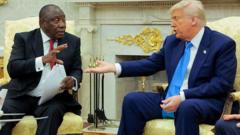
The United States government is moving forward with a plan to permanently dismantle its decades-long funding for South Africa’s HIV response, tying the future of the world’s largest treatment network to highly polarized political conditions. According to State Department officials and congressional briefings, Washington will execute a phased drawdown of the President’s Emergency Plan for AIDS Relief (PEPFAR) in South Africa, targeting a complete wind-down of core awards by early next year.
The justification relies heavily on non-health compliance factors. Diplomatic sources confirm that the US administration has conditioned the survival of PEPFAR on South Africa addressing domestic political matters, including dismantling Black Economic Empowerment policies, cutting diplomatic ties with Iran, and penalizing divisive political rhetoric like the anti-apartheid chant "Kill the Boer." By shifting public health aid into a tool for geopolitical leverage, the decision threatens the survival of a network supporting roughly eight million people living with HIV. You might also find this similar coverage insightful: The Illusion of Economic Leverage Why Cutting Off Sanctions Cash Never Actually Starves a Regime.
The Mechanics of a Public Health Collapse
The removal of American aid leaves a structural deficit that the South African healthcare system cannot immediately absorb. For over twenty years, PEPFAR has served as the financial backbone of South Africa's localized clinic infrastructure, injecting more than $8 billion into testing, community outreach, and clinical trials. While South African Health Minister Aaron Motsoaledi has maintained that state-purchased antiretroviral (ARV) medication supplies remain secure, the real vulnerability lies in the community-based architecture that delivers and monitors those drugs.
The initial funding freezes enacted in early 2025 forced the immediate termination of dozens of USAID-funded projects, directly eliminating thousands of health worker positions. These community health workers, peer counselors, and mobile clinic drivers form the actual pipeline for treatment adherence. When community-based testing groups close, patients drop off the radar. The consequence is not a simple budget shortfall; it is an immediate spike in treatment default rates. Without local support networks to track patients and manage treatment literacy, viral loads rise, drug resistance develops, and transmission rates escalate. As highlighted in latest coverage by The Guardian, the results are widespread.
The Geopolitical Price Tag
The friction between Washington and Pretoria has mounted steadily, driven by deep ideological divides. The US administration’s focus on the alleged persecution of white minority groups and Afrikaners in South Africa, alongside Pretoria’s actions at the International Court of Justice, has transformed a humanitarian partnership into a battlefield of retributive diplomacy.
State Department officials defend the drawdown by pointing out that South Africa is a middle-income country capable of funding its own healthcare infrastructure. This argument, however, ignores the immediate fiscal reality on the ground. The abrupt withdrawal of US aid—which historically accounted for nearly a quarter of South Africa’s total HIV expenditure—happens at a time when the domestic economy faces severe growth constraints and fiscal austerity.
Total South African HIV Budget Contribution
┌───────────────────────────┬──────────────┐
│ Domestic Government Funds │ PEPFAR Aid   │
│ 78%                       │ 22%          │
└───────────────────────────┴──────────────┘
The gap cannot be filled overnight by the private sector, which currently contributes less than two percent to the national HIV response. While civil society organizations have scrambled to establish alternative funding mechanisms like solidarity funds, the scale of the American pullout dwarfs local philanthropic capacity.
The Impact on Next Generation Prevention
The timing of the funding withdrawal is particularly damaging to technological breakthroughs in preventative medicine. South Africa is in the middle of rolling out long-acting injectable pre-exposure prophylaxis (PrEP), such as Lenacapavir, which scientific models show could effectively neutralize the epidemic if deployed at scale over the next two decades.
Dismantling the USAID and CDC distribution networks effectively starves these new treatments of the clinical infrastructure needed for distribution. The localized clinics that were built to run trials, manage storage, and administer injections are the very entities receiving termination notices.
UNAIDS data highlights that global development assistance for HIV fell by 23 percent in 2025, marking the sharpest decline on record. In high-burden environments, this has already translated to a 22 percent drop in local testing capacity. When testing ceases, the epidemic becomes invisible once more, reversing decades of measurable public health gains for short-term political victories.
A Broken Safety Net
The true casualty of this diplomatic standoff is the community safety net. Organizations that once reached tens of thousands of vulnerable individuals, including adolescent girls and young women who face disproportionate infection rates, have closed their doors. Beyond the clinical administration of pills, PEPFAR funding supported nutrition initiatives, support groups, and transport vouchers that enabled impoverished patients to reach distant regional clinics.
The assumption that a middle-income state can effortlessly absorb a multi-million-dollar clinical operation overnight is detached from the realities of public healthcare delivery. When political conditions replace epidemiological data as the metric for humanitarian aid, the virus gains ground. The current drawdown ensures that the progress made toward ending AIDS as a public health threat by 2030 will stall, leaving millions of individuals to navigate a fractured, underfunded system alone.